DAWA ZANGMO | Thimphu
Bhutan has entered a pivotal phase in its economic transition, advancing broad reforms aimed at creating a more supportive and predictable business environment.
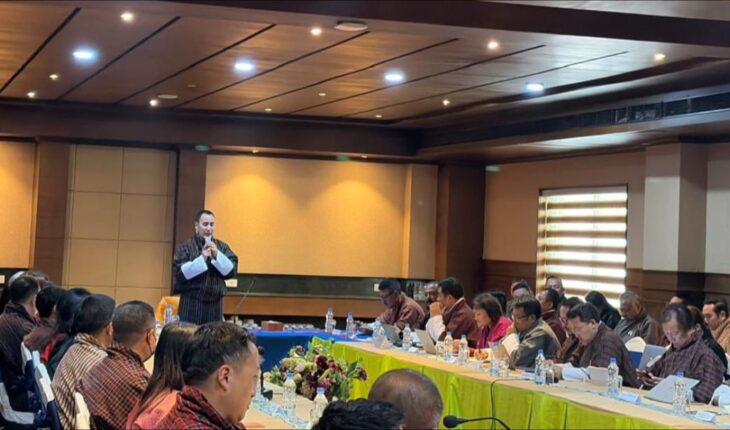
During the Business Regulatory Stakeholder Meeting held on November 27, the Minister for Industry, Commerce and Employment (MoICE), Namgyal Dorji, underscored the government’s firm commitment to building a regulatory ecosystem that is transparent, consistent, and conducive to business growth.
Lyonpo Namgay Dorji reiterated that the ongoing changes are not meant to simply remove existing rules, but to ensure that only effective and necessary regulations remain in place.
“The goal is not to eliminate regulations, but to make sure the right ones exist and that they function to support enterprise while safeguarding national values and interests,” the Minister stated.
For years, entrepreneurs in Bhutan have faced challenges associated with a system that is often slow moving and difficult to navigate. Approval procedures can be lengthy, requirements differ from one agency to another, and regulations are sometimes interpreted inconsistently across regions or officials. This environment has left businesses contending with overlapping mandates, unclear procedural steps, and variable enforcement practices.
Such obstacles have complicated business planning, raised operating costs, and discouraged both domestic and foreign investment. These challenges have also deterred many potential entrepreneurs from pursuing new ventures.
With Bhutan working to create more employment opportunities, expand its economic base, and support major national initiatives such as the Gelephu Mindfulness City, the need to update and modernize the country’s regulatory framework has become increasingly urgent.
Over the last 18 months, the government has undertaken what officials describe as the most comprehensive regulatory reform effort in Bhutan’s history. During this period, authorities identified 255 issues affecting business operations, which were subsequently streamlined into 210 major challenges.
These concerns spanned a range of areas, including licensing and permit systems, taxation processes, labour regulations, access to finance, local-level governance, infrastructure constraints, and the broader efficiency of public service delivery.
Of these challenges, 116 have already been resolved, 50 remain under active review, and 28 have been forwarded to the Cabinet for final approval. Officials say this progress reflects a shift toward evidence-based and outcome-oriented reform.
However, government representatives and stakeholders emphasized that addressing these obstacles alone will not be sufficient. To achieve meaningful improvement in Bhutan’s business climate, deeper systemic changes are required.
Administrative processes must be faster and easier to navigate, and they must be applied consistently by all agencies involved in business regulation. Rules need to be clearly worded so that both officials and entrepreneurs interpret them uniformly.
Outdated manual systems must be replaced by efficient digital platforms that minimize delays and reduce the possibility of human error.
Effective coordination among agencies is essential to avoid conflicting directives. Above all, businesses require a sense of stability, with regulations communicated properly and implemented predictably so that sudden changes do not undermine confidence.
These considerations form the foundation of Phase II of the Business Regulatory Review, which commenced this year. The government is now examining nearly 1,000 laws, policies, guidelines, and administrative procedures that shape business operations across the country.
The objective is to simplify overly complicated procedures, remove outdated elements, bring consistency to rules that are currently misaligned, and ensure that regulations are implemented fairly in all sectors and regions.
BCCI president Tandy Wangchuk explained that enhancing the business environment requires not only resolving existing bottlenecks but also constructing a long-term regulatory architecture that is coherent, streamlined, and easy for stakeholders to understand.
The meeting also addressed public concerns regarding the possibility of excessive deregulation. The Minister clarified that the reform agenda does not aim to weaken safeguards that protect consumers, workers, or Bhutan’s cultural and environmental interests.
Instead, the government seeks to establish a framework of “better regulations” that are clear, practical, and designed to facilitate legitimate economic activity rather than impede it. Lyonpo Namgay Dorji also noted that, “Good regulation ensures protection for the public while giving businesses the assurance that the operating environment will remain stable and predictable.”
Representatives from the private sector expressed appreciation for the government’s consultative approach and agreed that continued collaboration is essential for the success of the reform process. They stressed the importance of sustained dialogue, openness, and timely decision-making, highlighting that businesses must be able to feel tangible improvements in their daily interactions with regulatory agencies.
Many emphasized that a genuinely supportive business environment depends on consistent communication between the public and private sectors so that evolving economic needs and emerging opportunities are effectively reflected in policy.
Looking ahead, the government aims to finalize solutions for all outstanding issues identified in the 2024 review while working to harmonize the nearly 1,000 regulations that influence commercial activity.
Achieving a stronger business environment will require streamlined administrative systems, clearer and more stable rules, improved digital public services, enhanced coordination among agencies, and a culture of efficiency across the public sector.
If the reforms progress as planned, Bhutan is positioned to undergo a significant transformation one that supports entrepreneurship, attracts investment, and expands opportunities for citizens nationwide.