RENUKA RAI | Thimphu
The Ministry of Foreign Affairs and External Trade has clarified that the railway project is currently in its preparatory and survey stages, with construction expected to begin only in 2027.
The Gelephu–Kokrajhar railway is part of a broader bilateral initiative between Bhutan and India to establish Bhutan’s first-ever railway connectivity to the Indian rail network.
The project, along with the Samtse Banarhat railway line, follows the signing of a Memorandum of Understanding (MoU) between the two governments to strengthen cross-border transport infrastructure and economic cooperation.
To operationalist the MoU, the first Railway Project Steering Committee (PSC) meeting was held on November 20, 2025.
The meeting was co-chaired by the Secretary of Ministry of Infrastructure and Transport (MoIT) and the Additional Secretary (North) of India’s Ministry of External Affairs. Senior officials from relevant agencies on both sides participated in the discussions.
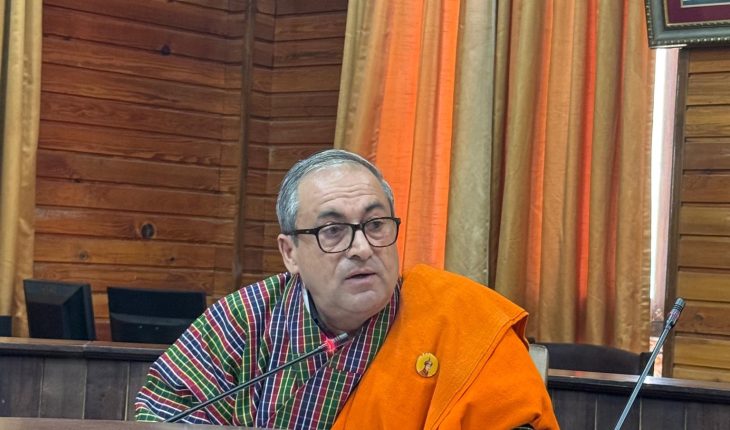
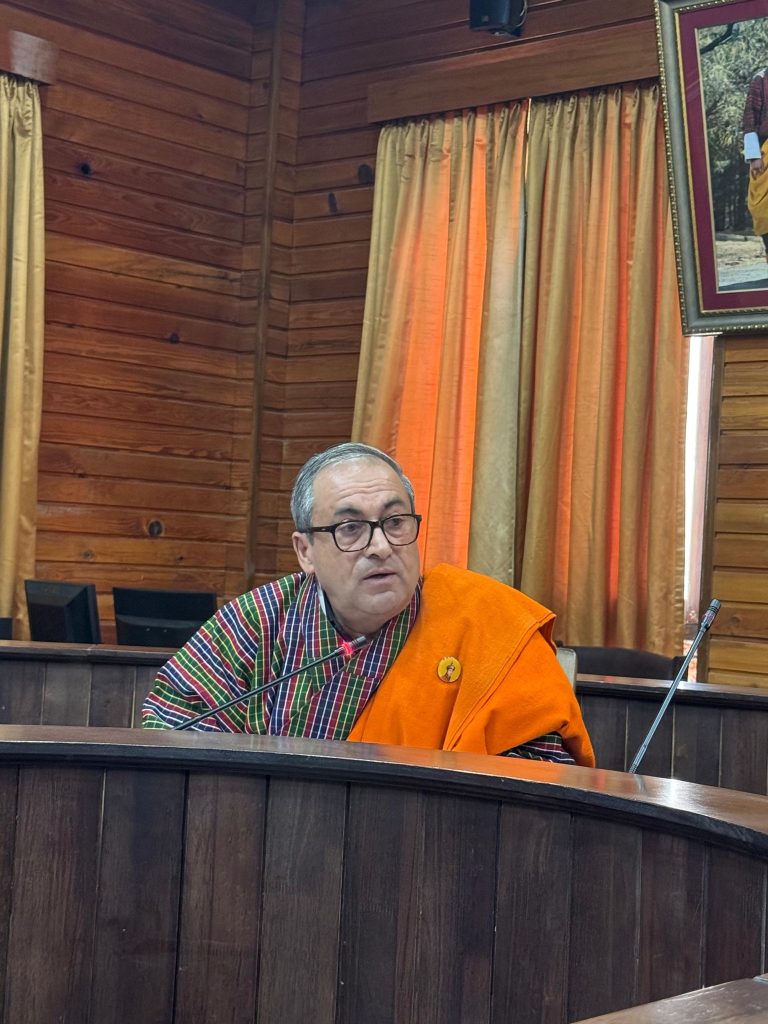
During the 24th meet the press session, Lyonpo DN Dhungyel, said that the meeting focused on clarifying institutional roles and responsibilities, addressing design- and site-related issues, and agreeing on next steps to resolve bottlenecks that could affect project implementation.
The PSC mechanism is intended to ensure close coordination between Bhutanese and Indian authorities as the railway projects progress from planning to execution.
With regard to the Gelephu–Kokrajhar railway, Lyonpo confirmed that the Northeast Frontier Railway (NFR) of India is currently conducting field surveys in Gelephu.
These surveys are being carried out to verify the proposed alignment and, where necessary, make adjustments to the centerline to account for ground realities and technical considerations.
The centerline for the proposed alignment was initially pegged on October 22, 2025, using precast reinforced concrete (RCC) pillars.
These markers were installed to clearly identify the route and facilitate detailed survey work, including geotechnical investigations and design finalization.
Lyonpo explained that such surveys are a critical step in railway construction, as they determine the feasibility of the alignment, identify potential environmental and engineering challenges, and inform cost estimates and design decisions.
The Gelephu–Kokrajhar railway line is estimated to cost Nu. 34.56 billion and will be fully funded by the Government of India.
The procurement process, including tendering and contractor selection, will be handled by the Indian side once detailed designs and ground works are completed.
Based on the current project schedule, construction is expected to begin in the first quarter of 2027.
Despite this, the project is being described by both governments as historic in significance. Once completed, the Gelephu–Kokrajhar railway will mark Bhutan’s first direct railway connection to India’s vast rail network.
The link is expected to significantly improve passenger and freight movement, reduce transportation costs, and enhance access to regional and national markets.
The railway is also seen as strategically important for the development of Gelephu, which has been identified as a key economic hub under Bhutan’s long-term development vision.
Improved connectivity is expected to support trade, tourism, and industrial growth in southern Bhutan, while also strengthening people-to-people ties between the two countries.
In parallel, progress is also being made on the Samtse–Banarhat railway project, which is intended to enhance connectivity in western Bhutan.
Following the first PSC meeting, the Royal Government of Bhutan requested a minor reconsideration of the terminal design in Samtse to avoid affecting a newly constructed quarantine centre.
Responding to this request, the NFR team revised the alignment and successfully completed centerline pegging of the updated route in Samtse.
RCC pillars have been installed to clearly demarcate the revised centerline, allowing further survey activities to proceed without impacting existing infrastructure.
The Samtse–Banarhat railway line is estimated to cost Nu. 5.76 billion and, like the Gelephu project, will be fully funded by the Government of India.
Officials noted that addressing design concerns at an early stage reflects the importance both sides place on minimizing social and infrastructural impacts while ensuring technical feasibility.
Together, the two railway projects represent a major expansion of Bhutan–India cooperation in the transport sector.
While Bhutan has long relied on road connectivity for cross-border trade and travel, railway links are expected to offer a more efficient and cost-effective alternative, particularly for bulk goods and long-distance transport.
Lyonpo emphasized that the current focus remains on technical preparation, detailed surveys, and institutional coordination rather than ceremonial milestones.
The PSC will continue to serve as the main platform for resolving issues, monitoring progress, and guiding the projects toward implementation.
While it would be a matter of honour for Bhutan if the Gelephu–Kokrajhar railway were to be inaugurated by Prime Minister Narendra Modi at an appropriate stage, Lyonpo stressed that any such event would depend on the completion of significant construction milestones in the future.
For now, authorities are working to ensure that both railway projects proceed in a phased, well-planned, and mutually beneficial manner.
As surveys and designs progress over the coming months, more clarity is expected on construction timelines and implementation schedules.
Until then, the government has urged the public to rely on official updates and confirmed information, noting that large infrastructure projects of this scale require careful planning and coordination before moving into the construction phase.