TIL BDR GHALLEY | Samtse
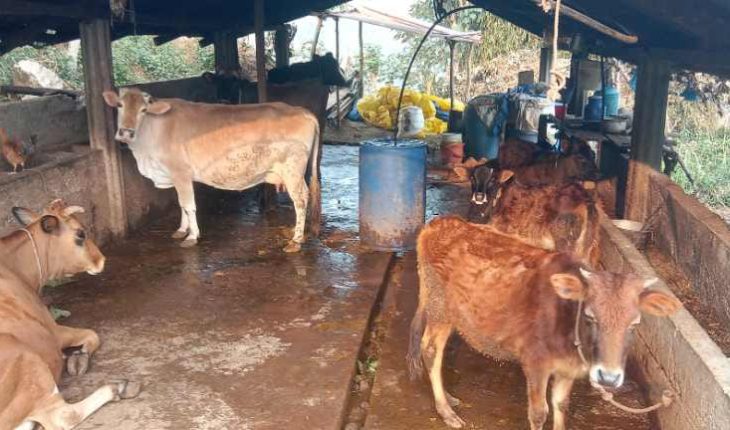
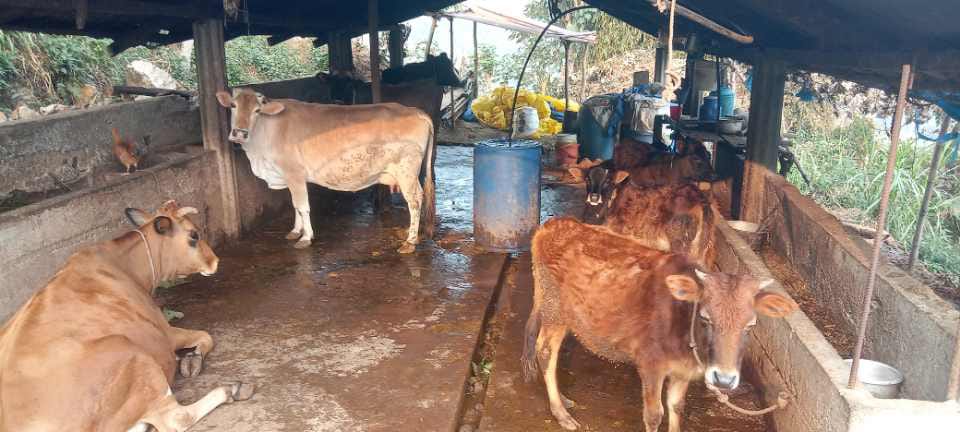
Dairy farming has long been the backbone of household livelihoods in Khempa–Pangzhing and neighbouring villages of Laptshakha in Tading, samtse.
Today, however, the sector faces mounting challenges from rising input costs, implementation of GST, and market inefficiencies, threatening the sustainability of milk production in the region.
Rising feed costs, narrow profit margins, and market inefficiencies are placing severe pressure on dairy farmers, threatening the sustainability of milk production that many households rely on as their primary source of income.
Farmers say the price of key inputs has increased sharply in recent years. Brewer’s spent grain (BSG) known as beer residue sourced from Passakha, once available for Nu. 8,000 to 9,000 per batch, now costs around Nu. 15,000 following GST implementation and higher demand.
Commercial cattle feed prices have also risen from Nu. 1,560 to Nu. 1,665 per bag, forcing many farmers to cut back on feed and accept lower milk yields.
“When feed costs rise, milk yield inevitably falls,” said Suk Bdr, a milk collector affiliated with Phuntsho Dairy in Panbari. “It is not just a reduction in quantity; it directly affects our livelihood.”
He added that if milk is unsold and returned, he loses between Nu. 500 and 600 in a single day. Even selling 40 litres brings only about Nu. 400 in profit.
The margins are extremely narrow despite strong demand for local milk in Phuentsholing and Samtse, marketing remains a challenge. Without a central distribution point, he distributes between 60 and 80 litres of milk daily to nine different buyers.
Farmers receive Nu. 45 per litre, while buyers sell it at Nu. 55. The Nu. 10 differences barely cover transportation, rent, and vehicle expenses, he said.
Every morning, between 500 and 600 litres of milk are collected from nearly 50 households in Panbari and Laptshakha.
Of these, only 40 are registered members of local the dairy cooperative, while others contribute independently to meet demand. “In the evening, however, it drops to 400–450 litres.” he said.
“Even if we supply 500 litres, it is still not enough,” Suk Bdr said. “Local milk is preferred because people believe it is organic and nutritious—suitable even for newborn babies. But maintaining supply is becoming more difficult due to rising costs.”
Toran Raj Ghalley, 25, have embraced dairy farming to diversify income streams. His household produces 25–30 litres daily, and sold through the cooperative at Nu. 45 per litre.
“We have land and resources, so we saw an opportunity to produce milk for our community,” he said. “Dairy income supports our children’s education, healthcare, and daily needs. But rising costs for feed and BSG are making it increasingly difficult to sustain production.”
He rears a mix of local breeds, Jersey cows, and Holsteins. While improved breeds offer higher yields, they require more nutritious feed.
“Access to climate-resilient seeds would reduce our dependence on expensive commercial feed and help us maintain production, especially during the lean season,” he said.
Seasonal challenges further complicate production. Usha Gurung, 27, whose family depends primarily on dairy, said winter grazing constraints lead to a drop in milk yield.
“We also grow vegetables, but dairy is our main income. Support such as feed subsidies, improved milking facilities, and access to grazing land would make a big difference,” she said.
Transporting milk to the collection centre is another daily burden. Toran Raj, whose farm is a 10-minute walk away from highway, carries up to 30 litres twice a day.
“If we are delayed even slightly, the quality of milk can be affected, especially on warmer days,” he said. “There have been times when milk had to be discarded because it could not be delivered on time. That is a complete loss for the household.”
Nir Maya, 36, said dairy farming has become increasingly labor-intensive job. “Earlier, we relied mostly on grazing and local fodder. Now we depend more on purchased feed, which is expensive. Our workload has increased, but our returns have not increased in the same way,” she said.
Nir Mal, 30, emphasized the need for institutional support. “Easier access to fodder seeds and some subsidy on feed would help us reduce costs and encourage farmers to continue dairy farming instead of giving up,” he said.
According to Karma Wangchuk, Livestock Extension Officer for Tading Gewog, 46 registered dairy members produce between 400 and 500 litres per day in winter and up to 800 litres in summer.
Around 50 households in Laptshakha and Pangzhing Wogma depend entirely on dairy for their livelihoods.
“Milk production and farm management have improved significantly,” he said. “We have supported farmers with artificial insemination using sex-sorted semen, fodder seeds, equipment, and training. Hygiene and sanitation are also prioritized.”
However, he acknowledged that limited land for pasture and the gap between farm gate and retail prices remain major concerns.
“The dairy sector here is crucial but fragile,” Wangchuk said. “Khempa–Pangzhing and Nindulakha-Dangreyboo Chewogs are heavily dependent on milk production. Without addressing feed shortages, price disparities, and market infrastructure, sustaining livelihoods will remain difficult.”
While the gewog plans to expand raw milk supply, address fodder shortages, and promote value addition through cheese and butter production at the Milk Processing Unit.
But for many farmers, the immediate worry is tomorrow morning’s feed and whether the milk will sell.