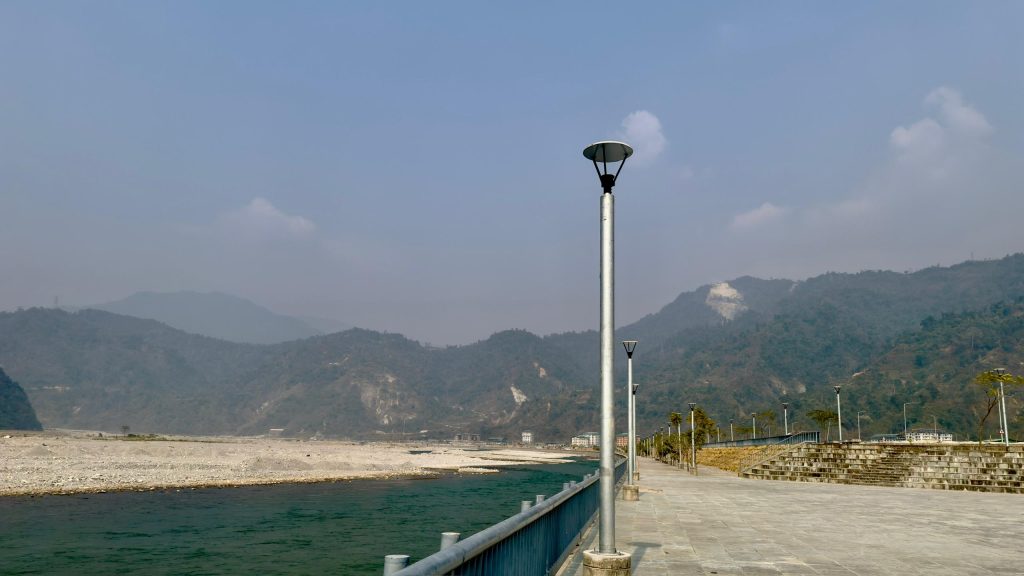
How the Phuentsholing Township Development Project is becoming the country’s boldest experiment in climate-smart urban growth
RINCHEN DORJI | Chhukha
On certain mornings in Phuentsholing, when the mist lifts slowly from the foothills and the Amochhu glides quietly under a pale sky, it is difficult to imagine the river as a threat. All’s calm with children walking to school and trucks rumbling toward the border gate as traders unlock their shutters.
But those who have lived long enough by the Amochhu know its other moods.
In summer, the river swells with monsoon rains pouring down from the Himalayan catchments upstream. Sediment-laden and restless, it has historically shifted channels, eaten into banks, and flooded low-lying stretches of Phuentsholing. The river has shaped the town’s economy—and limited its growth.
Now, along those very banks, the nation is attempting something unprecedented: building a new township from reclaimed land, engineered not just for expansion, but for resilience in a warming climate.
The Phuentsholing Township Development Project (PTDP) is being described by planners as a blueprint for future climate-smart cities in Bhutan. Its success—or failure—will echo far beyond Chhukha.
A Town Outgrowing Its Geography
Phuentsholing is Bhutan’s principal gateway to India with about 32,000 people (2025 est.) residing in the old frontier town, considered the nation’s economic hub.
Yet the town is physically constrained. Steep hills rise abruptly behind it while the Amochhu River presses against its front.
For years, planners warned that limited flat land was driving up property prices, encouraging unplanned expansion into vulnerable areas and straining drainage systems. At the same time, climate projections were growing more sobering.
“The foundations for PTDP as an emerging climate-smart city has been laid and charted according to plan. Fundamentals like flood embankments, drainage, interior roads, pedestrian and cycling lanes among others are complete,” said Uttar Kumar Rai, the Thrompon of Phuentsholing.
The Thrompon, who is serving his second five-year term, said despite few hiccups the project is on track and, once complete, it will be a major crowd puller in the region.
He said that, apart from state-of-art infrastructures, the new town will have community centres, theme parks, spiritual gateaways and a nature trails. But most importantly, he added, it will be well fortified against natural elements like floods.
“PTDP has adopted a nature-first approach in its planning, land development and management, and community engagement and stewardship,” Uttar Kumar Rai said, adding that the PTDP demonstrate how living in sync with nature can become the foundation for resilient urban growth.
Conception of a Bold Idea
The idea of reclaiming land from the Amochhu dates back over a decade with early feasibility studies initiated in the 2010s. The plan evolved into what is now implemented by the Amochhu Land Development and Township Project (ALDTP).
The vision was ambitious: reclaim more than 300 acres of land by diverting the river course, construct robust embankments, and develop a modern township equipped with climate-resilient infrastructure.
It was, in essence, an attempt to negotiate directly with the river.
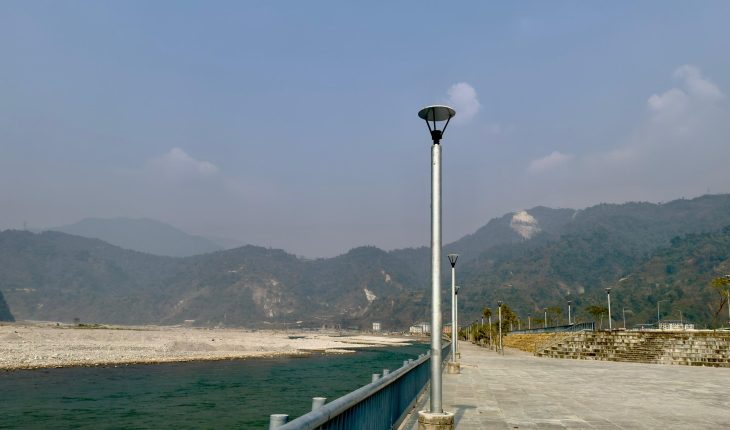
Site engineers said the current course of the Amochhu has been diverted toward its right bank—an area where there are no settlements. Massive flood barricades and reinforced embankments have also been constructed along the new channel.
According to project engineers, the river training works are designed to withstand up to a 100-year flood event, incorporating future climate projections. Concrete retaining walls, gabion structures, and sediment management systems line the river’s edge.
Satellite imagery comparisons presented during parliamentary briefings in 2025 show that the once-braided, unstable river channel near the township site has significantly stabilized.
Taming the Amochhu
Yet the Amochhu is not a tame river. Originating in Tibet and carrying heavy sediment loads, especially during monsoon months, it demands constant monitoring and maintenance.
Project officials acknowledge that climate uncertainty makes engineering design more complex than ever before.
The late retreating monsoons of October 2025 delivered a critical stress test.
On October 5, heavy rainfall across southern Bhutan caused the Amochhu to swell dramatically. According to hydrological assessments by the National Center for Hydrology and Meteorology (NCHM), peak discharge levels during the event exceeded the 10-year average.
While catastrophic damage was avoided—thanks in part to ongoing embankment works and temporary protections—low-lying areas experienced flooding, road disruptions and commercial losses.
For PTDP engineers, the event became a live case study.
Sediment deposition patterns were studied. Water velocity shifts were measured. Vulnerable stretches were reinforced. Drainage gradients were recalibrated.
“The PTDP stands on the course of Amochhu which is very volatile. The October flood was not just a warning—it was a rehearsal,” said Thrompon Uttar Kumar, adding the project is built such that it is able to withstand grave natural elements like floods.
Current Status, Progress and Challenges
As of February this year, land reclamation under PTDP is largely complete. Core infrastructure like flood retention walls with a 50-meter buffer zone from the core area, roads, drainage systems, utility corridors are complete or are in advanced stages.
“Apart from slope mobilization works, we have also initiated mass plantation in the core zones to ensure adequate greenery. If GMC will become the spiritual nerve of the country, PDTP is geared to become a sporting and leisure hub,” Thrompon Uttar Kumar Rai said.
Project authorities indicate that more than 90 percent of major physical works are completed. The final deadline for substantial completion of infrastructure is projected for late 2027, with phased occupancy expected earlier.
However, the path has not been smooth.
“Rising global material costs have increased budgetary pressures while heavy monsoon seasons have slowed construction. Technical challenges in maintaining the diverted channel persist,” an engineer for a construction company said.
Yet officials maintain that the project remains on track within revised timelines.
Beyond Expansion: A Climate-Smart Vision
Urban planners say PTDP is not merely about creating space, but about redefining how Bhutan builds cities.
Bhutan remains carbon-negative, with forest cover above 70 percent (National Environment Commission, 2023). Urban planners insist that future development must align with this national identity.
Throm Uttar Kumar Rai said the township incorporates planned and uniform growth with nature at the back of our minds.
“We will channelize our water resources to prudent use by building water and theme parks that will be a craze among visitors from across the region,” he said.
According to him there are buffer zones along riverbanks, 50meters, with elevated critical infrastructure above flood thresholds. In addition, there are advanced stormwater drainage systems designed for high-intensity rainfall.
Plans also include provisions for electric vehicle charging infrastructure, renewable energy integration and smart water monitoring systems—aligned with Bhutan’s Low Emission Development Strategy.
According to the World Bank’s 2022 Climate-Smart Cities framework, integrating land-use planning with risk-informed infrastructure can reduce climate-related economic losses by up to 30 percent. PTDP’s planners cite such benchmarks in shaping its resilience strategy.
Imagining Phuentsholing 2030
Stand at the river’s edge today and imagine the town five years from now.
Wide boulevards replace narrow, congested lanes. Tree-lined promenades run along a stabilized riverfront. Bicycle paths trace the embankments. Public plazas overlook landscaped green spaces that double as flood buffers.
Smart sensors track river levels in real time. Rainwater harvesting systems reduce runoff. Solar-powered streetlights illuminate pedestrian zones.
In a region increasingly vulnerable to climate extremes, PTDP envisions a city designed not merely to survive floods—but to coexist with them.
Local businessmen also opine that a well-planned township could attract private investment, diversify economic activity and create jobs—while reducing the risks that deter long-term investors in flood-prone areas.
A Model for Future Bhutanese Cities
If PTDP succeeds, it could provide a replicable model for climate-informed zoning laws, river training standards and integrated disaster risk governance.
The National Human Settlement Policy emphasizes resilient and inclusive urban growth. PTDP is its most tangible test.
Today, as the diverted river flows along its right bank—away from settlements and behind fortified barricades—it represents a new chapter in Bhutan’s relationship with nature.
“The Phuentsholing Township Development Plan is more than a construction project. It is a wager—that foresight, science and careful planning can outpace the growing risks of a changing climate,” said Sherab, CEO of a reputed construction company and currently engaged at PTDP.
He added that when the next major monsoon arrives, the embankments will be tested again. So will Bhutan’s vision and our resolve to adapt and evolve.
If the township stands firm, it may mark the moment when Bhutan began building not just cities but climate-smart futures.
This story was produced as part of the media reporting grant funded through the Australian Government’s Regional Media Support Fund through JAB.