DAWA ZANGMO | Thimphu
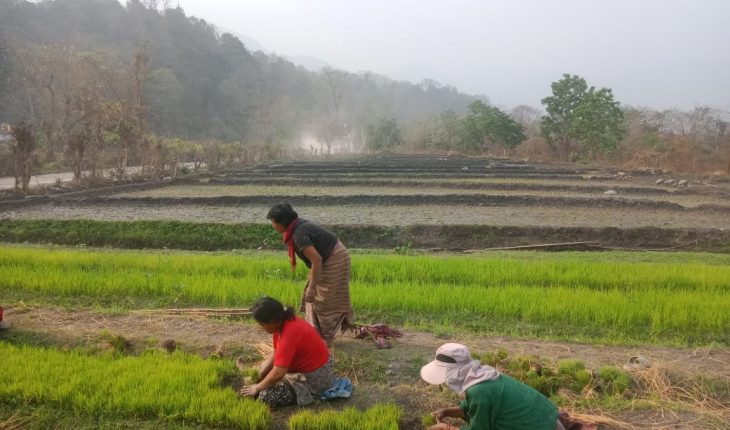
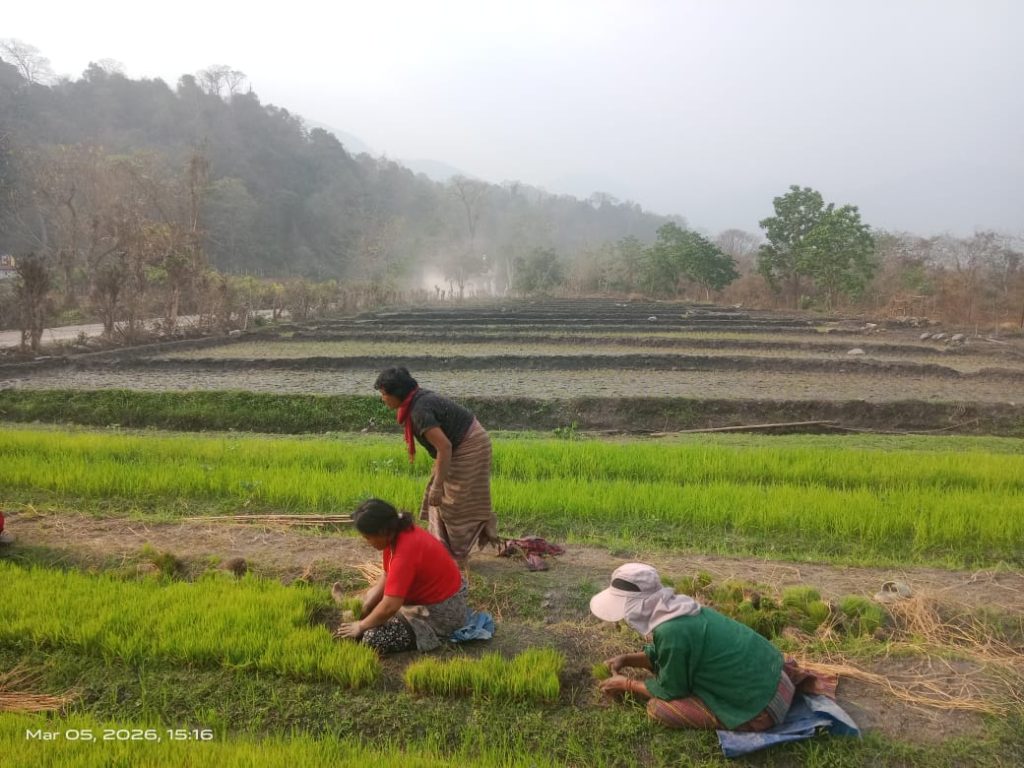
Farmers in Khamaedthang under Phuentshogthang Gewog in Samdrup Jongkhar dzongkhag have restarted spring paddy cultivation after a gap of seven years, marking a significant step toward improving rice production and household food security in the village.
With the resumption of spring paddy farming, local farmers can now cultivate rice twice a year, a development they say will help them move closer to becoming self-sufficient in rice.
For the farmers of Khamaedthang, said the revival of spring paddy cultivation signals renewed optimism. Many are now making full use of their fertile farmland, which had remained underutilized for years due to water shortages.
The change has been made possible with the construction of a smart irrigation channel completed last year. The irrigation system now provides a steady and reliable supply of water, enabling farmers to grow spring paddy something that was not possible in the past due to the absence of dependable irrigation.
Farmers in the village have already begun transplanting paddy seedlings in their fields. If the cultivation progresses successfully, harvesting is expected to begin in May and continue until June.
After completing the harvest of the spring crop, farmers will then prepare their fields for summer paddy transplantation, which usually begins in July.
Local farmers say the availability of irrigation water has made a major difference in their farming practices.
Dorji Gyeltshen, a farmer from Khamaedthang, said that the availability of adequate irrigation water allows farmers to cultivate paddy twice annually.
“Earlier, the main obstacle was the lack of water. With sufficient water supply now, growing paddy two times a year will benefit us. Even if we are not able to sell the harvest, at least we can meet our household rice needs,” he said.
Another farmer, Tulasa Tiwari, said the village could not cultivate paddy last year because the irrigation channel was still under construction. As a result, many households had to purchase rice from the market.
“Last year we could not grow paddy because the irrigation system was being built, and we had to buy rice instead. Now that the irrigation channel is complete, we have started cultivating spring paddy again. If the crop grows well this season, we intend to continue cultivating it in the coming years,” she said.
For many households, growing rice twice a year would significantly reduce their dependence on purchased rice.
Mindu Lhamo, another farmer in the village, said spring paddy cultivation plays an important role in ensuring food security.
“If we can successfully cultivate paddy twice annually, we will not need to buy rice from outside. That is why the opportunity to grow spring paddy is very important for our families,” she said.
According to the chiwog Tshogpa of Khamaedthang, Karma Namgyal, a total of 70 households in the village are planning to cultivate spring paddy this year. The cultivation will cover around 50 acres of agricultural land.
He said the irrigation channel constructed last year has played a crucial role in making double cropping possible.
“The irrigation channel completed last year was a major project for our community. With the improved water supply, farmers are now able to cultivate crops twice a year. If this year’s cultivation proves successful, we plan to continue the practice in the future,” Tshogpa Karma Namgyal said.
Despite the positive outlook, farmers say cultivating spring paddy also brings several challenges and requires considerable effort.
Another farmer Karma Dorji, who is cultivating spring paddy for the first time, said he is hopeful but uncertain about the outcome.
“If the crop grows well this season, I would like to continue growing spring paddy next year as well. Since this is my first time trying it, I am not completely sure how the harvest will turn out,” he said.
Thinley Wangdi, said that managing two cropping seasons back-to-back can be demanding for farmers.
“I hope to cultivate spring paddy every year, but it is not easy because we have to begin transplanting summer paddy immediately after harvesting the spring crop,” he said.
Farmers also pointed out that the timing of the spring harvest could make the work more difficult.
Tulasa explained that the harvesting period overlaps with the start of the rainy season, which can complicate farming activities.
“It will be challenging because the spring harvest coincides with the beginning of the monsoon, and right after harvesting we also have to start preparing the fields for summer paddy cultivation,” she said.
Despite these challenges, farmers in Khamaedthang remain optimistic about the future of spring paddy cultivation. They believe that if the harvest is successful, it will encourage more farmers to continue growing paddy twice a year in the coming seasons.
For now, the revival of spring paddy farming has brought renewed hope to the village, as farmers work hard in their fields with the expectation that improved irrigation and favorable conditions will result in a good harvest and strengthen food self-sufficiency in the community.