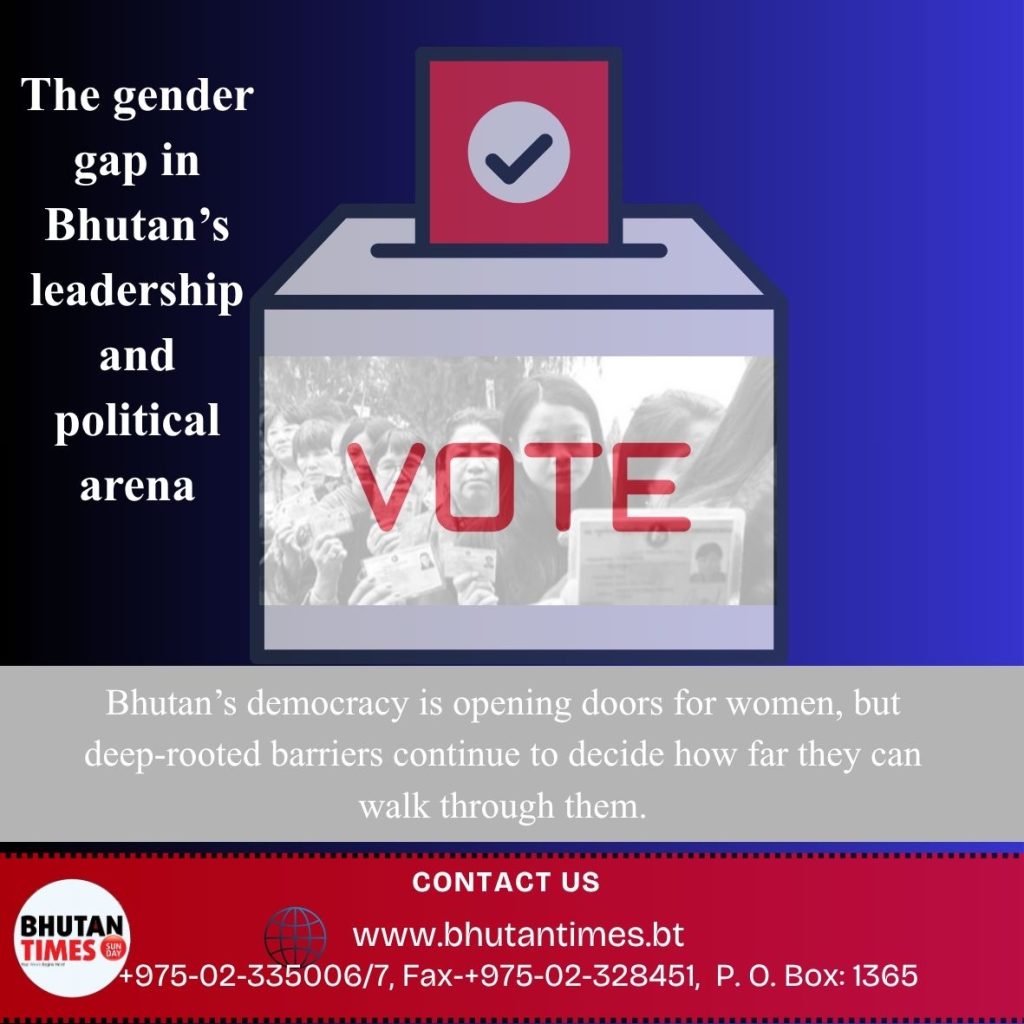
While women leaders are gaining ground in some regions, structural barriers, social norms, and limited support continue to restrict wider participation.
TIL BDR GHALLEY | Thimphu
For generations, Bhutanese women worked quietly behind the scenes running households, supporting communities, and shaping lives without stepping into public sphere. That silence is now giving way to active participation.
Women are moving from the margins into the ballot box, contesting elections, challenging stereotypes, and steadily changing the face of governance.
But this change is not uniform. The stories of women in politics reveal a striking contrast between growing acceptance and continuing struggle.
When Sherab Lham announced her candidacy for Gup in Hungrel Gewog in Paro, the reaction was immediate and skeptical.
“To be honest, people were quite shocked,” she said. “There had never been a woman Gup from my gewog, and some even thought it could bring bad luck. But leadership is about service, not gender.”
Her decision challenged long held beliefs about who should lead. Today, as Gup, she stands as a symbol of changing mindsets.
“Some people believed leadership positions like Gup were meant only for men,” she said. “But the community eventually trusted me.”
That trust did not come overnight; it grew through experience.
“At first, I had doubts,” said a 35-year-old male resident of Hungrel. “We were not used to seeing women in such positions. But after seeing her work, I believe leadership depends on capability, not whether someone is a man or a woman,” he added.
A 39-year-old resident said earlier, people talked about tradition, now they talk about performance. He said i a leader delivers, gender does not matter.
Sherab Lham’s leadership has also changed how communities engage. Issues such as domestic violence and personal hardship once rarely discussed are now more openly addressed.
“Women leaders bring perspectives that might otherwise remain invisible in governance,” she said.
Reflecting on her journey, she said, “People have now accepted that women can be Gup just as men can. Mindsets have changed. Even though my opponent was a man, the community trusted me and chose me. That trust means everything.”
While Paro reflects a growing acceptance of women in leadership, Samtse presents a more complex reality, where progress exists but barriers remain deeply rooted.
Lila Pradhan, a former Member of Parliament (MP) representing Ugyentse-Yoeseltse constituency, Samtse, said the challenges were both visible and subtle.
“Our society is still largely male dominated, and women often have fewer opportunities to participate,” she said. “Social barriers can be discouraging, such as traditional expectations that women should focus solely on household duties.”
She described politics as a space that demands resilience. “Perhaps women have been hesitant to take risks, but today we see many women in senior positions across various fields, including politics, proving that leadership is not limited by gender.”
“I approached politics with a practical mindset, learning to navigate challenges step by step. Self-motivation and personal conviction are what drive women to step forward and serve the nation,” she said.
Yet barriers persist. “Systemic and institutional barriers still exist, and we need stronger mechanisms to ensure equal participation,” she added.
Sarita Chhetri, serving her second term as Tshogpa in Norjansa – Peljorling chiwog under Tashichhoeling Gewog, said “Behind many women leaders is strong support at home because change often begins within families.”
She said family support plays a key role in women’s participation, adding that an educated partner can significantly support women in leadership roles.
She is also working to bring more women into governance. “I motivate women in my chiwog to speak up, share problems, and participate in governance. Their voices are crucial for inclusive development,” she said.
According to her, women leaders also influence how governance functions. “Women leaders often bring greater transparency and integrity. Their leadership can contribute to lower levels of corruption and more accountable service delivery.”
Among communities, perceptions are slowly evolving.
“Initially, many of us doubted whether women could manage leadership roles,” said Januka Ghalley, 26, a resident of Norjangsa. “Over time, women demonstrated competence, and today we vote for the best candidate, regardless of gender.”
“Seeing women serve effectively as Tshogpa has inspired confidence,” added Karma Choden, 33, from Tasichhoeling “Women leaders bring empathy and attention to issues that might otherwise be overlooked.”
Devika Pradhan, 60, a resident of Peljorling, said attitudes have gradually changed and leadership is no longer seen as a man’s domain.
“Women can lead just as well as men. I encourage my grandchildren, especially girls, to take part in community decisions.” she said.
However, skepticism toward women in politics has not entirely disappeared. Many still view leadership as a male domain, perceiving women as too emotional to hold such positions. Women also face broader challenges, including limited access to funding, political networks, and information, alongside societal expectations and the fear of judgment.
Dil Kumar, 45, from Peljorling, said that while attitudes are gradually changing, traditional views continue to influence decision-making, with leadership still often perceived as a man’s responsibility and hesitation persisting in supporting women due to long-held beliefs and expectations.
Punam Tamang, a Tshogpa candidate from Khempa-Panzhing chiwog in Tading Gewog, lost her election, but not her resolve.
“Losing the election was difficult, but it does not define my commitment,” she said. “I will continue to serve my community and contest again because true change comes from the courage to stand and to be counted.”
“Progress involves overcoming challenges and learning from them. Every step forward counts,” she said.
Across Bhutan, the numbers reflect this uneven reality.
Women make up more than half of registered voters, yet their representation in leadership remains low. From 13.89 percent at the national level in 2008, The figure fell to 6.94 percent in 2013 before climbing modestly to 15.28 percent in 2018, when seven women were elected.
However, the representation declined again in 2023, In the 47-member National Assembly, only two women secured seats, representing about 4.3 percent of the membership.
At the local level, representation has improved gradually but remains limited.
Bhutan’s first Local Government elections in 2011 marked a significant step in expanding democratic leadership to the grassroots level. Of the 1,431 positions contested that year, only 103 were won by women, representing 7.2 percent of all local leaders.
In 2016, women’s representation increased to about 11.5 percent, with 164 women elected, and by 2021, it rose modestly to around 12.87 percent, as 185 women secured seats out of 1,437 positions.
Despite this steady progress over the years, women continue to be underrepresented in local government leadership.
According to Dorji Wangmo, MP of Kengkhar–Weringla constituency, Monger women’s participation is part of a longer democratic journey.
“Early leadership exposure and peer networks help women see politics as achievable and meaningful,” she said. “Practical guidance and community encouragement are essential.”
“Women leaders sometimes face more personal scrutiny. But as democracy matures, leadership is increasingly judged by performance and service outcomes rather than gender.”
“Public office brings demanding schedules,” she said. “Whenever my schedule allows, I make it a priority to spend time with my family, especially my daughters.”
“When women are economically independent, they are more willing to take up leadership roles,” said Dr. Meenakshi Rai, director of programs and services at Respect, Educate, Nurture and Empower Women (RENEW).
She pointed to persistent social norms as major barriers. “Beliefs such as ‘women cannot make decisions’ or ‘women should take care of the family,’ along with gender-based violence, limit participation.” she said.
“A system that promotes gender equality with equity is crucial,” she added. “Family support, economic opportunities, psychosocial care, and strong legal protections are essential.”
She also suggested that quota systems at the grassroots level could help encourage participation.
National efforts have also aimed to address the imbalance. The National Commission for Women and Children has worked alongside the Royal Government to promote gender-friendly political spaces, while the National Plan of Action to Promote Gender Equality in Elected Offices seeks to increase women’s representation.
Yet, despite these efforts, progress remains uneven.
“In our gewog, there used to be a belief that girls cannot do certain things,” Sarita Chhetri said. “But women can do what men do if we are given responsibility and trust. Leadership is about what we do and how we do it, not who we are.”
Education and awareness remain critical for improving participation. “Voter education for women is vital. Awareness campaigns and information materials help women understand their rights, roles, and responsibilities in governance,” she noted.
Yet systemic obstacles persist. “Systemic and institutional barriers still exist, and we need stronger mechanisms to ensure equal participation,” Lila Pradhan said.
Local government remains the closest link between the state and the people, directly addressing the needs and concerns of communities said Sarita Chhetri.
From growing acceptance to continuing challenges, Bhutan’s journey toward gender-balanced governance remains uneven. But across both regions the narrative is evolving one woman, one vote, and one voice at a time.
This story is supported by the Bhutan Centre for Media and Democracy ( BCMD) with funding from the Digital Democracy Initiative ( DDI)