RENUKA RAI | Thimphu
A year marked by celebrations and renewed optimism has also become a defining chapter in the economic recovery of Bhutan.
According to the Annual Report 2025 released by the Royal Monetary Authority of Bhutan (RMA), the economy expanded by 7.5 percent in 2024, making it one of the strongest post-pandemic performances in the region.
The rebound, driven by services, hydropower-linked industrial activity and steady public investment, reflects a country attempting to balance rapid economic expansion with structural vulnerabilities that remain close to the surface.
The services sector once again emerged as the backbone of the economy, accounting for more than 57 percent of gross domestic product.
The revival of tourism after years of disruption was central to this growth. Hotels and restaurants recorded a dramatic expansion of over 30 percent, underlining the strength of pent-up demand and renewed international travel interest.
Public administration and financial services also contributed significantly, supported by increased government spending and steady credit growth.
The National Accounts data compiled by the National Statistics Bureau show that GDP per capita rose to Nu 360,266.7 in 2024, equivalent to USD 4,245.6, reinforcing Bhutan’s post-pandemic recovery trajectory.
Yet the growth pattern reveals an economy still heavily dependent on a few dominant sectors. While services boomed, agriculture which employs a substantial share of the rural population grew by 3.7 percent.
Livestock and forestry performed steadily, but long-term structural challenges such as rural-urban migration and labour shortages continue to weigh on productivity.
The industrial sector grew by 7 percent in 2024, reversing stagnation seen a year earlier. Electricity generation and construction were the primary drivers.
As new hydropower units neared commissioning and major infrastructure works continued, industrial output strengthened.
The anticipated operationalization of projects under the Punatsangchhu Hydroelectric Project Authority is expected to further accelerate growth in 2025 and 2026.
Medium-term projections suggest industry could expand by over 15 percent annually as hydropower exports rise.
Manufacturing, however, remains modest, growing by just 2.6 percent in 2024. Mining and quarrying contracted, reflecting slower demand for minerals such as limestone and gypsum.
These mixed signals point to the persistent challenge of diversifying beyond hydropower and tourism.
Inflation Stable, But Cost of Living Pressures Persist
Domestic inflation remained relatively contained, averaging below 4 percent.
Headline inflation fluctuated between 3.1 and 3.9 percent in 2025, with food prices contributing most to the upward pressure. Non-food inflation remained subdued.
Despite the moderation, the erosion of purchasing power over the past decade remains visible.
The RMA report notes that Nu 100 today is worth nearly half of its 2012 value. For households already grappling with rising urban housing costs and imported food dependency, price stability remains an ongoing concern.
Bhutan’s currency peg to the Indian rupee continues to anchor inflation trends, helping buffer against extreme volatility. However, reliance on imports leaves the country exposed to external supply disruptions and commodity price shifts.
One of the more encouraging developments in the report is the modest improvement in the current account deficit, which narrowed to 17.4 percent of GDP in FY 2024/25.
Although the trade deficit widened due to higher imports of capital goods and hydropower-related materials, stronger remittance inflows and tourism earnings provided partial relief.
Gross international reserves climbed to USD 800.3 million enough to cover nearly 16 months of essential imports. This cushion exceeds the constitutional requirement of 12 months and signals improved external resilience.
Remittances surged by 69 percent to USD 241.8 million, reflecting greater use of formal banking channels and digital platforms.
The diaspora’s growing role in supporting domestic consumption and reserve accumulation has become increasingly evident.
Debt Levels Climb Above 100 Percent of GDP
Despite strong growth and stable reserves, Bhutan’s public debt reached 100.5 percent of GDP by June 2025.
External debt accounts for the overwhelming majority, much of it tied to hydropower projects financed in Indian rupees.
While rupee-denominated hydropower loans are considered self-liquidating due to future export earnings, convertible currency debt exposes the country to exchange rate risks.
The depreciation of the Ngultrum against the US dollar over the past year has slightly increased repayment burdens.
The fiscal deficit widened to 2.6 percent of GDP in FY 2024/25, as government expenditure outpaced revenue.
Capital spending rose in line with infrastructure priorities under the 13th Five-Year Plan, supported by external borrowings and domestic bonds.
Officials argue that the temporary rise in debt reflects front-loaded investments that will generate long-term returns once hydropower plants become fully operational.
Credit growth accelerated to 17 percent in FY 2024/25, reaching Nu 257.9 billion. Housing absorbed the largest share, followed by services and manufacturing. The credit-to-deposit ratio rose to nearly 82 percent.
Importantly, the gross non-performing loan ratio declined to 3 percent, indicating improved asset quality. Nevertheless, sectoral concentration in housing and tourism remains a risk area, particularly if global travel demand weakens.
The RMA maintained an accommodative monetary stance, holding the cash reserve ratio at 8 percent while advancing work on an Interest Rate Corridor framework aimed at modernizing liquidity management.
Labor Market and Youth Unemployment
The unemployment rate declined to 3.5 percent in 2024, signalling improved labour absorption. Construction and services created new jobs, particularly in urban areas.
However, youth unemployment remains disproportionately high. Nearly half of all unemployed individuals are aged 15–24.
The mismatch between educational qualifications and labour market demand continues to challenge policymakers.
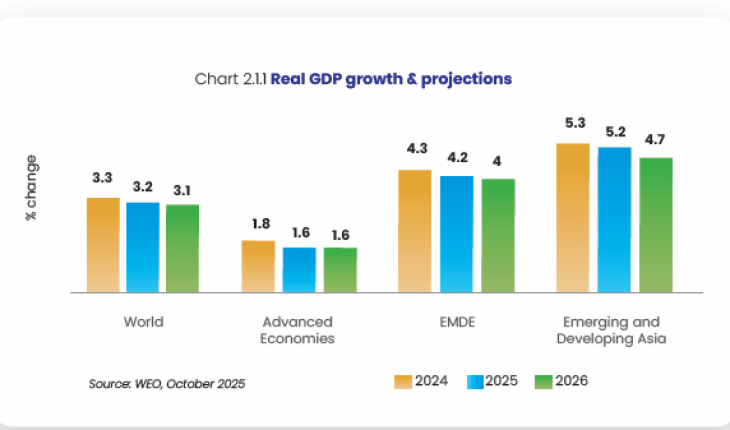
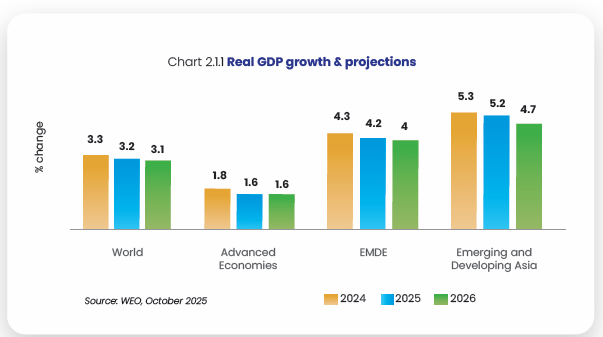
Looking ahead, the RMA projects GDP growth of 8.8 percent in 2025 before moderating slightly to 8.3 percent in 2026.
Industry is expected to lead expansion, fueled by hydropower commissioning and sustained infrastructure investment. Services will grow at a slower but stable pace as tourism stabilizes.
Inflation is forecast to remain manageable, though global uncertainties persist.
The external account is projected to gradually improve, and reserves are expected to strengthen further.