TIL BDR GHALLEY | Samtse
In the vegetable fields of Panbari under Tading Gewog in Samtse, farmers wake before sunrise to tend their crops, but what they earn at harvest often fails to match the value their produce commands in urban markets.
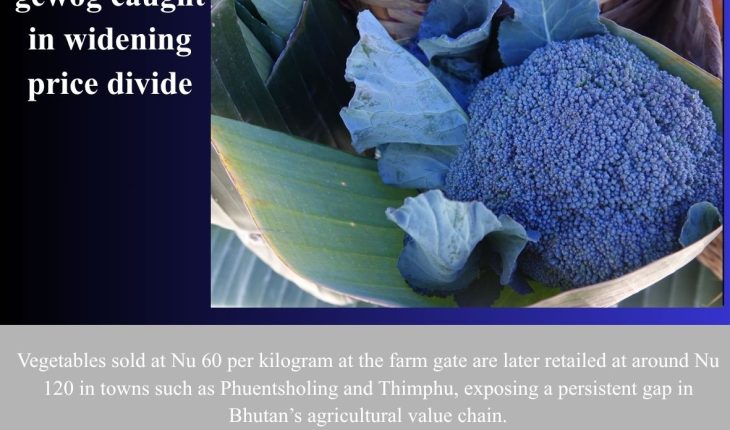
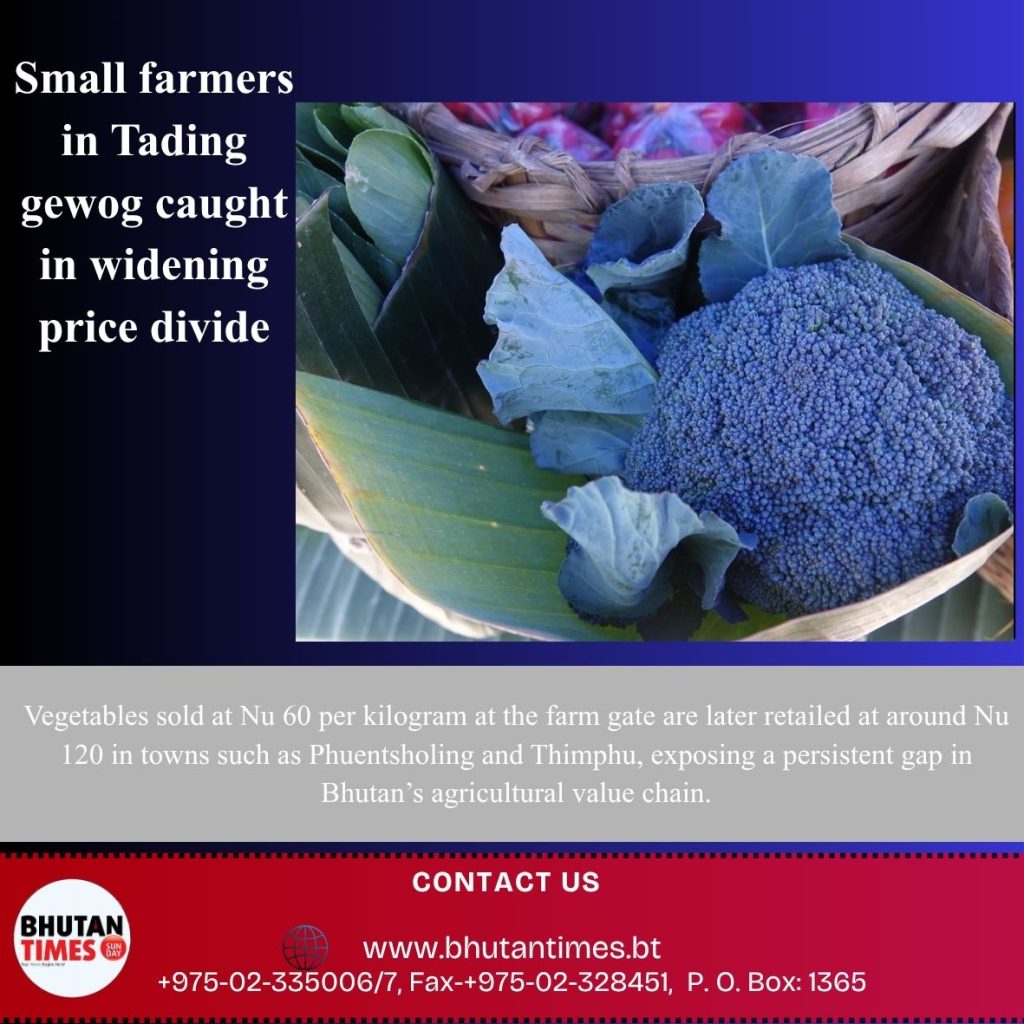
Vegetables sold at Nu 60 per kilogram at the farm gate are later retailed at around Nu 120 in towns such as Phuentsholing and Thimphu, exposing a persistent gap in Bhutan’s agricultural value chain.
For farmers this disparity is compounded by rising input costs and increasingly unpredictable weather patterns that threaten both yield and income stability.
“We sell our vegetables directly to retailers,” said Indra Lal, 43, a farmer from Panbari. “But the price we receive is always limited. We have no control over the rate. The same vegetables are later sold at double the price in the market. That is what frustrates us the most.”
He said farming involves heavy investment long before any income is earned.
“We buy hybrid seeds from Haa and Thimphu,” he said. “Each packet costs around Nu 250 to Nu 500. On top of that, we spend on manure, labour, and transport. When the price we get is low, we cannot even recover our costs. Sometimes we end the season in loss.”
Indra Lal also highlighted a major contradiction in seasonal farming patterns where early harvests bring better prices, but low yield limits earnings.
“We get higher rates only during the first season of harvest,” he said. “But at that time, we are not able to produce in high quantities because of weather conditions. So even when the price is good, the volume is too low to benefit us properly.”
He added that even before crops reach the field stage, farmers already face serious challenges in production quality and survival of seedlings.
“We are not able to get good or healthy saplings,” he said. “Many of the seedlings are weak from the beginning, and pests eat a large number of them. By the time we transplant, we have already lost a big portion of the crop.”
“When pests destroy the saplings, our production goes down,” he said. “So even if the market price is good, we do not have enough quantity to benefit.”
He said climate change has become one of the most unpredictable threats to farming.
“We face many challenges due to climate change,” Indra Lal said. “Untimely rainfall, strong winds, and hailstorms destroy crops when they are almost ready for harvest. Last time, a heavy downpour and hailstorm caused huge damage. We lost most of our vegetables in a single day. There is no inquiry from government.”
“When you work for months and lose everything in one storm, it breaks your confidence,” he said. “You start questioning whether farming is even worth continuing.”
Purna Bdr, Gewog agriculture extension supervisor confirm that farmers in the gewog are increasingly vulnerable to weather shocks that directly affect both yield and quality of produce.
He said multiple structural and environmental factors are contributing to the price and production challenges faced by farmers.
“One possible cause is import competition,” he said. “Cheaper vegetables are available across the border and even within local vendors, which indirectly affects the price of local produce.”
He also pointed to seasonal fluctuations during peak harvest periods. “During peak harvesting time, prices fluctuate significantly. Farmers find it difficult to maintain standard pricing because supply increases suddenly while demand remains stable,” he explained.
Another key issue is the dependence on middlemen. “Most farmers sell through middlemen due to transportation challenges,” Purna Bdr said. “These intermediaries often offer lower prices, reducing the farmers’ share of the final market value.”
He added that the absence of dedicated local sale outlets further weakens farmers’ bargaining position.
“If there were dedicated local sale outlets, it would greatly benefit farmers by reducing dependency on intermediaries,” he said.
The price gap between farm and market remains stark. Farmers in Panbari often sell vegetables at around Nu 60 per kilogram, while the same produce reaches consumers at nearly double the price in urban markets. He said that the largest breakdown occurs during distribution and retail stages, where transport costs, market fees, and profit margins significantly increase prices.
“The biggest gap happens after the produce leaves the farm,” Purna Bdr said. “Wholesalers and retailers add their costs and margins, which leads to higher retail prices.”
Despite these challenges, local authorities say efforts are underway to strengthen farmers’ collective capacity.
“The gewog has formed farmer groups for collective bargaining,” he said. “We encourage farmers to transport produce in bulk to reduce costs and improve negotiation power.”
However, he acknowledged that deeper structural issues persist.
“Limited market access, lack of value addition, and high input costs continue to be major barriers,” he said.
Market access remains a critical issue. While farmers are encouraged to transport produce collectively to urban centres such as Phuentsholing, there is no formal system ensuring consistent and fair market linkage.
“We have not established official market arrangements yet,” Purna Bdr said. “But we advise farmers to organize themselves to reduce transportation costs.”
Infrastructure constraints further worsen farmers’ vulnerability. Poor storage facilities and transport difficulties often force them to sell immediately after harvest, especially when weather damage threatens spoilage.
“Yes, inadequate storage and poor transport facilities force farmers to sell quickly at lower prices,” he said.
Farmers also receive technical support such as hybrid seeds, greenhouse facilities, and training in post-harvest handling, but many say these interventions are not enough to offset growing risks.
Looking ahead, he stated that continued price disparity and climate shocks could threaten the future of farming in the region.
“Persistent price gaps can lead to declining farmer incomes and reduced agricultural production,” Purna Bdr said.
Still, he believes agriculture can remain viable for young people if proper systems are strengthened.
“Farming can remain viable for young people if profitable market access and attractive income opportunities are provided,” he said.
For Indra Lal, however, the reality remains uncertain as both market instability and climate unpredictability continue to shape daily life.
“If we invest so much in seeds and labour and still lose crops to hailstorms or get low prices in the market, how can farming survive?” he said. “Without fair prices and protection from weather, young people will not stay in agriculture.”
As Panbari’s fields stretch into the horizon, the story is not only about price gaps, but also about a growing struggle against a changing climate and an uncertain agricultural future.