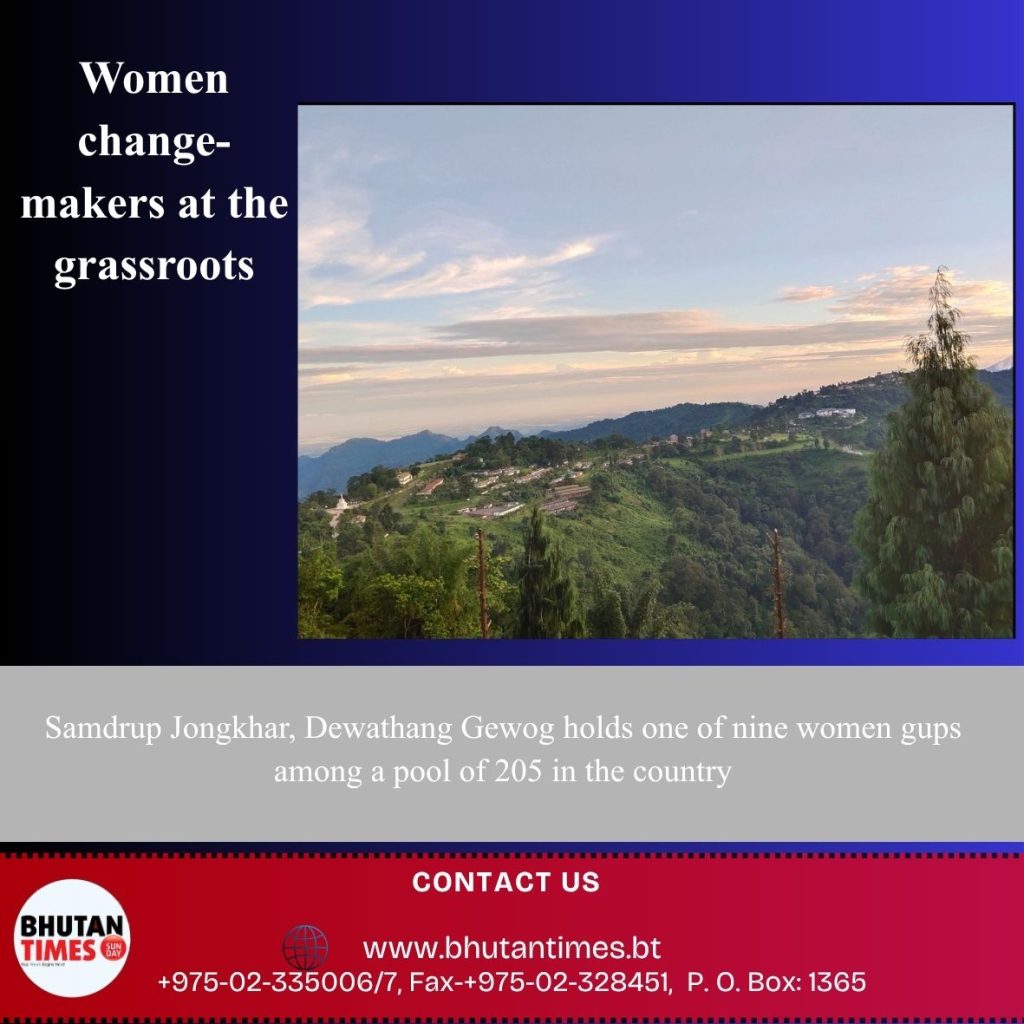
Karma Dema is one of only nine women gups among a pool of 205 in the country
NGAWANG JAMPHEL | Samdrup Jongkhar
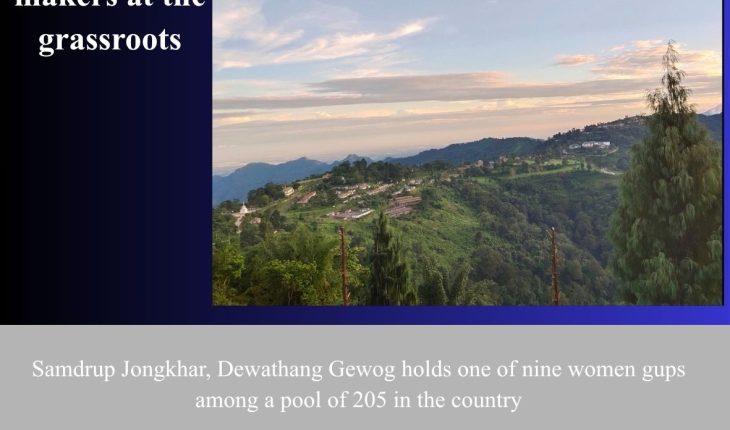
In the quiet hours before sunrise, when Dewathang is still wrapped in mist and the distant hills of Samdrup Jongkhar Dzongkhag are painted in pale blue, Karma Dema begins her day.
The 36-year-old once cherished these early mornings in the comfort of her cozy bedroom, a private space of stillness before stepping into the world.
Today, that world is much larger. It stretches across villages, meeting halls, farm roads, and ceremonial grounds.
As the Gup of Dewathang Gewog, she now carries the weight of public expectation and the quiet hope of many women who see themselves reflected in her journey.
Karma Dema is one of only nine women gups among 205 gewogs in the country.
Her election during the third Local Government (LG) Election marked not only a personal milestone but also a small yet significant step forward in women’s political representation in Bhutan.
While the country has made notable strides in human development and governance, women remain underrepresented in both local and national leadership positions, a reality that Karma’s story both challenges and illustrates.
Unlike many who enter politics with calculated ambition, Karma’s journey began with curiosity.
“I never planned to become a politician,” she says, seated at her modest office desk after a morning meeting with community members. “It started with a simple question in my mind about how decisions are made for our people and how I can be part of that process.”
Her interest in governance was shaped by her professional experience.
After graduating with a Bachelor’s degree from Gedu College of Business Studies in 2013, Karma joined Samdrup Jongkhar Initiatives (SJI) as a Program Officer. SJI, known for its grassroots development and community empowerment work, exposed her to the realities of rural livelihoods, which is from youth engagement and organic farming initiatives to community dialogues and capacity building.
“For me, it was an advantage working with SJI because I was already working directly with people, and that boosted my experience to work with people as their leader,” Karma explains. “I learned that leadership is not about authority, it is about listening and responding.”
Her daily work at SJI required her to visit villages, interact with farmers, facilitate community programs, and understand development challenges at their roots.
These interactions not only strengthened her communication skills but also deepened her empathy for the people she would later represent.
It was during the second LG Election in 2016 that Karma decided to contest for the post of Gup. At the time, the decision was more exploratory than strategic. She wanted to test her capacity and gauge public perception. However, the outcome was not in her favor.
“Losing the election was difficult,” she admits candidly. “I felt disappointed, and for a moment, I questioned whether I was ready or whether the community was ready for me.”
The defeat, however, did not mark the end of her public engagement. She returned to SJI later that year and resumed her responsibilities with renewed determination. Ironically, it was during this period that the community’s confidence in her began to crystallize.
Ngawang Dorji, an elderly farmer from Dewathang recalls her presence during those months: “Even after she lost, she continued to work among us. She did not withdraw or become distant. That is when many of us realized she was not driven by position, but by service.”
When the third LG Election approached, Karma did not initially plan to run again. But this time, the initiative came from the people themselves.
“They came to me and said, ‘We need someone who understands us and will stay with us,’” Karma recounts. “Their trust gave me courage.”
Encouraged by grassroots support, she contested once more, and this time she won.
Her victory placed her within a very small cohort of women leaders in local governance.
During the first LG Election, 21 women contested for the post of Gup, but only one was elected. The second LG Election saw only two women elected. The third recorded nine successful female candidates — the highest to date.
“It is encouraging that the number increased to nine,” Karma reflects. “But nine out of 205 is still very small. Representation matters because when women are present in leadership, priorities can become more inclusive.”
Her tenure has not been without challenges. Deep-rooted gender stereotypes continue to influence perceptions of leadership, particularly in rural communities where tradition holds significant social authority.
One recurring example involves the ceremonial offering of Marchang, a ritual practice traditionally performed by male leaders. In many gewogs, the Mangmi, who is often male, conducts the offering during official gatherings. When Karma assumed office, some community members questioned whether it was culturally appropriate for a woman Gup to perform the ritual.
“In the beginning, there were doubts,” she acknowledges. “People discussed whether it was acceptable for a woman to offer Marchang. But I believe that if I am elected as Gup, I must carry out all responsibilities with equal dignity.”
Over time, perceptions began to shift.
Sangay Choden, a shopkeeper in Dewathang, observes, “At first, some elders were unsure. But when they saw her sincerity and confidence, the doubts reduced. Now we see her as our leader, not as a woman trying to fit into a man’s role.”
Beyond breaking ceremonial barriers, Karma has also consciously reshaped the development priorities of her gewog. One of her strongest areas of focus has been youth engagement.
Having worked closely with young people during her time at SJI, she understands both their potential and their vulnerabilities.
“Youth is the energy of our community,” she says. “If we do not guide and support them today, we cannot expect a strong future tomorrow.”
Under her leadership, the gewog has given greater attention to youth-oriented activities, from skills training and awareness programs to encouraging participation in local decision-making forums. She has worked to ensure that young people are not merely recipients of development initiatives but active contributors to them.
A group of young men and women in Dewathang credit her for creating more inclusive spaces.
“Earlier, we felt that gewog meetings were only for elders,” says Kunzang Dorji, a 26-year-old youth from the gewog. “Now, our Gup encourages us to speak. She asks for our ideas and listens seriously.”
Karma believes that when youth feel heard, they develop a sense of ownership over their community. She often invites students and graduates to observe meetings, participate in discussions, and volunteer in local initiatives.
Her leadership has also had a noticeable impact on women’s participation in governance at the grassroots level. In the past, many women hesitated to speak during public meetings, often deferring to male family members. Cultural norms and self-doubt combined to limit their visibility in decision-making spaces.
Today, that dynamic is slowly changing.
“When the leader is a woman, other women feel more comfortable coming forward,” Karma explains. “They feel they can approach me easily and speak openly about their concerns.”
In gewog meetings, the presence of women has become more pronounced. They raise issues related to water supply, healthcare access, farm roads, childcare, and domestic challenges, which matters that directly affect their daily lives but are sometimes overlooked in broader discussions.
41 years old, a mother of three from one of the chiwogs shares, “Earlier, I used to sit quietly at the back. Now, I feel confident to speak. Our Gup understands our problems because she is also a woman. We feel at ease.”
This increased participation has enriched decision-making processes. By hearing diverse perspectives, the gewog administration is better equipped to design solutions that reflect real needs. Karma sees this not as a personal achievement, but as a collective transformation.
“Leadership is not about standing above others,” she says. “It is about standing with them.”
Despite these positive shifts, challenges remain. Structural barriers, limited resources, and lingering stereotypes continue to test her resilience. Balancing professional responsibilities with personal life also demands careful navigation. Yet Karma approaches these realities with quiet determination rather than complaint.
She remains grounded in everyday governance tasks, overseeing infrastructure projects, addressing water supply issues, coordinating with dzongkhag officials, and mediating local disputes. Her leadership style emphasizes consultation and community engagement rather than top-down decision-making.
“Development is meaningful only when people feel heard,” she says. “Sometimes listening to someone’s concern is as important as solving a large infrastructure problem.”
Her approach reflects lessons learned during her time at SJI, where dialogue and participatory processes were central to development work. This background, she believes, helped her transition into political leadership with relative confidence.
Looking back, Karma describes her journey as one shaped more by collective faith than personal ambition.
“I stepped out of my comfort zone because I believed I could contribute,” she says. “But it was the people’s trust that truly brought me here.”
In Dewathang’s evolving socio-political landscape, Karma Dema represents both continuity and change — continuity in her deep connection to community values, and change in challenging the notion that leadership roles are inherently male domains.
Ugyen Wangmo, an elderly woman from the gewog, captures the sentiment succinctly: “When we see Karma leading, we feel proud. She shows our daughters that leadership is possible.”
As Bhutan continues to strengthen its democratic institutions, the question of inclusive representation remains central. The incremental rise in women gups, from one in the first LG Election to nine in the third, signals progress, but also reminds us of the work that lies ahead.
For Karma Dema, the path forward is clear.
“We must create spaces where women feel confident to stand for elections,” she says. “Change will not happen overnight, but every step counts.”
Note: This story is supported by the Bhutan Centre for Media and Democracy (BCMD) with funding from the Digital Democracy Initiative (DDI)