RENUKA RAI | Thimphu
Despite strong economic growth and notable progress under the 13th Five Year Plan, Bhutan’s long-term development ambitions are facing a growing challenge from a shrinking and ageing population, driven by continued outmigration and declining birth rates.
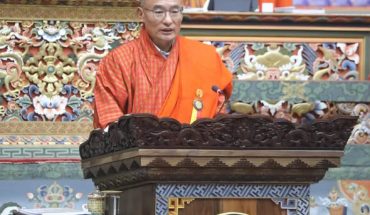
Presenting the State of the Nation Report to joint session of the Parliament on June 16, Prime Minister Tshering Tobgay described the continued migration of Bhutanese abroad as the country’s “greatest national risk” and an “existential crisis”, warning that the trend could have far-reaching implications for Bhutan’s future.
“As stated in the previous State of the Nation Report, the greatest national risk is the continued migration of Bhutanese people abroad which is an existential crisis,” the Prime Minister said.
The warning came amid an otherwise positive assessment of the country’s economic performance. The Gross Domestic Product (GDP) has increased from Nu. 280 billion at the start of the 13th Five Year Plan to Nu. 364 billion, representing a 30 percent increase in just two years. The government has also closed the Nu. 56 billion financing gaps under the Plan and now projects a surplus of Nu. 20 billion.
Major investments in hydropower, agriculture, tourism, education, healthcare and digital transformation have contributed to the country’s expansion. However, the report suggests that sustaining these gains will depend heavily on the country’s ability to retain and develop its human capital.
According to the report, more than 71,000 Bhutanese are currently working overseas, most of them young, educated and skilled individuals.
While overseas employment has brought economic benefits through remittances, policymakers are increasingly concerned about its long-term implications for the domestic workforce.
In 2025, Bhutanese working abroad sent home USD 342.94 million in remittances, contributing meaningfully to the economy. The report, however, stresses that the country’s future development ultimately depends on the strength of its economy and its people.
“Ultimately, addressing this existential crisis depends on the strength of our economy,” the Prime Minister said. “The economy will not develop on its own and certainly not with a few experts coming in to help us. The responsibility of developing our economy rests solely and fully with us.”
The Prime Minister acknowledged that Bhutanese who return from overseas bring broader exposure, skills and experience that can benefit the national economy. Nevertheless, the continued departure of working-age citizens has raised concerns about the country’s future productive capacity and its ability to meet the demands of an expanding economy.
The migration challenge is being compounded by another significant demographic trend declining birth rates.
The State of the Nation Report reveals that Bhutan’s Total Fertility Rate has fallen below the replacement level of 2.1 children per woman. Annual births have also declined by 26 percent over the past decade, falling from 11,001 births in 2015 to 8,153 births in 2024.
Births at the third order and above have declined by 27 percent since 2020. According to the report, these trends, combined with outward migration and population ageing, have long-term implications for Bhutan’s workforce, communities and socio-economic development.
For a country with a relatively small population, a shrinking working-age population could mean fewer people available to support economic growth and public services while also caring for an increasing elderly population. Rural communities, many of which have already witnessed population decline, could face additional pressures in sustaining local economies and community life.
Recognising the challenge, the government has launched the Third Child Plus Programme to provide support to families who have a third child. “Since our population is already small, this challenge must be addressed urgently,” the Prime Minister said, calling on Bhutanese to support population growth in the country.
The government has also invested heavily in creating opportunities at home. More than 55,000 youth have participated in skills and technical training programmes over the past two years, while around 3,000 unemployed youth have been provided employment opportunities. Technical Training Institutes have expanded their capacity from 900 to 3,000 trainees, and around 7,000 Bhutanese have received information technology training.
At the same time, the government has approved 35 new foreign direct investment projects worth Nu. 226 billion and supported thousands of new businesses and industries through concessional financing and entrepreneurship programmes.
Yet the report makes clear that economic growth alone may not be enough to reverse demographic trends. Many of Bhutan’s ambitious initiatives, including the 10X Economic Roadmap and the Gelephu Mindfulness City initiative, will require a skilled and productive workforce to succeed.
As Bhutan marks two decades of His Majesty the King’s reign, the State of the Nation Report reflects both pride in the country’s achievements and concern about future challenges.
Over the past twenty years, Bhutan has expanded access to education and healthcare, strengthened democratic institutions and achieved significant economic growth. However, the report suggests that the next phase of development may be shaped not only by financial resources and infrastructure but also by demographic realities.
For Bhutan, the challenge is no longer simply how to grow the economy, but how to ensure there are enough people to sustain that growth in the decades ahead.