TIL BDR GHALLEY | Thimphu
Bhutan has officially submitted its First National Report on the Implementation of the Nagoya Protocol (NP) to the Access and Benefit-Sharing Clearing-House (ABSCH) under the Convention on Biological Diversity (CBD).
The report, published by the National Biodiversity Centre (NBC), which serves as the national focal point for the Nagoya Protocol, provides a comprehensive account of the country’s progress in implementing the Protocol and promoting equitable sharing of benefits arising from the use of genetic resources.
The submission, completed ahead of the 28 February 2026 deadline set by the CBD Secretariat, makes Bhutan the second country in the Asia-Pacific region—after Mongolia—to submit its First National Report within the stipulated timeframe.
This achievement highlights Bhutan’s commitment to fulfilling its international obligations while strengthening national biodiversity conservation measures and demonstrating accountability in the global environmental arena.
“The submission of the National Report on Access and Benefit Sharing to the ABS Clearing-House is not just an international obligation. It represents accountability and commitment to international agreements,” as stated in the report.
“Submitting reports on time reflects that the country is serious about its obligations and provides an opportunity to highlight progress made towards national legislation, institutional mechanisms, compliance, and capacity-building on ABS.”
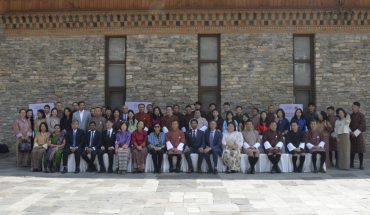
The report was prepared following extensive consultations at both national and regional levels. These involved the Technical Working Group (TWG), representatives from relevant government agencies, research institutions, universities, and other key stakeholders engaged in biodiversity management.
Comments and feedback received during these consultations were carefully incorporated into the final report to ensure it accurately reflects Bhutan’s achievements, challenges, and ongoing efforts in implementing the Nagoya Protocol and the ABS framework.
According to the report, Bhutan has made notable progress, achieving several key milestones in operationalizing the Nagoya Protocol.
These include the development of comprehensive national legislative and institutional frameworks for Access and Benefit-Sharing (ABS), strengthened coordination among relevant government agencies, and the facilitation of access agreements in line with national legislation and internationally recognized standards.
These measures collectively demonstrate Bhutan’s commitment to creating a robust framework for the sustainable use of genetic resources and ensuring benefits are shared fairly and equitably among all stakeholders.
The Nagoya Protocol, adopted under the Convention on Biological Diversity, focuses on access to genetic resources and the fair and equitable sharing of benefits arising from their utilization.
Bhutan’s report highlights both progress and areas requiring further development, including gaps in public awareness, technical and analytical capacity, challenges in monitoring and evaluation, and strategic approaches for improving national ABS implementation.
“The process of preparing national reports also contributes to strengthened national coordination, bringing together government institutions, research bodies, and other stakeholders to discuss progress and identify areas requiring further attention,” the report notes.
“This reinforces good governance and enables mobilization of support for developing and improving ABS systems.”
The report further details steps taken to integrate ABS considerations into Bhutan’s national legislation, biodiversity policies, and institutional mechanisms.
It outlines the approval procedures for access requests, mechanisms for facilitating benefit-sharing agreements, and guidelines for tracking the utilization of genetic resources.
These structures are designed to ensure that Bhutan’s genetic resources are managed sustainably, and that benefits—financial, technological, or knowledge-based—are shared transparently among local communities, researchers, and government institutions.
Awareness-raising initiatives have also been a key focus, aimed at educating officials, scientists, students, and local communities about the principles of ABS, the Nagoya Protocol, and their roles and responsibilities in conserving biodiversity.
Strengthened inter-agency coordination has helped streamline decision-making processes, reduce duplication of efforts, and promote collaboration across sectors.
Meanwhile, facilitated access agreements under national legislation have allowed research and commercial entities to engage with Bhutan’s genetic resources in a regulated and equitable manner.
The report serves as both a record of achievements and a roadmap for continued improvement, highlighting successes, identifying gaps, and outlining future priorities.
By documenting national progress, challenges, and strategic directions, Bhutan’s report provides a framework for policy development, capacity-building, and regional collaboration.
It also contributes to global knowledge on ABS implementation and offers a reference point for other countries seeking to enhance their national frameworks.
Through continued collaboration among government agencies, research institutions, and local communities, Bhutan aims to strengthen its ABS systems further, ensuring that the benefits arising from the use of its genetic resources support sustainable development, conservation objectives, and equitable sharing practices.