Bhutanese scholars launch critical editions of historic religious texts including the religious history of the South
TIL BDR GHALLEY | Thimphu
Bhutan’s centuries-old religious and intellectual traditions have gained renewed scholarly attention with the launch of two major academic publications documenting the country’s spiritual, political, and cultural foundations.
The works include a critical edition of The Religious History of the South by the 10th Je Khenpo Tenzin Chogyal and a three-volume compilation of biographies of Tsangpa Gyare, founder of the Drukpa Kagyu school.
The publications include a critical edition of The Religious History of the South by the 10th Je Khenpo, Tenzin Chogyal, which was edited by Dr. Sonam Jamtsho of the University of Hamburg.
It also includes a three-volume scholarly compilation on the biographies of Tsangpa Gyare, founder of the Drukpa Kagyu school, edited by Professor Seiji Kumagai, Geshe Thupten Gawa Matsushita, and Dr. Akinori Yasuda of Kyoto University.
The first publication, The Religious History of the South: The Continuation of the Precious Dharma – A Garland of Mañjunātha’s Aspirational Prayers, presents a critical edition of the work composed by the 10th Je Khenpo Tenzin Chogyal.
The second publication is a three-volume set examining the life and legacy of Tsangpa Gyare through a collection of historical biographies.
The volumes on Tsangpa Gyare include The Three Oldest Biographies of Tsangpa Gyare, (Volume 1), Three Later of the Seven Biographies of Tsangpa Gyare, (Volume 2), and The Longest Biography of Tsangpa Gyare, (Volume 3).
Speaking about the importance of publishing the critical edition, Dr. Sonam Jamtsho said that the lHo’i chos ’byung (religious history of the south) occupies a unique place in Bhutanese literature as the first work to present a unified narrative of the country’s religious, political, and cultural development.
“At a time when the pace of modernisation can quietly erode traditional foundations, making this important historical text available in scholarly form ensures that the dual system of religion and politics, the very framework upon which Bhutanese civilization was built, remains documented, accessible, and authoritative,” Dr. Sonam Jamtsho said.
He said the work is comprehensive in scope, covering profiles of key historical figures, accounts of religious and temporal institutions, legal codes, and cultural practices including painting, healing traditions, and scholarly life.
“In doing so, it preserves not only spiritual identity in the abstract, but the rich, layered texture of classical Bhutanese society a society whose values and structures continue to shape Bhutan as it exists today,” he said.
According to him, the editing process marks the first scholarly treatment of the lHo’i chos ’byung in nearly three centuries and provides deeper insights into Bhutan’s historical narrative.
“This editing process does not overturn the broad outlines of Bhutanese history so much as substantially deepen and refine them,” he said.
One of the key outcomes of the research was clarifying the intellectual sources used by 10th Je Khenpo Tenzin Chogyal in composing the text.
Scholars were able to identify references to earlier works, including Pema Karpo’s religious history and Tsang Khenchen’s biography of Zhabdrung Ngawang Namgyal.
“By identifying which sources Tenzin Chogyal drew upon, scholars can now trace with greater precision how historical memory was constructed, transmitted, and deliberately shaped in early eighteenth-century Bhutan,” Dr. Sonam Jamtsho said.
He explained that the author was not merely documenting events but weaving together multiple textual traditions to construct a coherent national narrative.
Another significant insight from the edition concerns the transmission of Mahamudra lineages within the Kagyu tradition.
“The text preserves two distinct lineage chains one culminating in Tenzin Chogyal himself and another in his contemporary Shākya Rinchen which can now be studied with confidence in their textual accuracy,” he said.
Dr. Sonam Jamtsho said that lineage transmission in the Kagyu tradition represents both doctrinal authority and continuity of teachings.
“A verified account of these transmissions deepens our understanding of how doctrinal authority was organised and legitimised in Bhutan’s early institutional history,” he said.
The critical edition also highlights the integration of the 1729 legal code into the historical text, an element that reveals the close relationship between religious historiography and political governance in early Bhutan.
“By establishing a reliable text of this legal section, the edition gives scholars a firmer basis for studying how monastic and civil authority were mutually reinforcing, rather than simply parallel, in the emerging Bhutanese state,” he said.
He added that the text also preserves valuable cultural records, including profiles of craft masters, astrologers, practitioners of traditional medicine, calligraphers, and painters.
“These details enrich existing historical frameworks by offering a more textured picture of classical Bhutanese civilisation than has previously been available in critically edited form,” he said.
He said the publication could also influence cultural policy and heritage preservation efforts.
“A critically edited, accessible edition of this kind can serve cultural policy because it offers a sound baseline for defining what Bhutan’s heritage actually comprises,” he said. “Monastic institutions, legal traditions, craft lineages, and religious successions are among the domains it illuminates.”
The publication also offers new opportunities for younger Bhutanese scholars and monastic students.
“With this edition now available in scholarly and modern book format, a new generation of researchers monastic and lay alike gains direct access to the earliest comprehensive historical account of Bhutan,” he said.
He added that the intellectual model described in the text, where scholar monks worked collaboratively as both teachers and students, could inspire future research traditions.
“That spirit of collaborative scholarship offers a living precedent for how younger scholars today might approach the work of keeping these traditions alive,” he added.
Bhutanese historian Dr, Karma Phuntsho said Bhutan’s literary culture faces challenges despite rising literacy levels.
“During olden days, only around 20 percent of Bhutanese could read and write, but today it has become the reverse,” he said. “However, we moved very quickly from oral transmission to audio-visual communication without enough time to develop a strong literary culture.”
He said this shift has affected the ability of younger Bhutanese to read classical texts.
“Unlike youth in many other countries who focus on their literature and culture, literature in Bhutan today is largely centred on English, while our traditional literature remains at the base,” he said. “After 20 to 30 years it may vanish if we do not strengthen it.”
“Not more than five percent of Bhutanese can read and understand the religious books related to Tsangpa Gyare,” he said.
Dr. Karma Phuntsho emphasized that academic research and analysis are crucial for preserving Bhutan’s traditions.
“Academic analysis and research are very important for thinking forward about our tradition, culture, and religion,” he said. “We should not view this only as religious history; it is about the culture, tradition, and religion of Bhutan.”
Professor Seiji Kumagai, one of the editors of the Tsangpa Gyare biographies, said the team hopes to make the texts more accessible to a wider audience.
“In future editions, we would like to publish an English translation so that Bhutanese citizens and people around the world can read and understand Tsangpa Gyare’s texts and biography,” he said.
He added that studying the life and teachings of Tsangpa Gyare can have a profound personal impact.
“Even though I may understand only a little about his life and teachings, reflecting on them can change the way i think and act,” he said. “It can make our lives happier than before.”
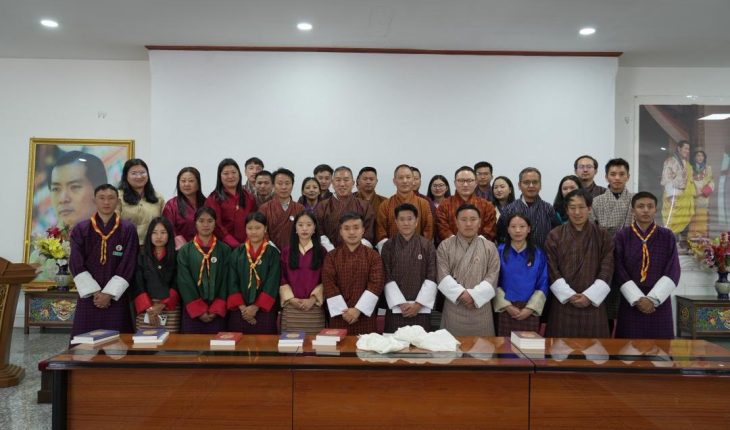
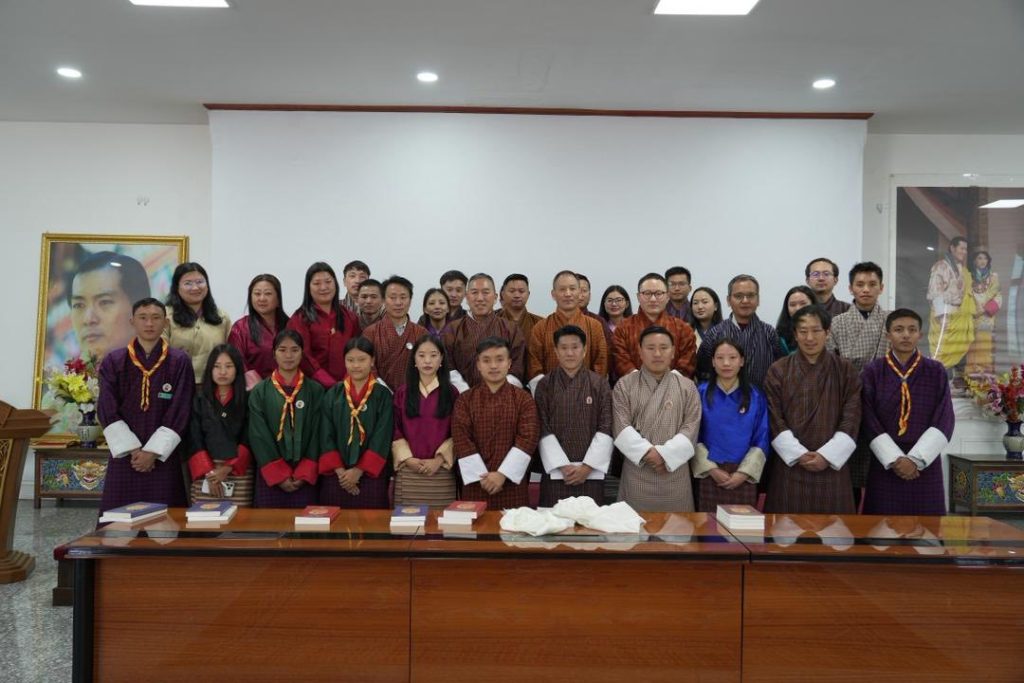
The launch of these scholarly works marks an important step in preserving and documenting Bhutan’s religious heritage, offering both researchers and the public new opportunities to engage with the historical foundations of the country’s spiritual and cultural identity.