
RENUKA RAI | Thimphu
Bhutan’s agricultural exports recorded a notable increase in 2025, generating Nu. 3.95 billion in revenue, according to a press release issued by the Department of Agricultural Marketing and Cooperatives (DAMC) under the Ministry of Agriculture and Livestock.
The latest figures show that the sector earned Nu. 440 million more than in 2024, reflecting a steady growth in agricultural trade despite fluctuations in the performance of several key commodities.
The rise in export earnings was largely driven by strong performance in a few major commodities, particularly cardamom, which continued to dominate Bhutan’s agricultural export market.
While some traditional exports such as potatoes, oranges, and cordyceps recorded a decline in revenue, the overall growth highlights the resilience of the country’s agricultural sector and the importance of high-value crops in boosting export income.
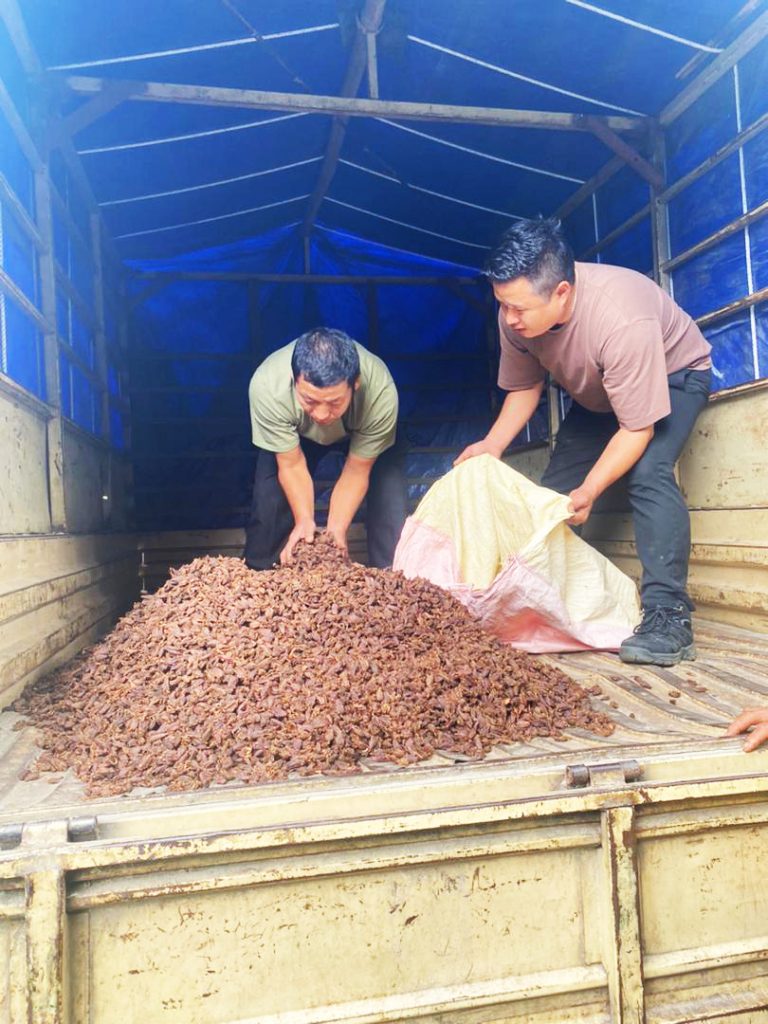
Cardamom emerged as the highest revenue-generating agricultural export in 2025. The commodity alone generated Nu. 2,044.40 million, marking a significant increase from Nu. 1,234.69 million recorded in 2024.
The surge represents a growth of more than 65 percent, making cardamom the single largest contributor to Bhutan’s agricultural export earnings during the year.
The continued dominance of cardamom in the export market reflects strong demand in regional markets and favourable price trends.
Farmers across cardamom-growing regions have increasingly relied on the crop as a major source of income, and the rise in export revenue demonstrates its growing significance to rural livelihoods and the national economy.
Apples also recorded an increase in export revenue in 2025. Earnings from apple exports rose to Nu. 35.36 million, compared with Nu. 30.71 million in the previous year.
Although the increase was modest compared to cardamom, the growth indicates steady demand for Bhutanese apples in international markets.
Other commodities also showed positive growth. Exports of carrots and turnips increased significantly, generating Nu. 72.71 million in 2025, up from Nu. 46.47 million in 2024.
Similarly, matsutake mushrooms recorded a rise in export revenue to Nu. 56.93 million, while ginger exports showed a small increase to Nu. 47.39 million.
Several other vegetables, including kohlrabi and kale, also contributed to export growth with moderate increases in revenue.
Despite these gains, several key agricultural exports experienced declines during the year. Potato exports, one of Bhutan’s traditional export commodities, saw a sharp drop in revenue.
Earnings from potato exports fell by more than 40 percent, declining to Nu. 320.25 million in 2025. In the previous year, the crop had generated over Nu. 539 million.
Similarly, export earnings from oranges declined by more than 11 percent, falling from Nu. 765.10 million in 2024 to Nu. 679.87 million in 2025.
Cordyceps, another high-value commodity known for its medicinal properties, also recorded a decrease in export revenue. Earnings from cordyceps dropped to Nu. 87.61 million in 2025, compared with Nu. 100 million in the previous year.
The mixed performance of these commodities highlights the challenges faced by the agricultural sector, including market fluctuations, changing demand patterns, and production variability caused by climatic and environmental factors.
In addition to primary agricultural commodities, agro-processed products also contributed significantly to Bhutan’s export earnings.
Among the processed products, stuffed pasta generated the highest revenue, earning Nu. 95 million in 2025, although this was slightly lower than the Nu. 109.31 million recorded in 2024.
Fruit, nut, or vegetable juices categorized as “other juices” recorded a notable increase in export revenue, rising to Nu. 69.80 million from Nu. 46.01 million in the previous year.
Processed areca nuts, commonly known as supari, also saw a dramatic rise in earnings, generating Nu. 58.90 million in 2025 compared to just Nu. 15.19 million in 2024.
However, not all processed products performed well. Orange juice exports dropped sharply, with revenue declining from Nu. 120.56 million to Nu. 52.30 million.
Similarly, litchi juice exports fell significantly, generating Nu. 42.90 million in 2025 compared to Nu. 118.70 million in the previous year.
At the same time, several emerging processed products experienced rapid growth. Other food preparations recorded a substantial increase in export earnings, while cranberry juice and apple juice also showed strong growth during the year.
These trends suggest that Bhutan’s agro-processing industry is gradually diversifying and exploring new market opportunities.
While exports showed overall growth, the country’s agricultural imports presented a different trend in 2025. The import of several major food commodities, particularly cereals and vegetables, declined significantly during the year.
Maize imports, which are mainly used for animal feed preparation by companies, dropped sharply. The value of maize imports fell by more than 41 percent compared to the previous year.
Similarly, the import of onions declined by over 30 percent, while chilli imports decreased by about 16 percent.
These reductions may indicate increased domestic production or changes in consumption patterns and supply chains.
However, some commodities recorded an increase in imports. Apple imports rose by about 23 percent during the year, suggesting that domestic production may not have been sufficient to meet market demand.
Rice remained the largest agricultural import commodity for Bhutan in terms of value and quantity. Other major imports included soybean oil, vegetable oil, wheat flour, betel leaves, dried lentils, onions, and tomatoes.
These commodities continue to play an important role in meeting domestic consumption needs.
The Department of Agricultural Marketing and Cooperatives noted that efforts are ongoing to strengthen Bhutan’s agricultural export sector.
The department has been implementing several initiatives aimed at enhancing market access for Bhutanese agricultural products and improving trade opportunities for farmers and agribusinesses.
Among the key strategies being pursued are the strengthening of market linkages between producers and buyers, the exploration of new export destinations, and the trial shipment of agricultural products to assess potential demand in international markets.
These initiatives are intended to expand the reach of Bhutanese agricultural products and increase export earnings in the coming years.
The department also emphasized the importance of value addition and agro-processing in increasing the competitiveness of Bhutan’s agricultural products.
By encouraging the development of processed products and improving supply chains, authorities hope to create new economic opportunities for farmers and entrepreneurs across the country.
Agriculture remains one of Bhutan’s most important economic sectors, providing livelihoods for a large portion of the population.
The growth in agricultural exports in 2025 demonstrates the sector’s potential to contribute significantly to the national economy, even as it faces challenges related to production, market access, and climate variability.
With continued policy support, improved infrastructure, and stronger market connections, Bhutan’s agricultural sector is expected to further expand its role in international trade while supporting the livelihoods of rural communities.