KINLEY KHANDU CHODEN | Thimphu
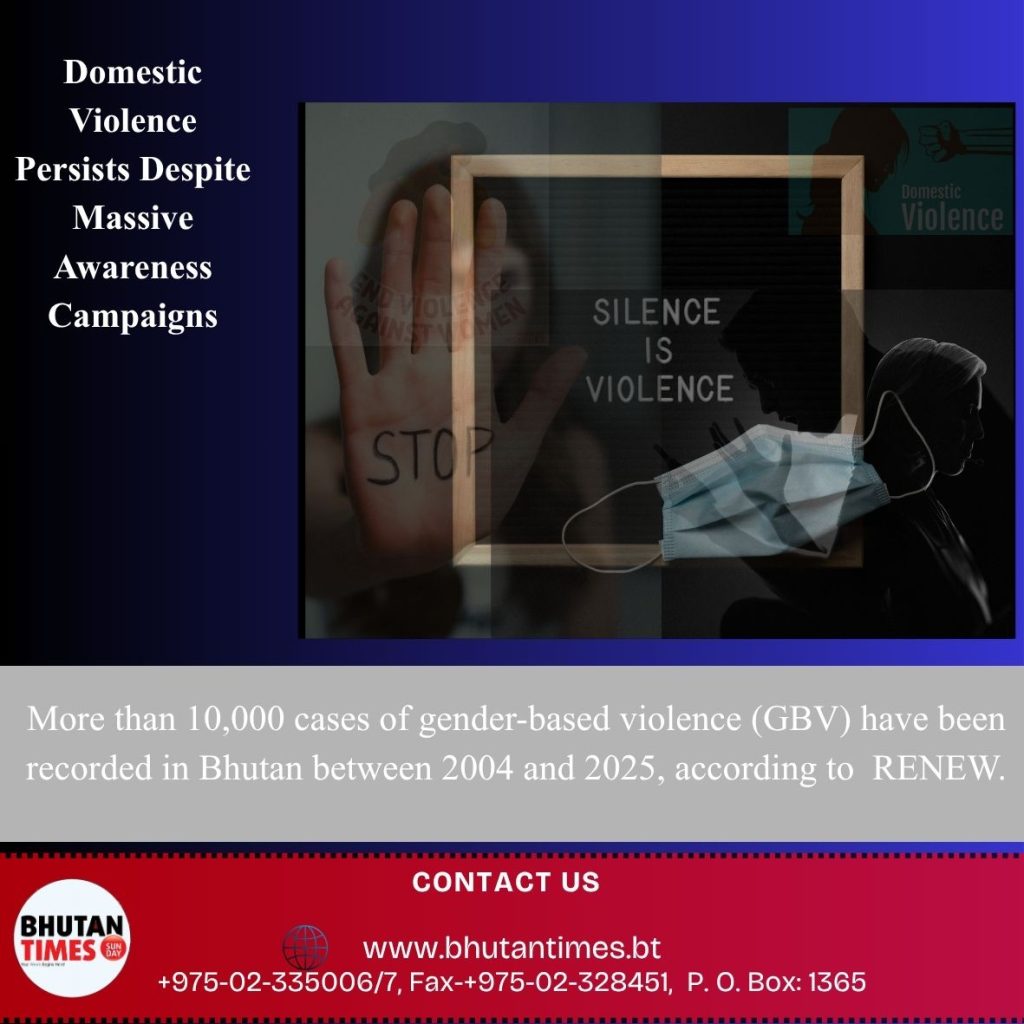
More than 10,000 cases of gender-based violence (GBV) have been recorded in Bhutan between 2004 and 2025, according to Respect Educate Nurture and Empower Women RENEW, underscoring the scale and persistence of domestic abuse despite growing awareness and stronger legal frameworks.
The cases span domestic violence such as physical, emotional, and sexual alongside child protection issues, teenage pregnancy, sexual and reproductive health concerns, and mental health-related cases.
While the figures highlight the magnitude of the problem, they also reflect a gradual shift: more survivors are coming forward to seek help.
Yet, despite years of advocacy and education, domestic violence remains deeply rooted.
Officials from RENEW said the persistence of GBV is driven by entrenched cultural norms, gender inequality, and stigma surrounding abuse.
“Despite growing awareness through advocacy and education programs, GBV remains a persistent issue due to deep-rooted cultural norms, gender inequality, and stigma surrounding reporting abuse,” the official stated.
For many survivors, silence still feels safer. Fear of social judgment, family breakdown, and economic insecurity continues to prevent reporting, allowing abuse to persist behind closed doors.
Compounding the problem are factors such as the normalization of harmful behaviour within relationships, limited engagement of men and boys in prevention efforts, and external pressures like alcohol abuse and financial stress.
RENEW has observed a steady increase in reported cases over the years. While this may indicate a rise in incidents, it also points to growing awareness and confidence among survivors. “Domestic violence, particularly emotional and psychological abuse, remains the most common, often accompanied by physical violence,” the organization noted.
Emerging patterns are also raising concern. Cases involving young couples, marital disputes, and sexual violence are increasing.
The data shows that domestic violence cuts across age groups, socio-economic backgrounds, and geographic locations, highlighting its widespread nature.
The Domestic Violence Prevention Act, along with services such as shelters, counselling, and legal aid, has strengthened national efforts to support survivors. However, implementation gaps remain a major challenge.
RENEW identifies limited resources in remote areas, delays in legal processes, and weak coordination among service providers as key barriers. These challenges are particularly acute in rural communities, where access to services and transportation remains limited. As a result, many cases go unreported or unresolved.
Despite these constraints, interventions are making a difference.
Through counselling, legal assistance, temporary shelter, and livelihood support, many survivors have been able to rebuild their lives. Awareness initiatives, including school programs and community outreach, have also helped reduce stigma and encourage reporting.
Efforts to strengthen response systems have expanded to include training for police, health workers, teachers, counsellors, and local leaders. These initiatives are improving coordination and ensuring more effective support for survivors.
RENEW warns that cases may continue to rise, driven by economic pressures, urban migration, unemployment, and shifting family dynamics. However, the increase may also reflect improved reporting rather than a surge in violence itself.
Beyond institutional data, public perspectives reveal how domestic violence is experienced on the ground.
Rinchen Pelden, 29, from Zhemgang, said the issue remains serious but often overlooked. “Many people consider it a private family matter, so it doesn’t always get the attention it deserves,” she said.
She added that fear and dependency keep many victims silent. “Some are financially dependent, some fear judgment, and others simply don’t know where to seek help.”
Rinchen Tshomo, 21 from Mongar, echoed the same concern. “Cultural expectations and fear of judgment can stop people from reporting,” she said, stressing the need for stronger awareness and support systems.
Social attitudes continue to shape responses to abuse.
Tandin Gyem, 21, from Thimphu, said victims often face more judgment than support. “Instead of recognizing the courage it takes to leave, society sometimes questions the victim’s decisions,” she said. Victims are frequently told to “adjust,” discouraging them from seeking help.
Still, there are signs of progress. Dawa Tshering, 22, from Paro, said awareness has improved in recent years. “More women are coming forward and standing up against domestic violence,” he said, attributing the shift to education, empowerment, and stronger legal protections.
He noted that past attitudes—where women were confined to domestic roles and denied opportunities—continue to influence present realities, even as change slowly takes hold.
Respondents agree that families and communities have a critical role to play.
“Families should support victims, listen without judgment, and help them seek professional assistance,” said Rinchen Pelden.
Dawa Tshering emphasized early intervention. “Even small conflicts can escalate if ignored,” he said, urging families to step in before situations worsen.
As Bhutan continues its efforts to combat domestic violence, the rising number of reported cases presents both a warning and a sign of progress. It reflects not only the persistence of abuse, but also a growing willingness to break the silence.