DAWA ZANGMO| Thimphu
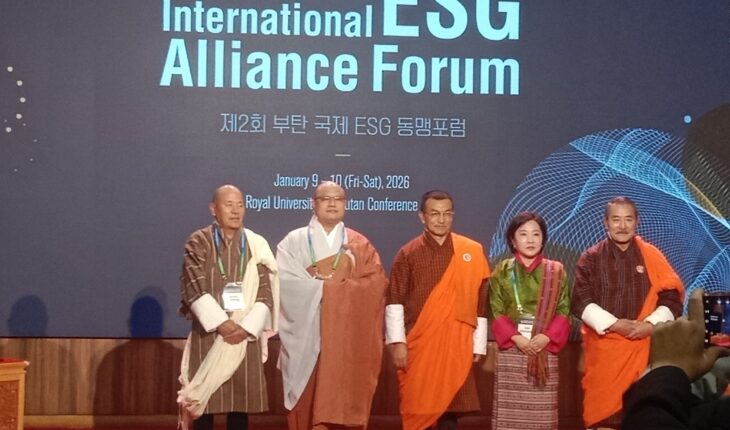
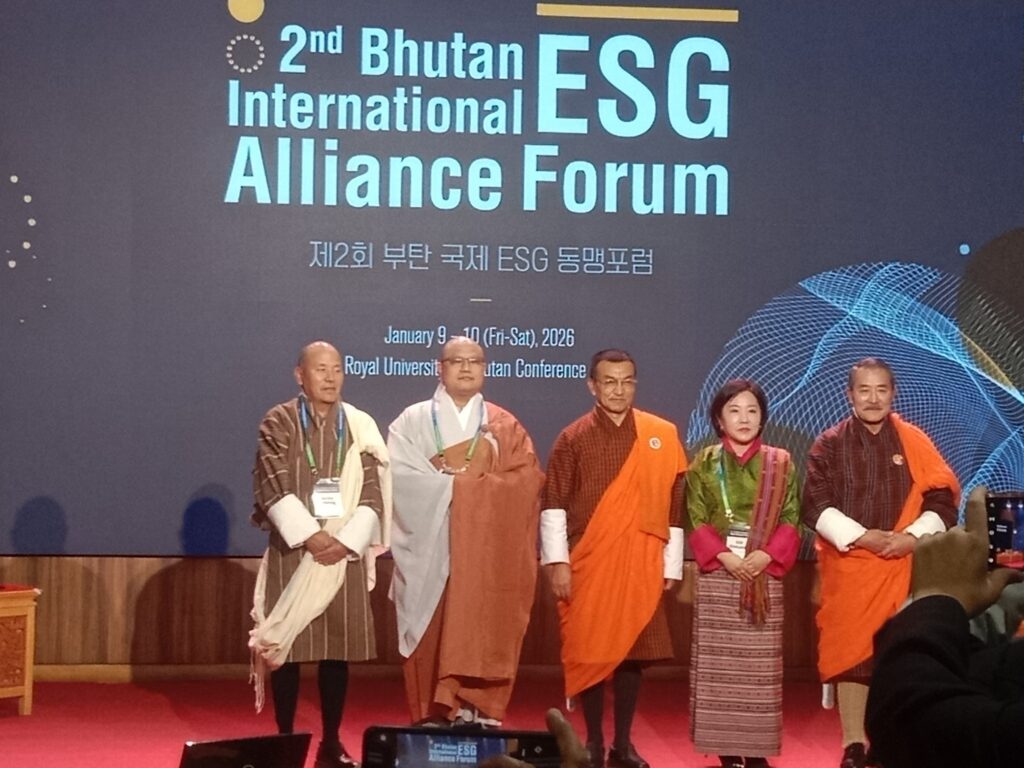
The second Bhutan International Environmental, Social and Governance ( ESG ) Alliance Forum was held from January 9 to 10, at the Convention Hall of the Royal University of Bhutan, marking the second consecutive year the Korea–Bhutan Friendship Association (KBFA) has convened the international gathering.
The forum was graced by Lyonpo Lekey Dorji, Minister of Finance, and Dasho Kesang Wangdi, Deputy Chairman of the Privy Council of Bhutan, along with senior officials and delegates from the Republic of Korea.
The two-day event brought participants from Bhutan and abroad, including policymakers, academics, tourism industry stakeholders, representatives of local governments, regional tourism associations, ESG specialists, and professionals from the meetings, incentive, conference and exhibitions (MICE) sector.
The forum aimed to strengthen cooperation and promote practical dialogue on ESG principles, with particular emphasis on sustainable tourism, responsible investment, and inclusive development.
Building on the success of its inaugural edition, the forum is serving as a platform for academic exchange, industry collaboration and international partnership among Bhutan, the Republic of Korea and other global stakeholders.
Discussions are being framed in line with international sustainability standards while reflecting Bhutan’s development philosophy of Gross National Happiness (GNH), which places importance on environmental conservation, cultural preservation, good governance and people centre growth.
The opening session underscored the role of ESG principles in promoting sustainable investment, responsible business practices and long-term development aligned with both Bhutan’s national vision and global sustainability goals.
A highlight of the opening day was a donation ceremony in support of SELWA, an organisation working with persons with disabilities. The ceremony reflected the forum’s emphasis on social inclusion and demonstrated how ESG principles can be linked with tangible community support.
The keynote address focused on climate change and Bhutan’s approaches to disaster preparedness and response.
This was followed by an academic session on carbon neutrality, featuring presentations by Bhutanese and Korean experts from government institutions and public enterprises.
The session examined Bhutan’s policies and practices that have positioned the country as a global example in environmental stewardship and low-carbon development.
Discussions during the day also centred on sustainable tourism, responsible investment and strategies to maintain carbon neutrality, highlighting the importance of aligning economic activities with environmental protection and social wellbeing.
Participants emphasized the need for closer collaboration between governments, the private sector and international partners to translate ESG commitments into practical and measurable outcomes.
During the session, the host noted that the core values of ESG closely correspond with Bhutan’s national development philosophy.
“The principles of Environment, Social and Governance are deeply aligned with Gross National Happiness, which places human wellbeing, community harmony and environmental balance at the centre of development,” she said.
Recalling her long association with Bhutan, she described the forum as being grounded in mutual trust and shared values between Bhutan and the Republic of Korea.
Finance Minister Lekey Dorji, in his address, said that the concept of ESG has long been embedded in Bhutan’s development path.
“Bhutan’s development philosophy, inspired by the vision of His Majesty the Fourth King, recognises happiness and holistic wellbeing as the true measures of progress, rather than economic growth alone,” Lyonpo said.
He highlighted Gelephu Mindfulness City as a forward-looking initiative that integrates sustainability, innovation and ethical governance.
The minister also pointed to Bhutan’s longstanding policies on forest conservation, universal access to healthcare and education, and community-centred development as strong foundations for advancing ESG objectives.
The first day concluded with reflections on the importance of cross-border cooperation in transforming ESG principles into effective policies and actions.
Participants noted that partnerships between Bhutan, the Republic of Korea and other international stakeholders are essential for sharing knowledge, mobilising resources and strengthening institutional capacity in areas such as climate action, sustainable tourism and inclusive growth.
On the second day, discussions focused on corporate and tourism industry responses to carbon neutrality.
Key topics included Buddhist ecological philosophy, ESG-based business strategies, sustainable tourism models and national policies supporting low-carbon development.
The programme also included closing sessions, a site visit and cultural performances highlighting the friendship and cooperation between Bhutan and the Republic of Korea.
Through its wide-ranging sessions, the forum sought to reinforce Bhutan’s position as a leader in values-based development while fostering stronger international collaboration on sustainability.
By linking global ESG frameworks with Bhutan’s GNH philosophy, the event is expected to provide a platform for dialogue on how environmental protection, social equity and good governance can be advanced together in practical and coordinated ways.