
KINLEY KHANDU CHODEN | Thimphu
Farewell dinners, emotional goodbyes at Paro airport, and packed suitcases have become familiar scenes across Bhutan. For many young people, Australia represents more than overseas study — it represents possibility.
But beneath the rising migration trend lies a deeper question: are Bhutanese youth leaving purely for ambition, or because opportunities at home feel increasingly narrow?
For Tenzin, 23, now in Perth, the answer is direct. “Less opportunities for graduates in Bhutan made me to move to Australia,” he said.
He describes a system where even entry-level roles demand prior experience.
“Whenever there is work available, it asks for experience. There is no entry-level job, and there are many internships with zero pay, resulting in nepotism where people with connections get the job,” Tenzin said.
He questioned as to how do we get experience when there is no chance, and how can youth survive on an intern with zero pay?
He also reflected on a broader concern among graduates who feel trapped between academic qualifications and limited job openings.
“The things Bhutanese only have are memorizing skills, not actual practical skills. But these memorizing skills get you jobs through Royal Civil Service Commission (RCSC),” he said, referring to the RCSC’s exam-based recruitment system.
Yet, he intends to return. “My family is there,” he said. Still, his advice to others is cautious: “Migrate if you want independence in life, but there is no guarantee you will succeed. It’s a choice of whether you want to struggle for something big or struggle for something small.”
His words capture a defining tension of this generation: migration is neither an easy escape nor a guaranteed success story.
Kinley, 25, also in Perth, frames her decision differently.
“I was motivated mainly for better education and career opportunities,” she said. “Australia provides internationally recognized qualifications, practical learning experiences, and wider employment prospects.”
Unlike some fresh graduates, Kinley had prior work experience in Bhutan. However, she felt growth prospects were limited.
“Bhutan does provide some opportunities, especially in government sectors, but the number of available jobs is limited compared to the growing number of graduates each year,” she said.
She points to skill gaps as part of the issue. “Practical skills, industry exposure, communication skills, and technical competencies need strengthening. There is often a gap between academic knowledge and workplace expectations.”
For families, migration brings both support and sacrifice. “Financially, it helps,” Kinley said. “But emotionally, being away from family is challenging.”
Sangay Nidup, 22, is still in Bhutan but planning to migrate. His decision, he says, was gradual. “After finishing my degree, I realized my field has very limited scope here. I want exposure to better research facilities and international standards.”
He previously worked as an intern. “The salary covered basic expenses, but I couldn’t save or plan long-term. That instability made me question whether staying would help me grow professionally.”
Sangay Nidup describes a highly competitive environment. “Even entry-level positions receive hundreds of applications. Sometimes experience is required even for starter roles. It’s frustrating.”
Yet he remains conflicted. “Deep inside, I would want to return because Bhutan is home. But it depends on opportunities and financial stability.”
Similarly, Passang Tshering, 24, planning to migrate, sees education abroad as a pathway to stability.
“Bhutan is developing, but career opportunities are limited, especially in specialized fields,” he said. High competition, experience requirements, and low starting salaries have shaped his decision.
“For some youth, migration feels like a necessity due to financial pressure. For others, it is a choice. In my case, it is both.”
For Kinley Pem, 21, also in Perth, migration was tied to education in nursing. “I wanted to pursue higher education in nursing from a well-recognized university,” she said, adding that currency differences also played a role in long-term financial considerations.
As a fresh diploma graduate from a nursing school in Bhutan, she saw limited immediate growth pathways.
She believes communication skills are among the key gaps for graduates. “It depends individually, but communication is most lacking,” she said.
Choening, 23, in Canberra, describes migration as both ambition and necessity.
“For some, it’s a choice for exposure and lifestyle. For others, it becomes survival due to limited opportunities or financial pressure,” she said. She too hopes to return one day to contribute her skills.
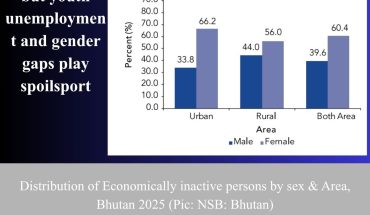
Collectively, these voices reveal structural challenges within Bhutan’s economy. The country produces an increasing number of graduates annually, yet job creation — particularly in the private sector — has not expanded at the same pace. Public sector employment remains highly competitive, while industrial diversification is still developing.
Employers frequently cite skill mismatches, particularly in technical and digital competencies. Graduates, meanwhile, argue that opportunities for hands-on experience are scarce. The result is a cycle: employers demand experience; graduates struggle to gain it.
At the same time, migration provides tangible benefits: remittances support families, exposure builds confidence and skills, financial independence feels more achievable in larger economies.
However, long-term implications remain uncertain. Rural communities report fewer young hands during farming seasons. Urban businesses experience staff turnover as workers leaves for overseas study. Families live with both pride and emotional strain.
For many youth, migration is a calculated risk. It is not simply about chasing higher wages — it is about predictability, structured pathways, and the possibility of growth.
Whether Bhutan can transform migration from permanent loss to temporary circulation depends on policy direction. Expanding private-sector growth, strengthening vocational pathways, and modernizing skill training could reshape the narrative.
Until then, young Bhutanese will continue weighing their options. As Tashi Tenzin pointed out, the choice may ultimately come down to perspective: “It’s a choice of whether you want to struggle for something big or struggle for something small.”
And for a generation standing at the departure gate, that choice feels more urgent than ever.