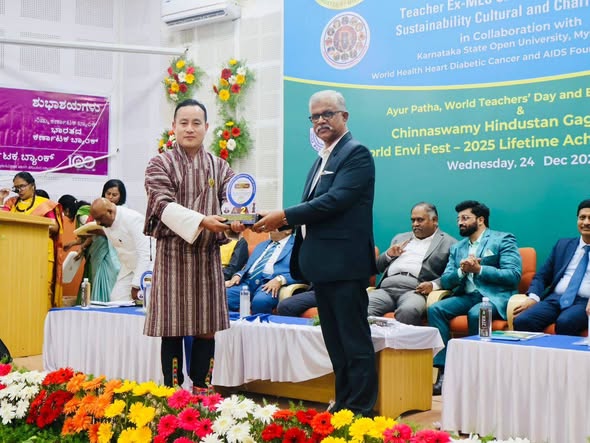
DAWA ZANGMO | Thimphu
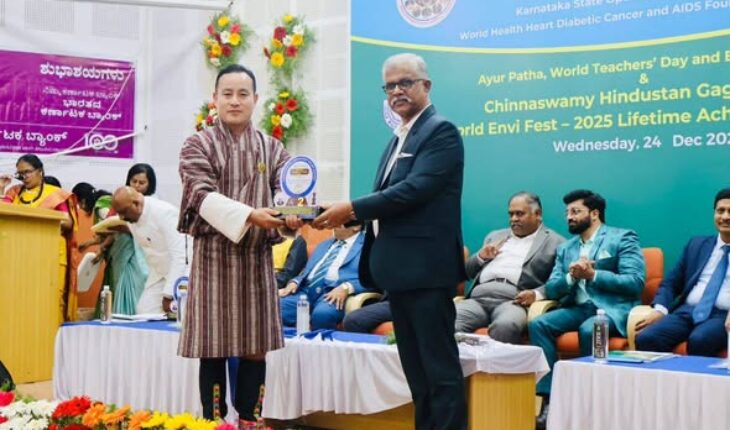
Tshering Wangchuk (PhD), President of the Horticulture Association of Bhutan (HAB), has been conferred the Hindustan Gagan Gaurav World Envi Fest–2025 International Award in recognition of his contributions to sustainable horticulture and environmental conservation.
The award was presented at a ceremony held at the Karnataka State Open University in Mysore, India on 25 December.
The international honour recognizes distinguished individuals who have made significant contributions to society, culture, and national development across diverse fields, including politics, journalism, literature, cinema, and environmental conservation.
Tshering Wangchuk’s recognition underscores Bhutan’s growing presence in global discussions on environmentally responsible agriculture and sustainable development.
During his tenure as president of the HAB, the organization has strengthened Bhutan’s engagement with international horticulture platforms.
Under his leadership, Bhutan’s participation in global horticulture expos was significantly expanded, providing farmers with opportunities to showcase Bhutanese produce on international stages.
The association also enhanced farmer networks, promoted sustainable agricultural practices, and built strong national and global partnerships, contributing to the elevation of Bhutan’s horticulture sector worldwide.
Responding to the recognition, Tshering Wangchuk said the award reflected collective effort rather than individual achievement.
He stated that the honour belonged to farmers, local communities, and those who work closely with the land every day, adding that it symbolized recognition of Bhutan’s belief that development should progress in harmony with nature.
He described the award as both a moment of gratitude and responsibility, noting that it demonstrated growing international appreciation for Bhutan’s natural, respectful, and sustainable farming practices.
Tshering Wangchuk emphasized that the recognition was the result of consistent and sustained effort over time. He highlighted key initiatives undertaken during his tenure, including strengthening the HAB as a representative voice for farmers, promoting eco-friendly farming methods, and encouraging sustainable packaging and value addition.
He also pointed to efforts to facilitate Bhutan’s participation in international horticulture exhibitions, where the work of Bhutanese farmers received global recognition.
In addition, he highlighted advocacy for climate-friendly and organic farming practices aimed at protecting both natural resources and rural livelihoods.
According to Tshering Wangchuk, these initiatives were guided by a central objective of ensuring that farmers are respected, supported, and connected to better economic opportunities.
He further explained that participation in international expos has brought tangible benefits to farmers. Such platforms, he said, help build confidence and visibility while allowing global markets to recognize the quality and purity of Bhutanese produce.
These opportunities have enabled farmers to explore new markets, adopt improved farming and packaging techniques, reduce post-harvest losses, and enhance incomes.
He added that the sense of pride generated through international exposure has also encouraged youth participation in farming, strengthening rural economies and supporting Bhutan’s green development goals.
Tshering Wangchuk also highlighted the broader role of sustainable horticulture in Bhutan’s development journey, stating that it allows farmers to earn livelihoods while protecting land, water resources, and biodiversity.
He noted that climate-smart farming practices help communities adapt to changing weather patterns, improving household resilience and long-term security. In this context, he described horticulture not only as an agricultural activity but as a way of safeguarding the country’s future.
Looking ahead, Tshering Wangchuk outlined key priorities, including strengthening climate-resilient farming systems, improving value addition, packaging, and market access, and encouraging greater participation of youth and women in the horticulture sector.
Addressing young people, he described horticulture as a profession with dignity and purpose, enabling individuals to work in harmony with nature, support their communities, and build sustainable futures.