TIL BDR GHALLEY | Samtse
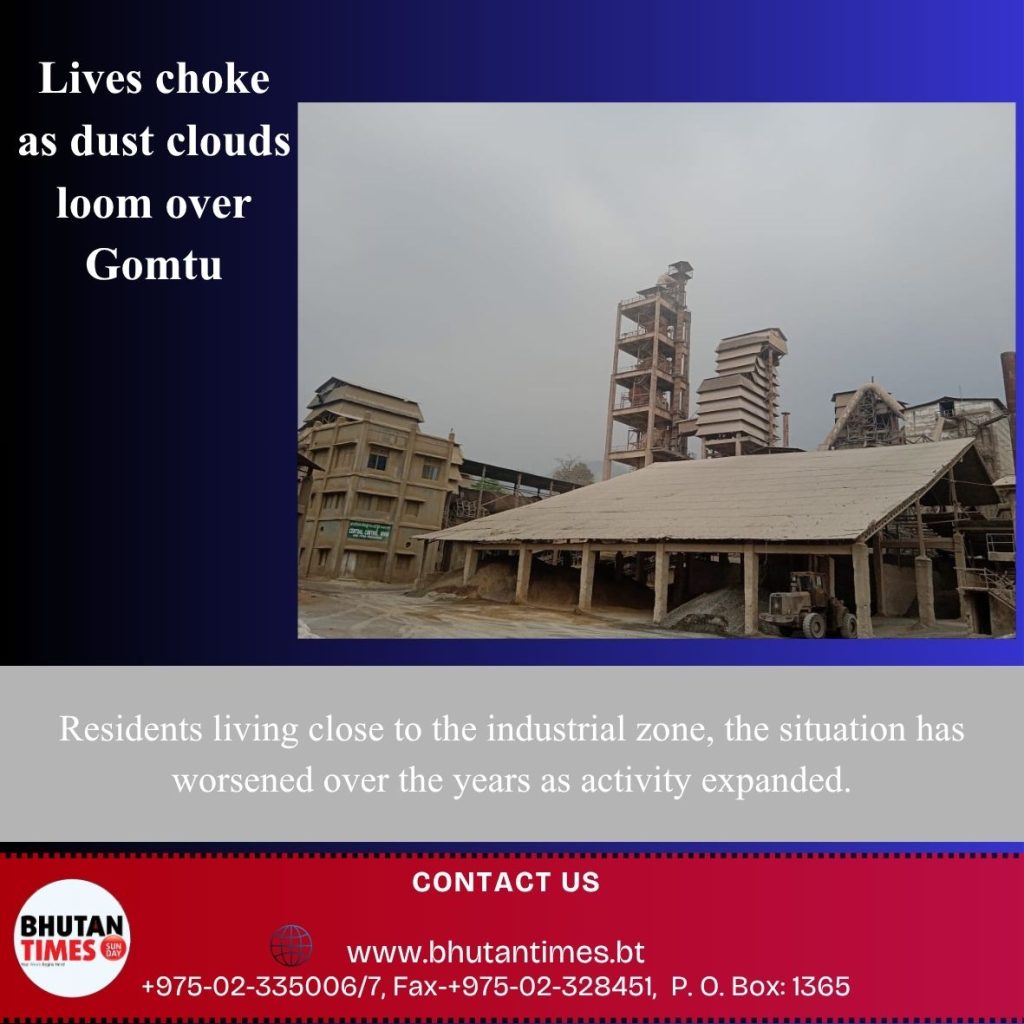
In Gomtu, Samtse, dust has become an unavoidable part of daily life. From early morning until late evening, trucks transporting raw materials rumble through the industrial town, stirring clouds of fine dust that settle on houses, crops, and roads.
Emissions from cement factories and other industrial plants, combined with dusty roads and constant vehicular movement, have raised growing concerns about air quality and public health.
“We see many patients coming with respiratory symptoms,” said Dr. Priyanka Mukhia, a general medical officer at Gomtu Hospital. “Currently the hospital receives around 50 to 90 patients daily, and about 20 percent of them present respiratory illnesses that may be directly or indirectly related to air pollution.”
She added that while other factors such as smoking and indoor smoke from mud stove contribute to respiratory illnesses, environmental dust significantly aggravates these conditions.
“People who are exposed to dust every day are particularly vulnerable,” she said.
According to her, children, elderly residents, and patients suffering from illnesses such as asthma, diabetes or tuberculosis are especially at risk. Many patients under the age of 19 frequently visit the hospital with symptoms linked to prolonged exposure to dust.
Prolonged exposure to dust can lead to respiratory infections, she added
For the residents of Gomtu, rainfall during the summer months provides only temporary relief. “When it rains, the air becomes clearer and the dust settles,” said Karuna Subba, 52, a shopkeeper near the industrial area. “But when the weather stays dry and the factories run continuously, the entire town becomes dusty again.”
During prolonged dry spells, residents say a visible haze of dust often blankets parts of the town.
Residents living close to the industrial zone, the situation has worsened over the years as activity expanded. “We cannot even keep our windows open,” said a 38-year-old mother in one of the factory colonies. “If we do, the house fills with dust within minutes.”
Farmers say the impact extends beyond homes and into agricultural fields. “Vegetables that should appear green are often coated in a layer of white dust,” said Punam Kr. 27, a farmer. “Before selling them in the market we have to wash them repeatedly.”
Dust deposition has also affected crop quality and productivity. “The leaves of vegetables are covered with fine powder, which affects their growth,” she said. “When buyers see vegetables covered with dust, they think they are not fresh.”
Children and elderly family members frequently suffer coughing and throat irritation. “Our children come home from school with dust on their clothes and faces,” said a 34-year-old mother of two. “Sometimes they complain it’s hard to breathe when trucks pass by.”
Industry officials acknowledge that cement production naturally generates dust but say measures have been introduced to reduce emissions.
“Cement production naturally generates dust,” said Bal Krishna Subba, Manager of Lhaki Cement. “However, we have installed systems designed to minimize emissions.”
Previously, the factory used electrostatic precipitators (ESP) high-efficiency pollution control devices used to remove dust particles from exhaust gases generated during kiln, raw mill, and cooler operations. The system also collected dust that could be reused in the manufacturing process.
The company has since upgraded its technology. “We have replaced ESP systems with baghouse filters,” said Lekhar Nath Sharma, Quality Control Head at Lhaki Cement. “Baghouses are more efficient in capturing particulate matter, with around 99.9 percent efficiency compared to about 98 to 99 percent efficiency for ESP systems.”
“We have dust collection systems installed at various points within the plant,” Lekhar Nath Sharma said. “Only very fine particles escape.”
Water spraying systems are also used within factory premises to control fugitive dust emissions.
“There are multiple industrial plants operating in Gomtu, and heavy vehicular movement also contributes significantly to dust in the air,” he said.
The company has also introduced several measures to improve energy efficiency and reduce emissions.
Motors in parts of the plant have been replaced with Variable Frequency Drive (VFD) systems to improve energy efficiency.
The factory also operates a waste heat recovery system, which captures heat from production processes and redirects it to the raw mill to dry raw materials.
“This helps reduce energy consumption and improves efficiency,” Lekhar Nath Sharma said.
The plant has also begun reducing its reliance on ordinary Portland cement (OPC), which produces higher carbon emissions.
“In the past, OPC produced around 1,100 to 1,200 carbon dioxide (CO2) per kilogram of cement,” he said. “Now we are producing more blended cement such as Portland Pozzolana Cement (PPC) and Portland Slag Cement (PSC), which are more environmentally friendly.”
The company has also explored switching from coal to Refuse-Derived Fuel (RDF), a high-calorific fuel produced from municipal and industrial waste.
“We have conducted feasibility studies on RDF,” he said. “However, due to financial constraints we have not been able to implement it yet. If government support is provided, we are ready to adopt it.”
Penden Cement Authority Limited (PCAL), another major operator, plans to modernize older equipment and has prepared an initial draft proposal to replace coal with RDF as part of efforts to adopt cleaner and more sustainable energy sources.
“We are prioritizing dust control at the source,” said a PCAL official. “If emissions are effectively managed at the origin, up to 60 percent of dust pollution can be reduced.” Nozzle systems along conveyor belts and modified suction systems at packing plants are expected to mitigate 20–30 percent of emissions. In addition, modified suction systems are planned for the packing plant to capture fine dust particles released during the packaging process.
The official said the company ensures that all raw materials are covered during transport to minimize dust pollution and control fugitive emissions. These measures, the official added, are part of broader efforts to manage emissions and maintain air quality within acceptable limits.
Air quality in such settings is primarily assessed through the measurement of particulate matter (PM), which serves as a key indicator of pollution levels.
The factories monitor two key categories of particulate matter: PM10 refers to particulate matter with a diameter of 10 micrometers or less, such as dust and smoke, while PM2.5 consists of much finer particles measuring 2.5 micrometers or less. The smaller the particle size, the greater the potential risk to human health.
Air quality standards are expressed in micrograms per cubic meter (µg/m³), indicating the concentration of pollutants in the air. These standards are measured over two timeframes: a 24 hours average, reflecting short-term exposure, and an annual average, indicating long-term exposure and associated health impacts. However, cement factories primarily rely on 24 hours monitoring data.
Permissible limits also vary by area type. Industrial zones, where pollution levels are typically higher, are allowed relatively higher limits. Mixed areas, such as urban or semi-urban regions, have moderate thresholds, while sensitive areas including schools, hospitals, and environmentally fragile zones are subject to stricter standards to safeguard public health.
24-hour monitoring data from the cement factories show particulate levels remain well within limits: below 9 µg/m³ in sensitive areas, under 13 µg/m³ in mixed areas, and less than 40 µg/m³ in industrial areas, all well below the prescribed benchmark.
These benchmarks assess air quality, and exceeding them signals health and environmental risks.
Despite these mitigation efforts, local leaders say residents continue to suffer from the impacts of industrial activity. Robat Lepcha, Gup of Phuentsholing Gewog, said some companies have failed to follow through on commitments made during public consultations.
“PCAL and Lhaki Cement operate water tankers to sprinkle water on roads, but several other industries agreed to do the same during consultation meetings,” he said. “Unfortunately, many of those commitments remain only on paper.”
The gewog administration has issued several warning letters to companies that failed to comply. “We have sent several warning letters, but there has been little positive response,” the gup said. “Not only cement factories, but powder plants, mining activities, and dredging operations also contribute significantly to the dust problem,” he added.
Authorities had earlier divided different areas among companies for water sprinkling and dust suppression. “But many companies do it only occasionally,” he said. “They sprinkle water for a few days and then stop again.”
According to the gup, stronger action from national regulators may be necessary. “If authorities such as the Department of Geology and Mines and the National Environment Commission impose fines for non-compliance, companies will take the issue more seriously,” he said.
As Gomtu grows as an industrial hub, residents say balancing development with environmental protection remains a challenge. While industries bring jobs, residents say it should not come at the cost of public health.
For many families, the concern has shifted from visible dust to long term health risks, with fears that prolonged exposure could lead to rising illnesses.
“Clean air should not be a luxury,” said Tobgay, 53.
“This story was produced as part of the media reporting grant funded through the Australian Government ‘s Regional Media Support through JAB”