Unchecked sand mining worries communities living along Punatsangchhu
DAWA ZANGMO | Wangduephodrang
A quiet sense of loss now hangs over communities living along the Punatsangchhu, where the river that once sustained livelihoods and nurtured fertile lands is gradually becoming a source of worry and uncertainty.
What was once a lifeline for farmers and villagers in Punakha and Wangdue Phodrang is now showing visible signs of strain, as increasing sand extraction activities begin to reshape both the river and the lives of those who depend on it.
The Punatsangchhu, one of Bhutan’s most significant rivers, is facing growing pressure from intensified sand mining operations across the two dzongkhags.
While river sand continues to play a crucial role in infrastructure development supporting road construction, bridges, and hydropower projects residents living along its banks say the cost is becoming increasingly difficult to bear.
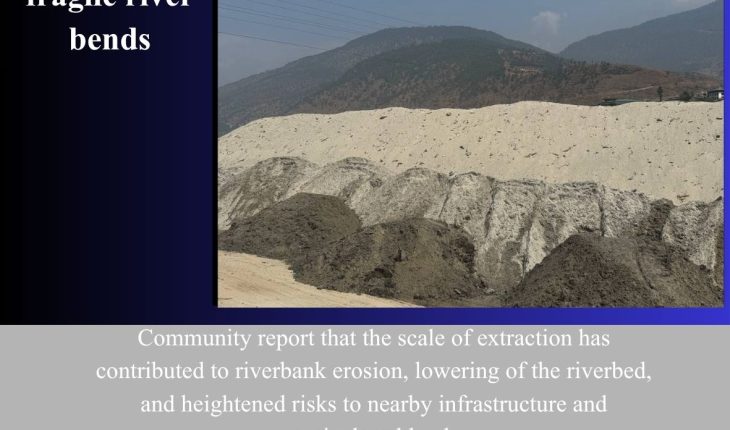
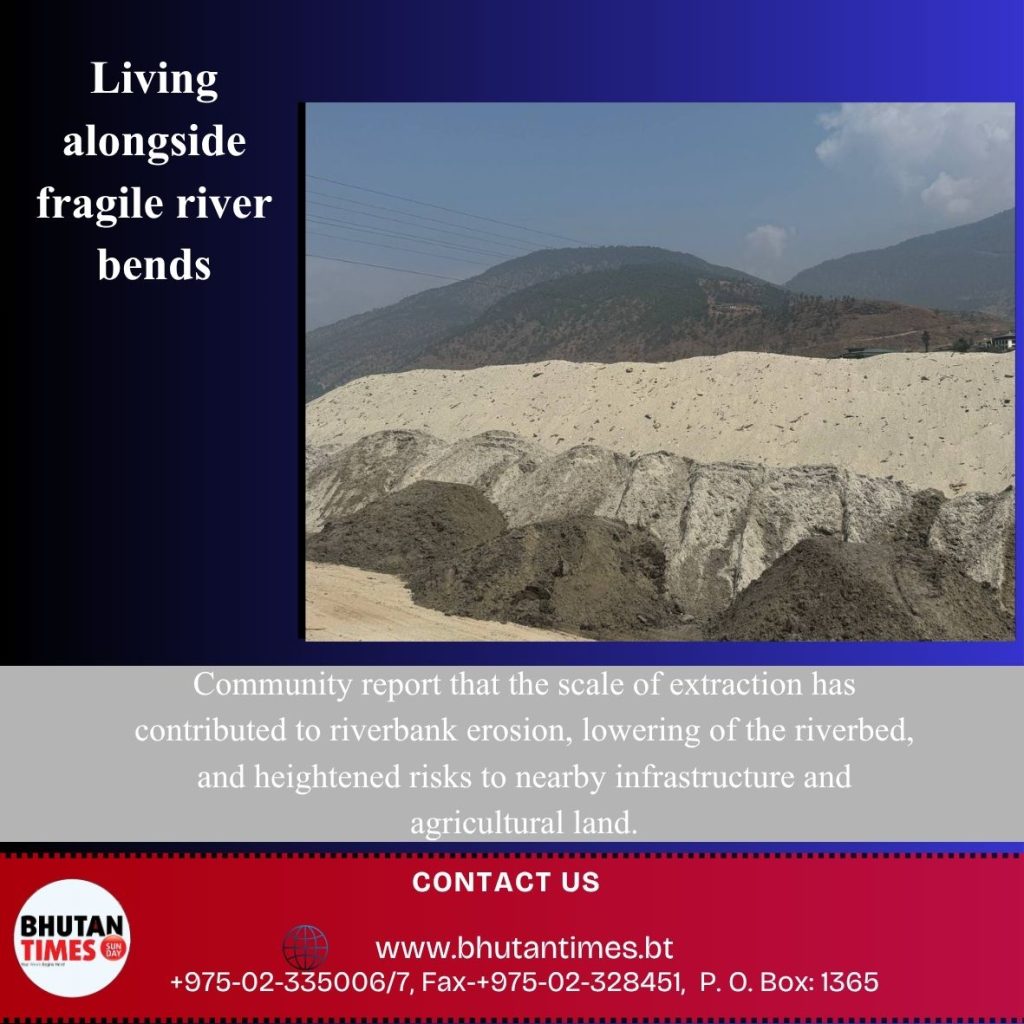
Community report that the scale of extraction has contributed to riverbank erosion, lowering of the riverbed, and heightened risks to nearby infrastructure and agricultural land.
Many fear that the weakening of riverbanks could worsen flooding during the monsoon season, putting both homes and livelihoods at risk.
In Thedtsho Gewog under Wangdue Phodrang and Barp Gewog in Punakha, residents say sand stocking yards and dredging operations have brought daily challenges. Villagers claim that continuous dredging has led to the gradual erosion of land located above the river, reducing the stability of nearby areas.
Adding to their concerns, strong winds frequently carry sand particles from the stocking yards into nearby agricultural fields, affecting crops and soil quality. These sand yards are located close to the river in Tshokorna Chiwog of Barp Gewog and in Thanggoo and Wangjokha Chiwogs of Thedtsho Gewog.
Thedtsho Gup Chador said that while communities have raised these concerns during Gewog Yargay Tshogchhung (GYT) meetings, the issues rarely gain broader attention.
“The communities living along the river in our gewog have reported damage to farmland and early signs that nearby bridges could weaken. These concerns have been raised in the GYT meetings, but they rarely reach the broader public,” he said.
He added that the growing demand for sand, driven by increasing construction and hydropower development across the country, has made the issue more pressing.
Local leaders from affected chiwogs echoed similar concerns. Yeshi, Tshogpa of Wangjokha Chiwog, said heavy trucks transporting sand have caused repeated damage to community roads.
“Sand-loaded trucks frequently pass through our community roads. Even when repairs are carried out, the roads begin to deteriorate again within two to three months. Maintenance is not immediate, and we hope the authorities from the Natural Resources Development Corporation Limited (NRDCL) will address these challenges,” he said.
Chime Tshering, Tshogpa of Thanggoo Chiwog, highlighted worries about the sand extraction project that recently began near their village.
“Since the sand mining project has started near our village, we would like NRDCL to assess the situation and install protective fencing before further damage occurs,” he said.
He also pointed to environmental impacts caused by constant truck movement.
“With ongoing mining activities, trucks travel throughout the day, creating dust and air pollution. This affects air quality in our community, and even cattle grazing in the area are exposed to dust, which can impact their health,” he said.
In Tshokorna Chiwog of Barp Gewog, residents say they have observed noticeable changes in the river’s flow. Dago, the Tshogpa, said intensified sand mining has altered the river’s direction, affecting farmland and irrigation channels.
“We have noticed that the river’s direction has changed since sand mining increased. It has affected farmland, irrigation channels, and the livelihoods of people in our chiwog,” he said, adding that the concerns have been raised with the dzongkhag administration.
During the monsoon season, he noted, the river increasingly shifts toward farmland located near extraction sites, washing away areas close to weakened riverbanks.
“During the monsoon, the river flows closer to farmland and washes away land near areas where sand mining has taken place,” he said.
While acknowledging that sand mining contributes to the economy, Dago said the environmental and social impacts are becoming harder to ignore. “Strong winds carry sand particles into nearby homes, especially during the windy season. Because of the dust, residents often cannot keep their windows open,” he said.
Residents also raised concerns about compensation, noting that while some households received support for damaged farmland, others affected in similar ways did not.
A 51-year-old resident, Tshering, said the changes have affected everyday life, particularly vegetable cultivation. “Before sand mining, we used to grow plenty of vegetables and had fresh produce from our gardens. Now, sand dust covers our fields, making it difficult to grow anything,” she said.
Another resident, Kinley Om, said her land began eroding after dredging started near the river.
“After the dredging works began, parts of my land started to erode. Since then, I have left that land fallow for several years,” she said.
Transportation of sand has created additional challenges. Villagers report that more than 150 truckloads of sand are transported daily from the area, compared to about 50 truckloads during the pandemic period. The continuous movement of heavy vehicles has worsened road conditions, making travel difficult for residents.
Dago Zam, a resident of Tshokorna, said the deteriorating road conditions have also affected local livelihoods. “We were told the road would be blacktopped, but that did not happen. Instead, it was maintained with concrete, which did not last long. Now it is difficult for smaller vehicles to use the road,” she said.
She added that poor road conditions have had wider impacts, including forcing a landlord in Lhamoi Lungpa to lose all her tenants.
Residents also expressed concern over the height of sand piles in stocking yards. Nardo, another resident, said the piles have exceeded agreed limits. “They had agreed to keep the sand only up to the height of the CGI sheets, but now the piles are much higher. The wind carries sand into nearby fields, creating problems for the community,” he said.
He added that compensation was provided only for damaged farmland and not for impacts on homes.
In response, officials from NRDCL said they are taking steps to minimize environmental damage and erosion. B.B. Ghalley, Senior Production In-Charge at NRDCL in Wangdue, said the company works in coordination with the Department of Environment & Climate Change and follows established regulations.
“To prevent riverbank erosion and environmental damage, we consult relevant authorities and follow mitigation measures. We also do not allow diversion of the river alongside extraction sites,” he said.
He added that a 200-metre wind barricade was constructed to reduce the spread of sand, though it has not fully achieved the desired results. “As part of a pilot project, we are constructing an embankment using river gravel. If successful, similar structures will be built in other affected areas,” he said.
According to NRDCL, approximately Nu 4.56 million has been paid as compensation to 26 households for damage to crops and paddy fields near the sand storage areas.
Currently, three sand extraction sites are operating along the Punatsangchhu in Punakha and Wangdue Phodrang. The Sha region remains one of the primary sources of river sand for construction projects in western and central Bhutan.
Yet, for the communities living along its banks, the river is no longer just a resource it is a reminder of a changing landscape, where development and daily life are increasingly at odds.
“This story was produced as part of the media reporting grant funded through the Australian Government ‘s Regional Media Support through JAB”