RENUKA RAI | Thimphu
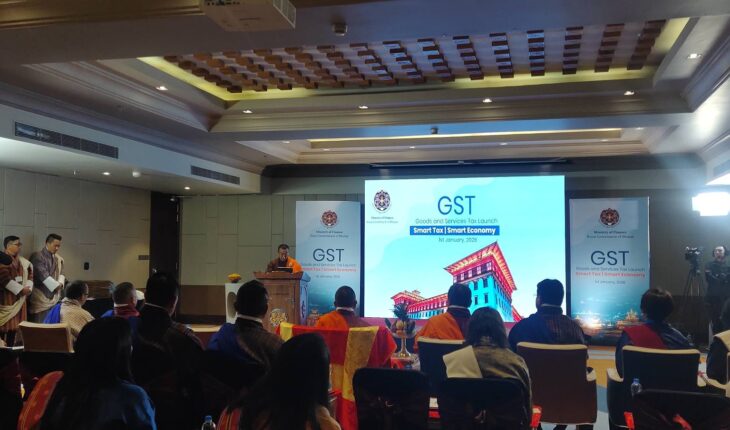
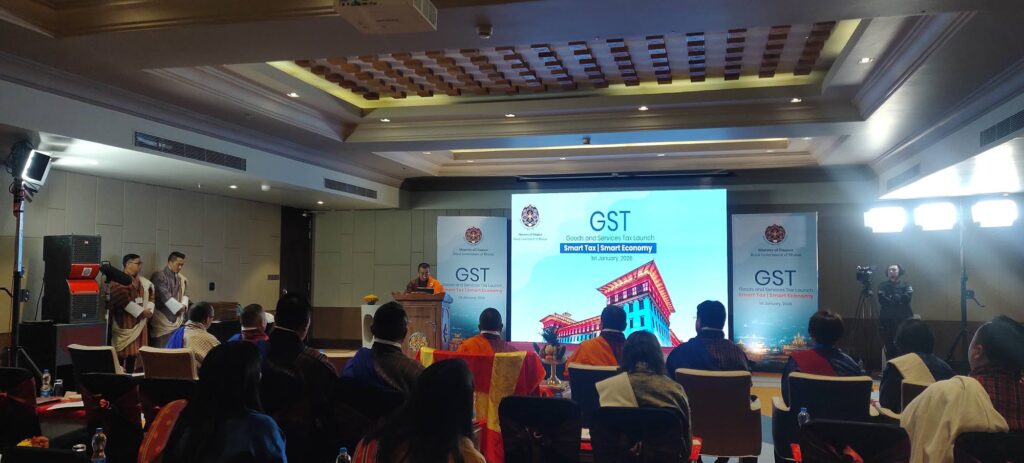
The Ministry of Finance officially launched the Goods and Services Tax (GST) on 1 Jan 2026, at a uniform rate of 5 percent, marking one of the most significant reforms in the country’s tax system in recent years. The new regime replaces the earlier sales tax framework and introduces a single, nationwide tax on goods and services.
Finance Secretary Lekey Wangmo during the launch said the reform is aimed at simplifying taxation, improving compliance, strengthening domestic revenue collection through online systems, and promoting greater fairness, transparency, and accountability. However, as the tax comes into force, confusion among the public and businesses remains evident, particularly around who should charge GST, who pays it, and what items are exempt.
The government has clarified that GST is a consumption-based tax, meaning it is paid by consumers when they purchase goods and services. Businesses do not bear the tax themselves but act as collection agents on behalf of the government. Only businesses registered with the Department of Revenue and Customs (DRC) are authorised to charge the 5 percent GST. Registration is mandatory for businesses with annual sales exceeding Nu 5 million, calculated based on goods bought and sold over the year. Once registered, a business is issued a GST Taxpayer Number, which must be reflected on invoices and displayed at business premises.
Despite these clear rules, confusion has emerged across markets and commercial centres. Many consumers say they are unsure whether the GST charged at shops is legitimate, especially when sellers fail to issue proper GST invoices or do not display their registration certificates. In some cases, customers reported being charged GST at small shops and stalls that appear unlikely to meet the Nu 5 million turnover threshold. This has raised concerns that GST may be misused as an additional charge rather than a government tax, leading to frustration and mistrust among consumers.
Authorities have reiterated that unregistered businesses are strictly prohibited from charging GST. The DRC has warned that it will actively monitor compliance and take swift action against any business or individual found charging GST without registration or charging it on exempt supplies. Consumers have been encouraged to play a role in ensuring compliance by requesting GST tax invoices at the point of sale. A valid invoice should include the seller’s GST number, business name, address, and the amount of GST charged.
Another area of widespread confusion relates to exemptions. While GST applies broadly to goods and services, essential items and key social services have been deliberately kept outside the tax net to protect consumers. Essential goods such as rice, salt, cooking oil, sanitary napkins, wheelchairs, and items used by persons with disabilities are exempt. Core services, including education and healthcare, are also not subject to GST, along with selected financial services. Authorities have clarified that cosmetic and non-essential items are taxable, and charging GST on exempt items is a violation of the law.
However, inconsistent application of exemptions has added to public concern. Consumers say the same item may be charged GST in one shop but not in another, creating confusion and suspicion. Some sellers have admitted they are uncertain about how to classify certain products, especially during the early days of implementation. Officials maintain that such issues are expected during the transition period and will reduce as awareness improves and enforcement becomes more consistent.
The Nu 5 million GST registration threshold has also drawn public attention. According to the government, the threshold has been set to ensure administrative efficiency during the initial phase of implementation. GST requires businesses to maintain proper accounts, issue invoices, and file monthly returns, and not all small businesses currently have the capacity to comply with these requirements. By setting the threshold, the DRC aims to focus initially on businesses that are better equipped to meet compliance standards, while gradually expanding the tax base as systems and capacities improve. Over time, as the invoice system becomes more efficient and compliance improves, the threshold is expected to be reviewed and eventually removed.
For registered businesses, GST brings both responsibilities and risks. Businesses are required to charge GST only on taxable supplies, issue proper invoices, maintain accurate records, file monthly returns on time, and remit the net GST collected to the DRC. Failure to comply with these requirements can lead to serious consequences. The DRC has cautioned that filing inaccurate returns, delaying submissions, claiming incorrect input tax credits, or charging GST inappropriately may result in classification as a high-risk taxpayer. This can lead to delays in refunds, exposure to audits, financial penalties, and in severe cases, prosecution.
Small and medium-sized businesses have expressed concern about these risks, particularly during the transition period. Many business owners say they are still adjusting to new accounting systems and fear that unintentional errors could attract penalties. Some have raised concerns about increased operational costs, including the need to hire accountants or purchase software to comply with GST requirements. Others worry about cash flow issues if refunds are delayed due to errors or audits.
In response, the DRC has acknowledged that GST represents a major shift from the previous sales tax regime and has announced a transition period to help businesses adapt. Authorities have stressed that the immediate focus is on awareness, education, and system stabilisation, rather than punitive enforcement, provided businesses make genuine efforts to comply. Taxpayers facing difficulties have been encouraged to contact the department for guidance and support.
Despite the challenges, the government maintains that GST offers significant long-term benefits. With a single tax rate of 5 percent applied uniformly to both goods and services, the system is designed to be simpler and easier to understand than the previous tax structure. The input tax credit mechanism ensures fairness by allowing businesses to adjust taxes already paid on inputs against taxes collected on sales, thereby avoiding double taxation. If excess tax is paid, businesses are eligible for refunds.
GST is also expected to enhance competitiveness, particularly for exporters. Goods and services supplied outside Bhutan are taxed at a zero percent rate, ensuring exports are not burdened by domestic taxes. Manufacturers and exporters can claim refunds on GST paid on inputs used for export production, improving cash flow and supporting growth.
Compliance has been further streamlined through online systems and self-assessment, giving taxpayers greater control while improving transparency and accountability. Authorities believe that as more businesses formalise their operations, GST will contribute to a stronger, more reliable domestic revenue base.
As Bhutan navigates the early stages of GST implementation, officials emphasise that public understanding and cooperation will be critical to the success of the reform. Consumers are urged to remain vigilant and informed, while businesses are expected to take responsibility for compliance. Although confusion and concern are evident in the initial phase, the government remains confident that with time, awareness, and consistent enforcement, GST will help build a more efficient, transparent, and equitable tax system for the country.