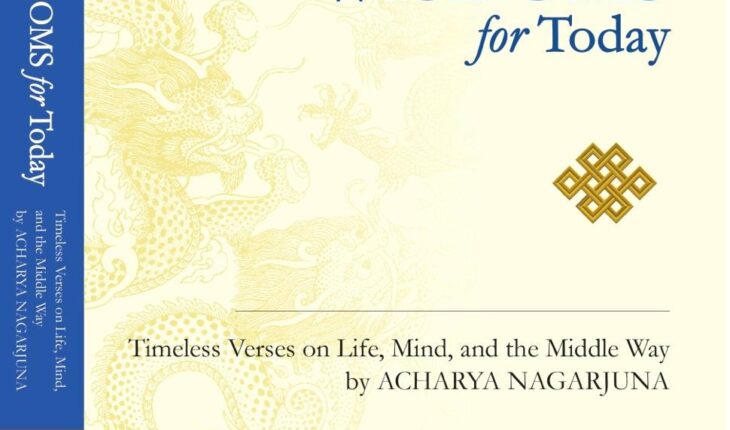

January 1, 2026. It has to be the most auspicious New Year for me and my family in all our time on this planet. The Buddha, the Guru, and the Acharya rode into our humble hermitage decked out in a gilded palanquin that will forever be treasured as 360 Wisdoms for Today.
There was an air of urgency when my friend and fellow-educator, Dr Dorji Thinley, President of Paro College of Education, called me to advise that he would drop by sometime in the evening. Little did I know then that he would be the chosen treasure-bearer to usher in the greatest souls of the Buddhist world!
My honoured guest opened the treasure-chest with his inimitable grace and endearing smile and placed a copy of his fresh magnum opus in my nervous hands whereby I lifted the sacred masterpiece up to my forehead and paid my tributes to my dear scholar-friend for gifting to Bhutan and the world a priceless rosary of precious gems the like of which the intellectual community hasn’t seen hitherto.
Over the past three years or so, Dr Dorji Thinley had quietly applied himself to achieving what ordinary academics would dread even attempting – breathe a new life into the timeless masterpieces of the peerless Arya Nagarjuna of the Nalanda fame and beyond through the potent medium of his flawless English by engaging its incredible linguistic richness and multi-layered literary elegance of which he is a master craftsman.
Many seekers and visitors have stood ‘at the sacred site of the illustrious Nalanda University’, but it took a sublime sensibility like Dr Dorji Thinley, to recognise the moment of truth and follow the call of ‘one of the ancient world’s greatest centres of learning’.
There was no looking back then. The life and deeds of Nalanda’s profoundest mind, Acharya Nagarjuna (150-250 CE) became the undimmed focus of Dr Dorji Thinley’s attention while he explored every available source of information on Nagarjuna who had become synonymous with the finest that the great university was known for.
Among Nagarjuna’s timeless accomplishments, his treatises on Bodhisattava, doctrine of emptiness, Mulmadhyamaka or the Middle Way, the true nature of reality, nirvana, cause and effect, dependent origination, conventional truth and ultimate truth, incarnation, Four Noble Truths, the Buddha Nature, eternalism and nihilism stand out as the great seer’s legacies.
360 Wisdoms for Today is based on the Timeless Verses on Life, Mind, and the Middle Way by Acharya Nagarjuna and comes in two parts. Part I consists of Hundred Verse of Wisdom, and Part II has 260 verses under the title The Staff of Wisdom. The overarching theme of both is the cultivation of noble conduct.
It is a matter of rare credit to the exceptional ability of the translator to mine the sublime wisdom of the multifaceted philosopher, poet, scholar and spiritualist that Nagarjuna was. But this is precisely what Dr Dorji Thinley does by diving to the depths of the Nagajuna mind and revealing the priceless treasures hidden away in the ocean of each verse. And, to explore and explain the meaning of as many as 360 verses while remaining faithful to the integrity and sovereignty of the Acharya’s original thought with the ease and facility that Dr Dorji brings to bear on each is no small feat.
A discerning reader will find the introduction itself an extensive study in historical research and exposition that provides a deeply insightful summary of the great Nalanda academic tradition and the luminaries who kept the light of learning glowing bright through the centuries. A foretaste of the governing themes and the varied stylistic devices used in the verses as indeed the universality of the message are an incentive to move the reader to the rich verses inside.
The translator has executed not only a superb equivalence of meaning between the original Choekey text and the target language, but he has provided a neat phonetic transcription of the verses followed by a comprehensive explanation supported by research-evidence, where necessary, to support the reader get a fuller appreciation of the message as well as the medium.
Saying more with less is the strength of poetry. Just four modest lines, for instance, but they contain a world of meaning.
The three metaphors in the verse—the wise and learned, crystalline glass, and the heroic warrior—vividly illustrate different facets of excellence and renown. The wise and learned represent individuals whose wisdom and knowledge naturally flourish within a community that values such qualities. Crystalline glass adorned with precious gems symbolizes clarity and beauty enhanced by valuable qualities, which suggests that wisdom, like gems, makes the individual or group it touches more radiant and distinguished. The heroic warrior on the battlefield embodies courage, valour, and the visible impact of action in a challenging environment. True heroism shines most brightly when tested in adversity. Together, these metaphors convey that wisdom, beauty, and valour are distinct yet complementary forces, each becoming more evident and powerful in the right context.
མཁས་པ་རྣམས་ཀྱི་གྲགས་པ་ནི༎ མཁས་པ་ཉིད་ཀྱི་ནང་དུ་འཕེལ༎
རིན་ཆེན་ཤེལ་ལ་རིན་ཆེན་དང༌༎ གཡུལ་ངོ་དག་ཏུ་དཔའ་བོ་བཞིན༎
mkhas pa rnams kyi grags pa ni// mkhas pa nyid kyi nang du ‘phel//
rin chen shel la rin chen dang// gyul ngo dag tu dpa’ bo bzhin//
The fame and renown of the wise and learned
Flourishes among the wise and learned themselves,
Like precious gems that illuminate a crystal glass,
Or heroic warriors shine with valour on the battle field.
Each of the 360 verses is celebrated in the book with due regard to the meaning, pronunciation of Choekey words and explanation of meaning with exceptional clarity and academic integrity. Intellectual rigour and scholarly discipline being the hallmark of a good translator, Dr Dorji Thinley has invoked and adhered to the highest standards of translation criteria as laid down by none other than the greatest translator of the Nalanda-era, Lochen Berotsana (700s CE).
A translator must possess “a sharp and analytical mind – intelligent, wise, judicious, lucid; a firm, stable, and equanimous mind – trust-worthy; an excellent, wholesome, and positively disposed mind or temperament; a skilled, adept, dextrous, and artistic mind; an eloquent and discerning mind, wishing to express; an attentive, retentive, and cognizant mind; an and associative, and integrative mind, capable of seeing the connectedness or relatedness of phenomena.”
The uncompromising standard-setter that Dr Dorji Thinley is, he has exemplified the Berotsana commands throughout the work that he has undertaken and given an extraordinary account of his powerful intellectual assets as well as his proven enviable personal standards.
Translation is not only an exacting professional undertaking, but a deeply grounded act of faith. The translator takes the same road the original writer has gone, dreams the same dream, and carries the same vision. The ultimate aspiration of the translator is, therefore, to attain to the same level of illumination as the mind that produced the work in the first place.
Dr Dorji Thinley has not only matched the high demands of the great Acharya’s matchless works but revealed the timeless treasure of Nagarjuna to the world through the power of the English language. Every time a work is translated, the writer is born again and lives on in the care of succeeding generations of readers in a new language.
Precious legacies of the wisdom-works of enlightened souls are bequeathed to the world through the passionate dedication, tireless efforts and deep love for humanity that exceptional translators like Dr Dorji Thinley exemplify.
The compelling relevance of this unprecedented translation work is self-evident given today’s urgent need for the restoration ethical conduct, mindfulness, and integrity at all levels – individual, institutional, societal, national, global. The enlightened Acharya would be pleased to know that a Bhutanese educator has honoured his timeless legacy and shared the treasure with the world.
Through Dr Dorji Thinley’s 269-page, elegant and reader-friendly hard-bound 360 Wisdoms for Today, Acharya Nagarjuna is incarnated again. The wisdom is for us and the world to use.
* * *
Some tribute-reflections… Thakur S Powdyel, former Minister of Education.