
RENUKA RAI | Thimphu
In a significant move aimed at modernising Bhutan’s financial regulatory landscape and strengthening private sector participation, the National Assembly this week began deliberations on the Financial Services (Amendment) Bill2025 an amendment that seeks to address long-standing structural imbalances in the country’s insurance industry.
The debate follows extensive review by the National Council, which earlier flagged concerns that the current law, particularly the Financial Services Act of Bhutan (FSAB) 2011, creates unequal market conditions and restricts fair competition among insurers.
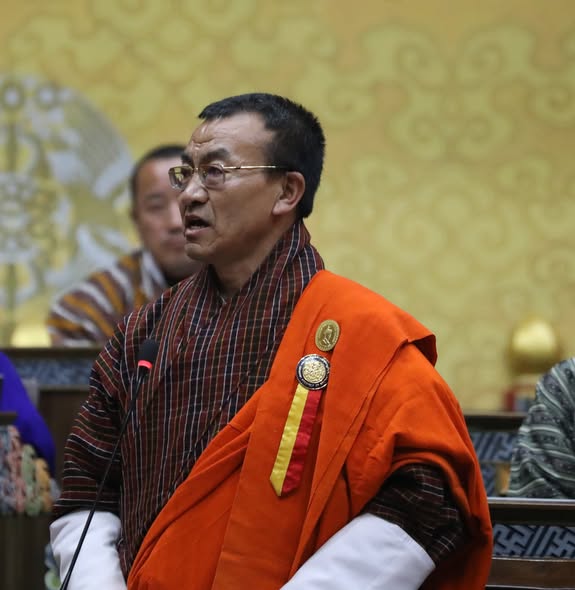
Finance Minister Lyonpo Lekey Dorji introduced the Financial Services (Amendment) Bill of Bhutan 2025 in the National Assembly on 28 November, which seeks to amend and strengthen the Financial Services Act of Bhutan, 2011, with the primary objective of enhancing regulation of the country’s insurance sector and safeguarding the interests of policyholders.
At the heart of the proposed amendment is a provision that prohibits new insurance companies from operating as “composite insurers” offering both life and general insurance while allowing legacy insurers that existed before 2011 to continue doing so.
Lawmakers argued that this regulatory asymmetry contradicts the constitutional objective of supporting private sector development and undermines a competitive insurance ecosystem.
Article 9, Section 10 of the Constitution mandates the State to “encourage and foster private sector development through fair market competition.”
However, the FSAB’s Section 25(b) and 25(c) place new entrants at a structural disadvantage by restricting them to either life or general insurance, while legacy firms enjoy the wider market of both segments.
The Assembly’s discussion highlighted that this imbalance does not merely affect business opportunities but also has economic implications.
Members pointed out how limited competition can stunt product diversification, suppress innovation, and slow the growth of the insurance market an industry seen as critical for financial inclusion and long-term economic resilience.
Legislators also acknowledged the National Council’s earlier observation that such regulatory barriers could discourage domestic and foreign investment at a time when Bhutan is actively seeking to attract capital and expand financial services.
Section 25(b) of the FSAB explicitly states that “an insurer shall be restricted to writing either general or life insurance business,” with narrow exceptions for reinsurance in the opposite line.
Meanwhile, Section 25(c) grants composite rights only to companies already conducting both businesses prior to the Act’s implementation. These legacy composite insurers are required to maintain separate books of accounts to ensure that risks in one line do not spill over into the other.
While this safeguard protects policyholders, Members of Parliament (MPs) noted that it simultaneously creates exclusive advantages for older firms—a scenario increasingly viewed as incompatible with a level playing field in a growing but small insurance market like Bhutan.
The Assembly also examined global regulatory trends. Many members acknowledged that separating life and general insurance lines is considered international best practice due to distinct risk profiles.
Life insurance deals with long-term liabilities and actuarial calculations, while general insurance overs short-term risks with volatile claims patterns. Countries such as Thailand, Malaysia, and Hong Kong have implemented strict separation frameworks, with some introducing rules to phase out composite insurers altogether.
However, the debate also underscored that many small or developing markets still permit composite insurance under strict prudential supervision. The International Association of Insurance Supervisors (IAIS) supports composite operations where regulators can enforce robust risk management, ring-fencing of assets, and strong governance systems.
The Assembly reaffirmed that Bhutan’s situation differs from larger economies. With a limited insurance market, maintaining separate legal entities for life and non-life lines can be cost-inefficient, reduce economies of scale, and deter new entrants.
Members argued that allowing composite insurers—subject to modern supervisory standards—would be more appropriate and proportionate for Bhutan’s economic context.
Another major issue raised during deliberations was the discrepancy between the FSAB and the Foreign Direct Investment (FDI) Rules and Regulations 2025.
The new FDI rules already allow investors to operate on a composite basis, recognising that restricting them to either life or general insurance may not attract sufficient foreign participation.
With primary legislation and investment rules pointing in different directions, lawmakers acknowledged the need to harmonise the regulatory framework.
The proposed amendment seeks to eliminate this inconsistency, giving both domestic and foreign insurers the same ground rules and enabling coherent licensing and supervision.
Supporters of the amendment emphasised that the Bill would ensure equal treatment between legacy and new insurers, thereby fostering fair competition.
This, in turn, is expected to stimulate the creation of new products tailored to Bhutanese consumers particularly in areas like health, agriculture, and micro-insurance, where gaps persist.
The Assembly also discussed how the current framework may unintentionally stifle private sector development. With most new companies forced to choose either life or general insurance, the market remains concentrated, limiting consumer choice and slowing innovation.
Members underlined that a more vibrant insurance sector would contribute to economic resilience, protect households and businesses from financial shocks, and complement government efforts in inclusive growth.
To address concerns about financial stability, the Bill introduces stringent safeguards to ensure that life and non-life operations remain insulated from each other even within composite companies.
These include ring-fencing of assets and liabilities, transparent accounting separation, strengthened governance systems, and differentiated solvency requirements. These measures align with IAIS Insurance Core Principles, which stress risk-based oversight and protection of policyholders.
According to several members, adopting such practices will allow Bhutan to embrace composite insurers without compromising prudential integrity.
During the debate, MPs acknowledged the importance of striking the right balance between regulatory prudence and market growth. While global trends favour separation of insurance lines, they agreed that Bhutan’s small market size calls for a calibrated approach that encourages competition while maintaining oversight.
The Assembly expressed optimism that this reform would support broader economic goals by aligning financial regulation with national policies on private sector development and foreign investment attraction.
With the deliberations reflecting broad support for the amendment, the Bill is expected to proceed to further scrutiny and refinement before final adoption.
If passed, it will mark a substantial shift in the structure of Bhutan’s insurance industry, opening doors for new players, encouraging innovation, and addressing long-pending concerns over fairness and competitiveness.
As Bhutan continues navigating its economic transformation, the Financial Services Bill represents an effort to modernise its financial system while remaining sensitive to the realities of a small, developing market.
The Assembly’s review underscores a growing recognition that regulatory reform must evolve alongside economic ambition ensuring that the insurance sector remains both competitive and stable as the country moves forward.
The National Assembly supported the proposal for amendments and assigned the bill to the economic and finance Committee for further review and presentation on 10 December 2025 for third reading.