
NSB survey shows youth account for over 42% of unemployed, while labour force participation remains stable at 64.6%
TIL BDR GHALLEY | Thimphu
Bhutan’s unemployment rate edged up in the final quarter of 2025, while youth joblessness remained significantly higher than the national average, according to the Labour Force Statistics Bulletin, Quarter Four 2025, released by the National Statistics Bureau (NSB) in January 2026.
The bulletin reports that overall unemployment rose to 3.8 percent in Quarter Four 2025, up from 3.2 percent in the previous quarter and 0.7 percentage points higher than the same period in 2024. However, the NSB noted that the confidence intervals for Quarter Three and Quarter Four overlap, indicating that the observed quarter-on-quarter increase is not statistically significant.
While overall unemployment remains relatively low, the survey highlights youth unemployment as a persistent concern. The youth unemployment rate, covering individuals aged 15 to 24 years, rose to 20.6 percent during the quarter. Youth accounted for 42.2 percent of all unemployed persons, according to the bulletin.
The survey found that 77.6 percent of Bhutan’s population, or 604,696 people, were aged 15 years and above, forming the working-age population. Of this group, 390,856 individuals were economically active, meaning they were either employed or actively seeking work.
“Males accounted for about 59 percent of the economically active population, while females accounted for 41 percent,” the NSB reported. Economic activity was higher in rural areas at 66.6 percent, compared to 33.4 percent in urban areas.
The Labour Force Participation Rate (LFPR) stood at 64.6 percent in Quarter Four 2025. Participation was higher among males at 72.7 percent than females at 55.8 percent. By area, the LFPR was 67.7 percent in rural areas and 59.3 percent in urban areas.
Compared to the same quarter in 2024, labour force participation remained largely stable, according to the NSB. On a quarter-on-quarter basis, however, the LFPR declined by 0.9 percentage points from Quarter Three 2025.
The bulletin reported that the overall inactivity rate rose to 35.4 percent in Quarter Four 2025, an increase of 0.9 percentage points from the previous quarter and 0.2 percentage points compared to the same quarter in 2024.
Gender disparities remain pronounced. The female inactivity rate stood at 44.2 percent, compared to 27.3 percent for males, reflecting a 17-percentage-point gap. Inactivity was also higher in urban areas (40.7 percent) than in rural areas (32.3 percent).
“Education and family duties remain the leading reasons for being outside the labour force,” the bulletin states. According to the NSB, males most commonly cited studies or training, while females predominantly cited household and family responsibilities. About 17 percent of inactive individuals reported retirement or pension as their primary reason for non-participation.
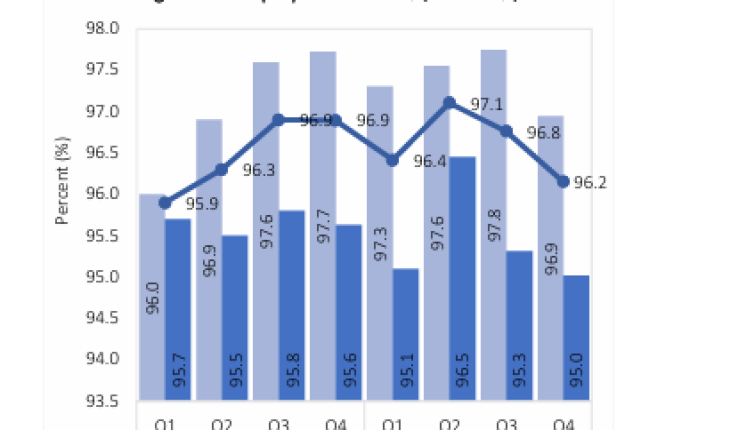
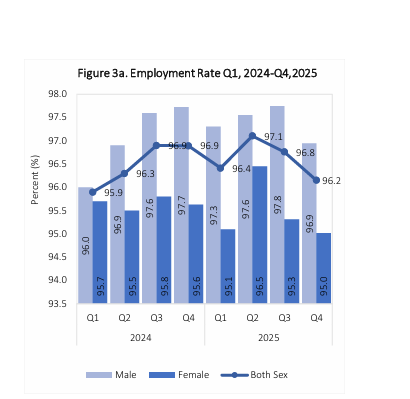
Despite rising unemployment, Bhutan’s employment rate remained high at 96.2 percent in Quarter Four 2025, marking a slight decline from 96.8 percent in the previous quarter.
Employment rates stood at 96.9 percent for males and 95.0 percent for females. By area, rural employment was significantly higher at 98.0 percent, while urban employment stood at 92.5 percent.
The NSB attributed the higher rural employment rate to the large share of rural residents engaged in own-account agricultural work, particularly farming on their own land.
Agriculture continued to be the largest employer, accounting for 46.3 percent of total employment in Quarter Four 2025. The services sector employed 40.9 percent, while industry accounted for 12.7 percent, according to the survey.
In terms of employment status, 35.5 percent of employed persons were paid employees, including regular and casual workers. Own-account workers accounted for 34.2 percent, while family contributing workers comprised 30.3 percent of the workforce.
“A notable gender disparity is observed across these employment categories,” the NSB noted, highlighting differences in the nature of work undertaken by men and women.
The mean monthly labour income for employed persons stood at Nu. 25,720. Male employed persons earned a mean income of Nu. 28,361, which was Nu. 7,702 higher than female employed persons, the bulletin states. Male workers earned higher incomes than females in both urban and rural areas.
Youth unemployment remained elevated, with rates highest among younger age groups and remaining above the national average until the 25–29 age group, after which unemployment declined steadily.
The most frequently cited reasons for unemployment were recently completed studies (22.7 percent), lack of adequate qualifications (21.0 percent), and lack of experience (17.2 percent). Other reasons included voluntary resignation (13.9 percent) and qualification mismatch (7.9 percent).
In terms of duration, 53.2 percent of unemployed persons had been without work for less than six months, while 26.6 percent had been seeking employment for more than one year, classified as long-term unemployed, the NSB reported.
The Labour Force Survey was conducted in November 2025, covering 2,928 households across all 19 dzongkhags. Of these, 2,865 households participated, resulting in a response rate of 97.8 percent. The survey follows the International Labour Organization (ILO) labour force framework, ensuring international comparability.