KINLEY KHANDU CHODEN | Thimphu
For Thinley Wangchuk, writing was never something that came naturally. Yet a story inspired by personal experiences of grief, loss, and human connection has earned him international recognition and positioned him among Bhutan’s emerging voices in filmmaking.
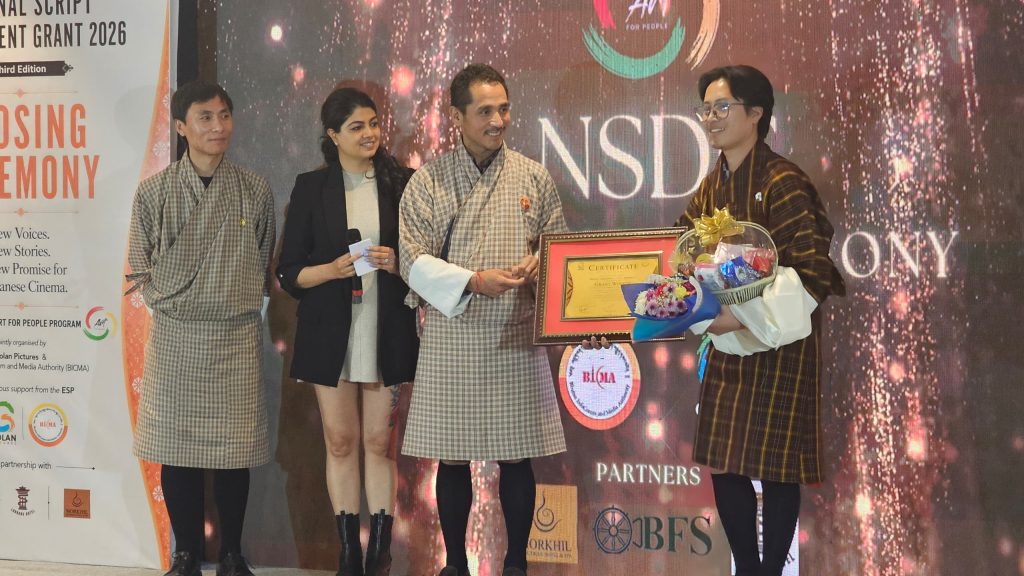
The Assistant Creative Director at Samuh is one of the recipients of the 2026 Script Development Grant for a feature film project, an achievement he describes as both unexpected and deeply meaningful.
“When I learned that I had won this award, I was thrilled and honored. It was something I never expected because writing is not something I consider myself particularly good at,” he said.
But for the filmmaker, the recognition represents more than the success of a single script. It marks the culmination of a personal journey that challenged his confidence and made him to confront fears he had long carried about writing.
“More than the award itself, however, I think the real achievement was overcoming my fear of writing. Since I am not a writer by profession, simply developing the habit of writing feels like a victory to me. That, in itself, was winning.”
The award-winning project grew from experiences that had stayed with him for years. Drawing from moments he had witnessed and lived through, he began shaping a story centered on death, grief, and the relationships that define people’s lives.
“The treatment is largely drawn from my own experiences, particularly experiences related to death, human connections, and the bonds we share with family and friends,” he said.
Inspired by his own experiences, he developed the concept before discussing it with a friend as the story took shape. The exchanges helped him refine the narrative, while his desire to explore themes rarely portrayed in Bhutanese cinema gave the project a distinct direction.
Turning those ideas into a screenplay, however, proved far more difficult than he anticipated.
“As I mentioned earlier, it was far from easy. Since I am not a writer and have little experience with writing, it was difficult to put my thoughts onto paper. In the beginning, even starting to write was a challenge.”
The script development programme demanded discipline and consistency. Participants were expected to submit revised treatments every week and regularly engage with mentors to refine their work.
For Wangchuk, balancing professional responsibilities with the demands of writing often meant sacrificing sleep.
Weekly deadlines became a constant challenge. More than once, he found himself working through the night to complete assignments before morning.
“I often struggled to write on time, and many submissions were delayed until the last minute. There were nights when I stayed awake working through the night just to submit my work the following morning.”
Despite the pressure, mentorship and structured guidance helped him gradually build confidence. The programme taught him how to organize ideas, develop narratives, and transform personal experiences into compelling stories.
At the heart of the script lies an exploration of mortality and the emotional realities surrounding loss.
“If this film eventually makes it to the screen, the most important themes are death, the loss of loved ones, and the bonds we share with family and friends.”
Rather than focusing solely on death itself, the story examines the difficult journey families and friends experience when confronted with the inevitability of losing someone they love.
“More than anything, it is about grief, particularly the grief associated with knowing that someone is going to die,” he explained.
As one example, he referred to people suffering from terminal illnesses who may not have access to treatment or transplants. Their experiences, he said, reflect the prolonged grief, uncertainty, and emotional burden that the film seeks to explore.
Beyond filmmaking, he views storytelling as an important tool for documenting Bhutan’s evolving identity.
“As a creator, filmmaker, or writer, or simply as a creator in general, I believe our role is to be record keepers and archivists. Through our work, we reflect our culture, our people, and the issues we face during a particular period in time.”
He believes this role is becoming increasingly important as Bhutan undergoes rapid social and cultural change.
“For me, reflecting Bhutanese culture is especially important because, as Bhutan rapidly globalizes and urbanizes, we are losing many cultural practices.”
Among his concerns is the gradual decline of oral storytelling traditions that once played a central role in Bhutanese communities.
“Storytelling was once a strong part of our culture, but television, social media, and technology have gradually replaced it.”
For Wangchuk, films, books, podcasts, and other creative works serve as modern archives capable of preserving cultural knowledge for future generations.
At the same time, he believes storytelling should do more than celebrate tradition. It should also encourage society to confront difficult realities.
“When it comes to contemporary issues, I strongly believe that storytelling can influence change,” he said.
He argues that many social challenges remain hidden despite affecting people’s lives every day.
“Reflecting contemporary social issues is important because it helps others see realities they may not have noticed before.”
According to Thinley Wangchuk, Bhutanese society often gravitates toward positive narratives while avoiding conversations about uncomfortable issues that deserve greater attention.
“I think it is important to tell stories about the issues that genuinely affect people, especially those that are socially significant and deeply troubling.”
For him, creative work functions as a mirror through which society can better understand itself.
“There is a saying that we are defined more by what we hide than by what we show.”
Winning the grant has strengthened his confidence as both a filmmaker and storyteller.
“This script emerged from my own personal experiences—the things I have seen, heard, and gone through. Winning this award is a significant milestone for me.”
The recognition has also encouraged him to continue writing, something he once viewed as a weakness.
“As a filmmaker, it gives me confidence to continue writing stories for myself and for others. It is an important stepping stone in my career.”
The project may eventually become his debut feature film if he is able to secure the necessary funding and opportunities to bring it to the screen.
Looking beyond his own achievement, he believes Bhutan’s film industry holds tremendous potential. He sees strong screenwriting as a pathway to attracting funding, international collaboration, and wider audiences interested in original Bhutanese stories.
“Bhutan has many original and unexplored stories that international audiences are interested in.”
To strengthen the industry, he advocates for more script development programmes and training opportunities that can help aspiring writers understand the craft of screenwriting.
Many young Bhutanese, he said, possess the desire to tell stories but lack opportunities to learn how stories are structured for film.
His advice to emerging writers reflects the lesson he learned through his own experience.
“Watch a lot of films and continue to write, regardless of whether the writing is good or bad. The more you write, the better you become at expressing your thoughts.”
Today, Thinley Wangchuk is developing several new projects, including a short film based on a personal story and an anthology feature film titled 180 Days. At the same time, he continues refining the script that transformed him from a reluctant writer into an internationally recognized storyteller.
For a filmmaker who once doubted his ability to write, the award is more than a professional milestone. It is proof that some of the most powerful stories emerge from the experiences people are often reluctant to put into words.