KINLEY KHANDU CHODEN | Thimphu
Bhutan’s ambition to become the world’s first fully organic nation has drawn global attention for its bold commitment to sustainable agriculture and environmental protection.
At the center of this effort is the National Centre for Organic Agriculture (NCOA), tasked with guiding farmers, developing organic technologies, and strengthening the country’s organic farming system.
Yet while the vision remains compelling, voices from farmers, vendors, and consumers reveal a more complex reality—one shaped by both opportunity and persistent challenges.
The NCOA has played a key role in institutionalizing organic agriculture. According to its Program Director, Dr. Norden Lepcha, the Centre’s mandate extends beyond research.
“NCOA was renamed in 2020 from the Agriculture Research and Development Centre Yusipang, with a mandate to look after organic research and development, regulation, and to implement a primary certification system called the Local Organic Assurance System,” he said.
In addition to research, the Centre develops organic alternatives to conventional inputs and provides training to farmers and agricultural officials to strengthen national capacity.
Government-supported training programs remain a cornerstone of this effort. Through fully funded workshops, farmers are introduced to organic standards, farm record-keeping, and the production of bio-inputs. Infrastructure support is also provided.
“Structures such as bio-digester, vermicompost, greenhouse, and seeds are generally provided on a cost-sharing basis,” Dr. Norden Lepcha said, adding that domestic organic certification is offered free of charge to encourage adoption.
Despite these initiatives, transitioning to organic farming continues to pose significant challenges.
One of the most pressing issues is pest and disease management. With chemical pesticides prohibited, farmers must rely on bio-pesticides, which are often less effective.
“The available bio-pesticides in the country are not as effective as chemical pesticides,” Dr. Norden Lepcha said. He added that these alternatives can also be costly and have a short shelf life, limiting their reliability.
Weed control presents another obstacle. Without chemical herbicides, farmers depend heavily on manual labor—an approach that increases both workload and production costs.
“There are also no effective bioherbicides to suppress weeds, which makes organic agriculture laborious and increases the cost of production,” he said.
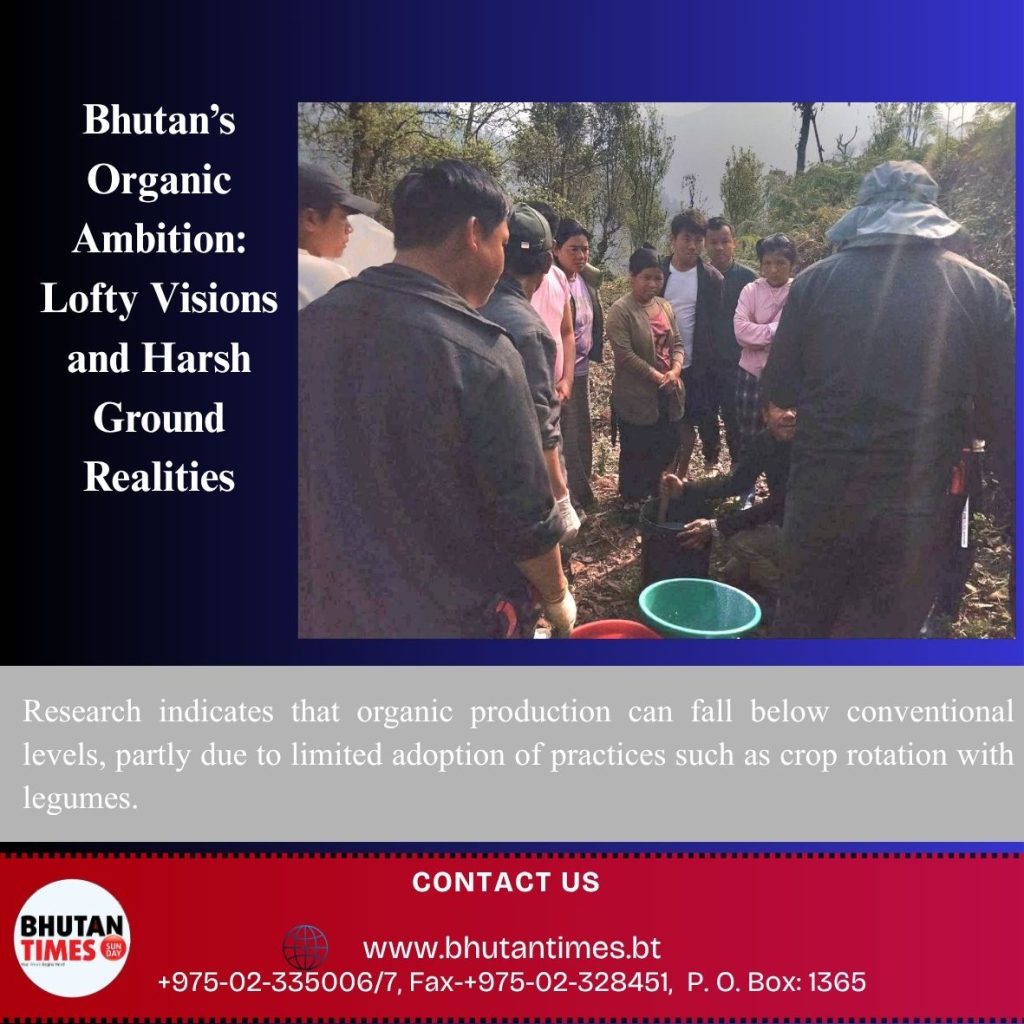
Lower yields further complicate the transition. Research indicates that organic production can fall below conventional levels, partly due to limited adoption of practices such as crop rotation with legumes.
“Such lower yields can demotivate farmers,” he noted.
These challenges are reflected in the daily experiences of farmers.
Pema Choden from Haa said government support has been critical. “When I started farming, the government covered 80 percent of the cost, while I contributed 20 percent,” she said, adding that subsidies also help with seeds and market access.
She currently produces tomatoes, selling them at Nu. 1,300 per tray. However, access to key inputs remains a concern.
“One major challenge is the need for coconut soil, or coco peat,” she said. “Without it, the seeds do not grow properly.” Because coco peat is imported from India, it is often expensive and difficult to obtain.
Farmers in other regions report similar struggles. Penjor, a farmer from Wangdue, said organic farming requires more labor and careful management.
“Without chemical fertilizers, crops sometimes grow slower, and we have to work more to manage pests and diseases,” he said. Income, he added, can be unpredictable. “Some seasons are good, but sometimes production is low, which affects our earnings.”
Access to inputs remains another constraint. “Some materials like organic inputs or special soil are difficult to get and can be expensive,” Penjor said.
Still, for some farmers, the long-term benefits outweigh the difficulties. In Dagana, Khandu Wangdi said his decision to adopt organic farming was driven by environmental and health considerations.
“I decided to switch because organic farming is better for health and the environment,” he said. “The production is sometimes lower, but the quality of the crops is better.”
Beyond production, market dynamics also shape the success of organic agriculture.
Vendors say consumer trust and consistent supply are key factors. Rada Wangmo, a vendor from Wangdue, noted that farmers who sell directly often perform better.
“Compared to farmers who sell their products directly, they are able to sell faster and in larger quantities,” she said.
However, demand remains uneven. Dorji Choden from Paro, said higher prices can discourage buyers.
“Yes, organic products can be harder to sell because of higher prices and lower demand,” she said, adding that greater public awareness could help boost consumption.
Consumers, too, express mixed views. Karma Choden, a resident of Thimphu, said she prefers organic food for health reasons. “Yes, I prefer organic products because they are healthier and safer for my family,” she said.
However, trust remains an issue. “Sometimes I am not sure if all products are truly organic,” she added.
In response to these challenges, Bhutan’s strategy is evolving. Rather than pursuing a complete nationwide conversion, the focus is shifting toward targeted, high-value markets.
“Organic farming will be promoted for selective commodities,” Dr. Norden Lepcha said, pointing to crops such as asparagus, quinoa, buckwheat, coffee, and ginger as future priorities.
The approach aims to position Bhutanese organic products in premium markets, where higher prices can offset lower yields and increased production costs. Strengthening certification systems and improving market access are also key goals.
Success, he said, will be measured by growth in certified organic land, increased farmer participation, and improved incomes.
Bhutan’s organic ambition remains a work in progress. While the country continues to build its reputation as a global leader in sustainable agriculture, the experiences of those on the ground suggest that realizing a fully organic future will depend as much on addressing practical challenges as on sustaining policy vision.