RENUKA RAI | Thimphu
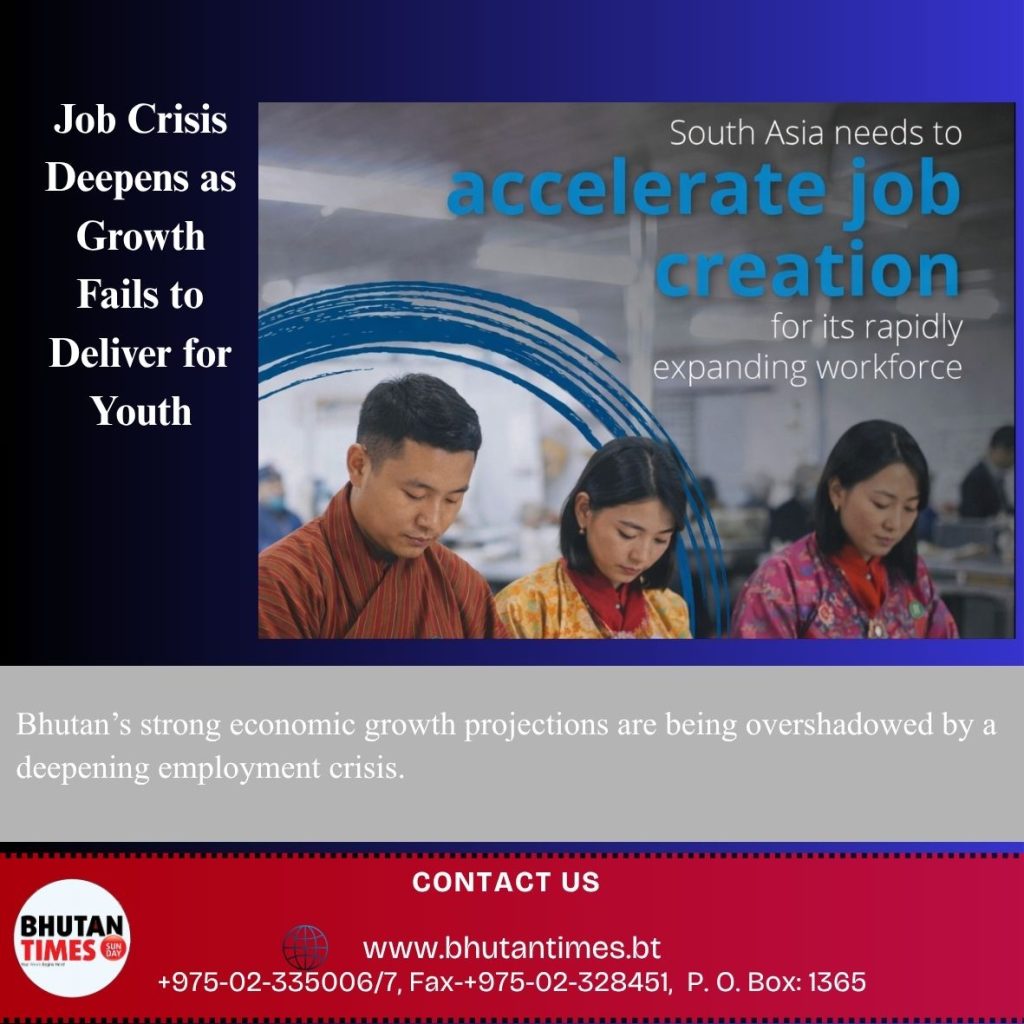
Bhutan’s strong economic growth projections are being overshadowed by a deepening employment crisis, as rising youth unemployment and increasing outward migration highlight a widening gap between economic expansion and job creation.
While the latest Bhutan Development Update by the World Bank Group projects steady GDP growth in the coming years, the report underscores a critical concern the country is struggling to convert economic gains into meaningful employment opportunities, particularly for its young population.
Youth unemployment currently stands at 20.6 percent, reflecting a persistent challenge in absorbing new entrants into the labour market.
At the same time, outward migration has surged, with nearly 9 percent of Bhutan’s population reported to have left the country by 2025 in search of better prospects abroad.
This trend points to growing dissatisfaction among young Bhutanese, many of whom face limited opportunities at home despite improvements in education and skills.
“Bhutan has maintained robust growth,” said Xavier Furtado, World Bank Group Country Manager for Bhutan. “But the challenge is to translate this growth into jobs.”
At the core of the issue is the structure of Bhutan’s economy. Hydropower, which drives much of the country’s GDP growth, is a capital-intensive sector that generates relatively few jobs.
While it contributes significantly to national income, it does not create employment at the scale needed to meet the demands of a growing workforce.
As a result, economic growth has not translated into widespread job creation, leading to what economists describe as “jobless growth.”
The impact of this imbalance is increasingly visible across Bhutanese society. Many young people are choosing to migrate abroad, particularly to countries offering higher wages and broader career opportunities.
While remittances from these workers contribute to the economy, the long-term implications of losing a significant portion of the workforce are concerning.
The report also highlights the challenges faced by women and rural populations, who often have limited access to employment opportunities.
Structural barriers, including limited market access and fewer opportunities for skill development, continue to restrict participation in the workforce.
In this context, the agrifood sector emerges as a critical area for potential job creation. Employing around 55 percent of the population, the sector remains central to rural livelihoods. However, much of the work is low-productivity and subsistence-based.
The report suggests that transitioning workers into higher-value activities such as food processing, logistics, and agribusiness services could increase incomes by up to 33 percent.
It states that this shift could create more sustainable and better-paying jobs, particularly for rural communities.
“However, realizing this potential will require substantial investment in infrastructure, training, and regulatory reforms. Access to finance, improved supply chains, and stronger market linkages are essential for transforming the sector,” the report adds.
The World Bank report states that the same time, rising inflation is adding to the challenges faced by households. With food and fuel prices expected to increase, many families are experiencing a higher cost of living. This reduces disposable income and limits the ability of individuals to invest in education, business ventures, or skill development.
“Higher-than-expected fuel prices remain a key risk,” said Yumeka Hirano, World Bank Senior Economist, noting that inflation could further strain household finances.
The report also emphasizes the need for broader economic reforms to address the employment crisis. Encouraging private sector growth is seen as a key priority, as businesses play a crucial role in generating jobs.
Sectors such as tourism, digital services, and small-scale manufacturing offer potential pathways for employment generation.
Expanding these industries could provide opportunities for a diverse range of skill levels and reduce reliance on a single sector.
Foreign direct investment (FDI) is also identified as an important driver of job creation. By attracting investment in labour-intensive industries, Bhutan can create new employment opportunities and stimulate economic diversification.
However, achieving this will require a more supportive business environment, including streamlined regulations, improved access to credit, and policies that encourage innovation and entrepreneurship.
The findings reflect a broader challenge across South Asia, where strong economic growth has not always translated into adequate job creation.
As highlighted in regional reports, the rise of new technologies and changing labour market dynamics are reshaping employment patterns.
For Bhutan, the challenge is particularly acute given its small population and limited economic base. Addressing unemployment is not only an economic priority but also a social imperative, as prolonged joblessness can lead to wider inequalities and social tensions.
Looking ahead, the report underscores the importance of adopting a more inclusive approach to growth one that prioritizes job creation alongside economic expansion.
This includes investing in education and vocational training, supporting entrepreneurship, and creating opportunities for youth to participate in emerging sectors.
As Bhutan navigates an uncertain global environment, addressing the employment challenge will be key to ensuring a more inclusive and sustainable future.