TIL BDR GHALLEY | Thimphu
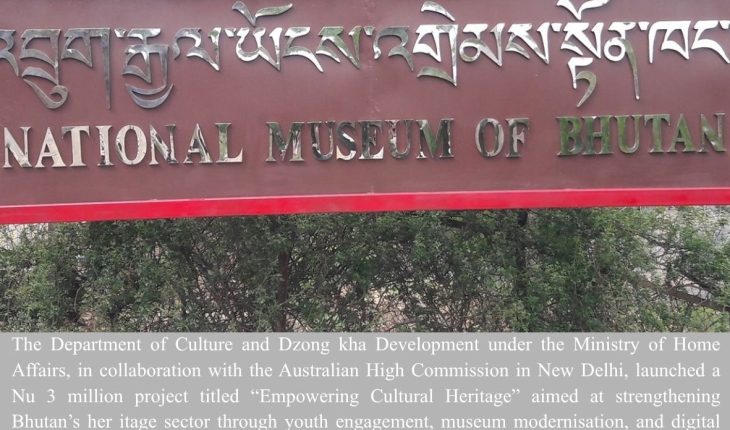
The Department of Culture and Dzongkha Development under the Ministry of Home Affairs, in collaboration with the Australian High Commission in New Delhi, launched a Nu 3 million project titled “Empowering Cultural Heritage” aimed at strengthening Bhutan’s heritage sector through youth engagement, museum modernisation, and digital innovation.
Implemented by the department’s Museum Division, the initiative seeks to enhance Bhutan’s cultural institutions while reinforcing bilateral cooperation between Bhutan and Australia.
Officials said the project represents a significant step toward safeguarding cultural heritage while promoting education, innovation, and sustainable development.
Tshering Uden Penjor, chief of the Museum Division said museums are becoming increasingly important within Bhutan’s cultural landscape and are evolving into spaces for learning, reflection, and public engagement.
“We remain committed to building museums that are more accessible, dynamic, and responsive to the needs of our communities, particularly our youth,” she said.
According to her, the project would support efforts to deepen museum education, improve interpretation and accessibility, strengthen professional competencies, and establish museum and heritage standards in Bhutan.
“Heritage must not only be preserved, it must be experienced, interpreted, and carried forward by the next generation,” she said.
Bhutan currently operates several museums under the Museum Division, including the National Museum of Bhutan, Royal Heritage Museum, and National Textile Museum.
Home Minister Tshering said culture remains central to Bhutan’s national identity and resilience.
“For Bhutan, culture is at the heart of who we are. It shapes our identity, strengthens our communities, and supports our resilience as a nation,” the minister said.
“Our heritage lives in our traditions, in the knowledge of our elders, and in the skills of our artisans. It is passed down through stories, practices, and everyday life.”
The minister said museums must evolve beyond their traditional role as repositories of historical objects.
“Museums are not just places to store objects. They should be living spaces that connect communities, foster belonging across generations, and encourage people to participate in and take pride in their heritage,” the minister said.
Highlighting the rapid pace of technological and social change, the minister stressed the importance of ensuring cultural institutions remain relevant and engaging for younger generations.
“We are living in a rapidly changing world where technology and new ways of living are shaping how people engage with knowledge. Our cultural institutions must remain relevant, accessible, and engaging for our younger generation,” the minister said.
“Young people are not merely beneficiaries of these initiatives; they are the future custodians of our heritage.”
The minister added that the initiative would invest in practical and meaningful programmes designed to encourage young people to explore, question, create, and strengthen their connection to Bhutanese identity.
“Heritage is not only about the past. It is about the future that you will shape,” the minister said.
Philip Green, Ambassador of Australia to Bhutan, said the partnership would strengthen museum capabilities while improving public and youth engagement through modern approaches.
“This project brings not only high-level curatorial capabilities, but also the importance of connecting with communities, connecting with people, and connecting with youth,” the ambassador said.
He said integrating technology into museums would help visitors better understand artifacts and their cultural significance.
“Modern museums should not simply display old artifacts with written explanations. Technology can help people understand artifacts within their cultural and historical context, and better understand where we are today,” he said.
The Museum Division reported increasing participation by young people in museum-related activities, with youth engagement reaching 5,749 participants between 2024 and 2025. Museums also generated Nu 37.449 million in revenue during the same period.
Sonam Youden, Member of Youth council and student representing studying at Shari Higher Secondary in Paro described museums as important centres of education, inspiration, and cultural preservation.
“Museums in Bhutan are not just buildings that store old objects. They are centres of learning, inspiration, and cultural preservation,” she said.
“Youth must connect with the past to shape the future,” she said. “Preserving our heritage is not the responsibility of a few stakeholders alone. It is a shared responsibility.”
She also called for stronger collaboration between schools and museums to ensure Bhutan’s cultural heritage continues to be preserved and appreciated by future generations.