Capital investment dominates national budget as government boosts spending on healthcare, education, agriculture, infrastructure, digital transformation, and local development
TIL BDR GHALLEY | Thimphu
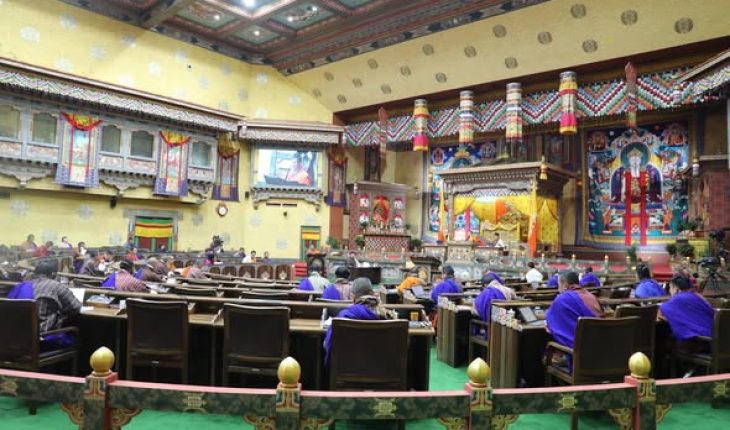
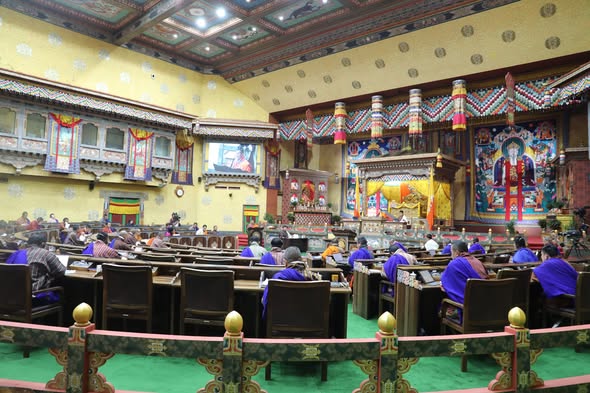
Finance Minister Lekey Dorji presented a national budget outlay of Nu. 135.565 billion for the fiscal year 2026–27 under the theme “Building Resilience and Self-Reliance,” with major investments directed towards healthcare, education, agriculture, infrastructure, digital transformation, local governance, and climate resilience at the ongoing National Assembly session on 14 May 2026.
The proposed budget projects total resources of Nu. 110.281 billion against total expenditure of Nu. 135.565 billion, resulting in a projected fiscal deficit of Nu. 25.284 billion, equivalent to 6.54 percent of Gross Domestic Product (GDP).
Capital expenditure accounts for the largest share of the proposed budget. Of the total allocation, Nu. 72.536 billion has been earmarked for capital expenditure while Nu. 63.029 billion has been allocated for current expenditure.
Presenting the annual budget, the finance minister stated that the fiscal framework focuses on strengthening economic resilience, enhancing public service delivery, supporting productive sectors, and advancing long-term national development priorities.
The health sector has been allocated Nu. 12.43 billion to improve healthcare services, strengthen emergency response systems, expand specialized medical care, and support digital transformation in healthcare delivery.
Of the total allocation, Nu. 965.0 million has been earmarked for tertiary and specialized healthcare infrastructure, including Nu. 829.0 million for the construction of the Multi-Disciplinary Super-Specialty Hospital and Nu. 136.0 million for the mother and Child Hospital at Mongar.
The budget also includes investments in CT, MRI, and IVF services at Jigme Dorji Wangchuck National Referral Hospital and expansion of hospitals in Samtse, Trashigang, and Phuentsholing.
A further Nu. 1.009 billion has been allocated for procurement of medical equipment and ambulances, including Nu. 902.8 million for medical equipment and Nu. 106.3 million for ambulance services.
The government has also allocated Nu. 110.2 million for enhancement of the electronic Patient Information System and AI-enabled digital health initiatives.
Additional allocations include Nu. 279.8 million for clinical capacity development and Nu. 120.0 million for mental health and social support services under the Pema Secretariat.
The education sector has received a total allocation of Nu. 34.94 billion for infrastructure development, curriculum reform, teacher development, technical education, and tertiary education expansion.
Of the total allocation, Nu. 3.038 billion has been earmarked for capital investment, mainly for development of 20 Phase I Central School clusters.
The government has also allocated Nu. 150.0 million each for establishment of the International School in Thimphu and the STEM School at Drukgyel Higher Secondary School.
Curriculum reform initiatives will receive Nu. 289.0 million for implementation of the Cambridge-aligned curriculum for Classes IX and XI, including teaching-learning materials, digitization of curriculum resources, teacher training, and assessment reforms.
Teacher development initiatives have been allocated Nu. 385.1 million while Nu. 196.1 million has been earmarked for WASH upgrades in schools.
The budget also includes Nu. 112.9 million for Early Childhood Care and Development centres and Nu. 50.0 million for Yarabling School Phase II.
Under the Technical and Vocational Education and Training sector, Nu. 150.0 million has been allocated for modernization of training systems and Nu. 582.2 million for expansion of Technical Training Institutes and Rural Development Training Centres.
For tertiary education, Nu. 1.042 billion has been allocated for infrastructure expansion, Nu. 92.0 million for digital transformation, Nu. 80.0 million for human resource development, and Nu. 21.0 million for accreditation and quality assurance.
The Renewable Natural Resources sector has been allocated Nu. 12.88 billion to strengthen food security, agricultural productivity, rural livelihoods, biodiversity conservation, and climate resilience.
The Ministry of Agriculture and Livestock has received Nu. 1.611 billion for investments in agriculture, livestock production, irrigation systems, biodiversity-based enterprises, and natural resource management.
The budget includes Nu. 280.0 million for construction and rehabilitation of irrigation systems, Nu. 45.1 million for Commercial Chirup Farms at Samrang and Pemathang, and Nu. 48.9 million for the Yarjugang Agriculture Commercial Farm.
To support resilience in the agriculture sector, Nu. 76.6 million has been allocated for the National Crop and Livestock Insurance Scheme.
The government has also allocated Nu. 140.7 million for strengthening domestic market linkages, promoting value addition, and expanding digital marketing platforms.
Additional allocations include Nu. 7.9 million for export market expansion, Nu. 9.2 million for farm shops, and Nu. 2.0 million for the Floriculture Centre of Excellence in Tsirang.
The report further includes Nu. 24.0 million for biodiversity conservation and bioprospecting initiatives, Nu. 58.2 million for water resource inventories in 14 dzongkhags, and Nu. 590.0 million for sustainable forest management.
The mining and manufacturing sector has been allocated Nu. 1.97 billion to strengthen industrial development, trade infrastructure, energy security, and employment generation.
The allocation includes Nu. 114.8 million for completion of the Norbugang Industrial Park and expansion of the Nganglam Dry Port.
To strengthen fuel security, Nu. 193.0 million has been allocated for fuel stockpiling, including Nu. 98.0 million for the Garmani Fuel Depot and Nu. 95.0 million for emergency reserves.
Employment generation initiatives have received Nu. 234.4 million under the Youth Engagement and Livelihood Programme and Overseas Employment Programme.
The mining subsector has been allocated Nu. 105.0 million for mineral exploration activities and mining technologies.
The tourism sector has received Nu. 255.8 million to support tourism promotion, tourism products, branding initiatives, and digital tourism systems, including Nu. 60.8 million for airfare subsidy obligations.
The transport sector has been allocated Nu. 9.50 billion for road improvement, connectivity enhancement, bridge construction, and green transport initiatives.
Routine road maintenance will receive Nu. 481.9 million while Nu. 2.464 billion has been allocated for improvement of Dzongkhag roads.
The budget also includes Nu. 1.645 billion for Primary National Highways, Nu. 1.082 billion for Secondary National Highways, and Nu. 505.6 million for bridge strengthening and construction.
To promote low-emission mobility, Nu. 583.5 million has been earmarked for electric vehicles and green transport systems.
Airport infrastructure development has been allocated Nu. 295.1 million.
The housing and community sector has received Nu. 10.79 billion for urban services, water systems, public transport, and resilience infrastructure.
Integrated water systems will receive Nu. 530.0 million while Nu. 1.180 billion has been allocated for public transport systems.
Green infrastructure and park development projects in Thimphu have been allocated Nu. 276.5 million.
The budget also includes Nu. 250.0 million for the extended Kaja Throm project, Nu. 70.0 million for the Hongtsho Crematorium, Nu. 622.1 million for the Government Office Complex, and Nu. 66.0 million for the Gelephu flood mitigation project.
The communications and technology sector has been allocated Nu. 3.68 billion to support digital governance, ICT connectivity, digital economy development, and technology-driven services.
The government expects the sector to support creation of 1,000 digital jobs and attract five Foreign Direct Investments in the technology sector.
The budget includes Nu. 36.9 million for Rural Communication Project Phase VII and Nu. 300.0 million for Phase VIII to improve telecommunications access in remote areas.
The energy sector has been allocated Nu. 1.58 billion in support of Bhutan’s target to achieve 25,000 MW energy generation capacity by 2040.
The allocation includes Nu. 25.0 million for a 1 MW turbulent micro hydropower pilot project and Nu. 568.2 million for the ongoing hydropower project in Lunana.
The budget also includes Nu. 34.2 million for solar PV systems, Nu. 50.4 million for solar installations in three central schools, and Nu. 66.8 million for establishment of a Green Hydrogen Refueling Station at Gidakom.
Local Governments have received the largest allocation under the FY 2026–27 budget at Nu. 47.01 billion, representing an increase of 23.6 percent over the approved FY 2025–26 budget of Nu. 38.03 billion.
Of the total allocation, Nu. 29.271 billion constitutes capital expenditure for infrastructure development and long-term investments at the local level.
The finance minister also proposed an upward revision of Nu. 1.2 billion to the supplementary budget for FY 2025–26 following the receipt of additional domestic and external grants and loan financing. Following the revision, the total budget outlay for FY 2025–26 has increased to Nu. 139.6 billion.
The National Assembly is scheduled to deliberate on the Budget Appropriation Bill next month.
The report states that investments in productive sectors, healthcare, education, agriculture, infrastructure, digital transformation, and climate resilience are expected to support the national objective of “Building Resilience and Self-Reliance.”