
DAWA ZANGMO | Thimphu
Two exhibitions exploring the legacy of His Majesty the Fourth Druk Gyalpo through student artwork and contemporary textile art opened at the Royal Textile Academy (RTA) in Thimphu on October 14, bringing together artistic expressions of Bhutan’s history, cultural identity, and textile heritage.
‘Yabsay’ and ‘Beyond the Weave: Innovation, Heritage and Identity’, the exhibitions commemorate the 70th birth anniversary of His Majesty the Fourth Druk Gyalpo.
‘Yabsay’ features artworks by Druk School students under the guidance of their art teacher, Chorten Norbu, while ‘Beyond the Weave’ presents textile creations by artist and designer Sangay Choden.
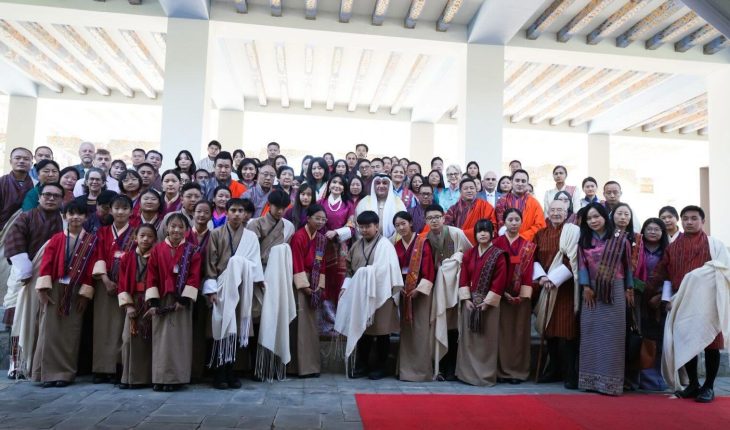
The exhibitions were organised jointly by the Royal Textile Academy and the Textile Museum under the Museum Division of the Department of Culture and Dzongkha Development, Ministry of Home Affairs. Her Majesty Gyalyum Sangay Choden Wangchuck, Royal Patron of the Royal Textile Academy, graced the inauguration as the chief guest.
The exhibitions will remain open to the public at the Royal Textile Academy in Chubachu, Thimphu, until November 30.
Through ‘Yabsay’, students express their understanding of His Majesty’s life, leadership and contributions to Bhutan, using art to reflect on the country’s history and cultural identity.
Chorten Norbu said the title ‘Yabsay’ represents the bond between father and son and symbolises continuity in Bhutan’s monarchy.
He said the exhibition provides students with an opportunity to express their appreciation of His Majesty’s legacy while developing their understanding of Bhutanese history through their own creative interpretations.
According to Chorten, art education extends beyond teaching technical skills in drawing and painting. It also helps students develop imagination, patience and confidence while strengthening their appreciation of Bhutanese culture.
The exhibition gives students a platform to communicate what His Majesty contributions means to them and how they understand his legacy as members of the younger generation.
While ‘Yabsay’ focuses on students’ interpretations of Bhutan’s history and leadership, ‘Beyond the Weave’ explores how traditional Bhutanese textile knowledge can be applied in contemporary artistic practice.
Sangay Choden, a self-taught textile artist and fashion designer with more than 18 years of experience, said the exhibition marks her first solo presentation of textile art.
She said the exhibition seeks to encourage experimentation with traditional Bhutanese weaving techniques, colours, motifs and patterns, particularly among young people pursuing careers in fashion and garment-making.
The exhibition features techniques such as weaving, felting, hand stitching and textile manipulation, combining traditional textile knowledge with contemporary artistic approaches.
Sangay Choden said she wanted to demonstrate that Bhutanese textiles could be explored beyond their conventional applications, allowing traditional techniques to be adapted to new forms of artistic expression while retaining their cultural significance.
However, she said the development of the textile and fashion sector continues to face challenges, including limited access to formal training, financial constraints and a shortage of skilled workers. Drawing on her experience in the industry, Sangay said short training courses lasting two to three months were often insufficient to prepare trainees for professional work.
She called for more structured training programmes that allow trainees to develop technical skills over a longer period and gain practical experience. She also emphasised the importance of creating employment opportunities for trained individuals.
Sangay said closer collaboration among designers, weavers and artisans could help address some of these challenges by facilitating knowledge-sharing, encouraging experimentation with materials and supporting the development of new products.
She also highlighted the need for a common platform where creative professionals can collaborate and explore opportunities in international markets.
She said sustaining traditional textile practices requires support for skilled artisans as well as opportunities to apply their knowledge in contemporary design.
RTA Executive Director Ugyen Tenzin said the two exhibitions honour His Majesty the Fourth Druk Gyalpo’s 70th birth anniversary by presenting his legacy through student artwork and contemporary textile innovation.
He said exhibitions play an important role in preserving Bhutanese cultural heritage by providing a platform for artists to showcase traditional knowledge and reinterpret it through contemporary ideas and approaches.
The Academy supports emerging artists and students through exhibitions, competitions, training programmes and educational initiatives aimed at developing their skills and providing opportunities for public recognition.
The Executive Director said the Academy would introduce a new student category in the National Design and Art Competition next year, coinciding with the competition’s silver jubilee.
The initiative will provide students with an additional opportunity to showcase their work and develop their artistic abilities