RENUKA RAI | Thimphu
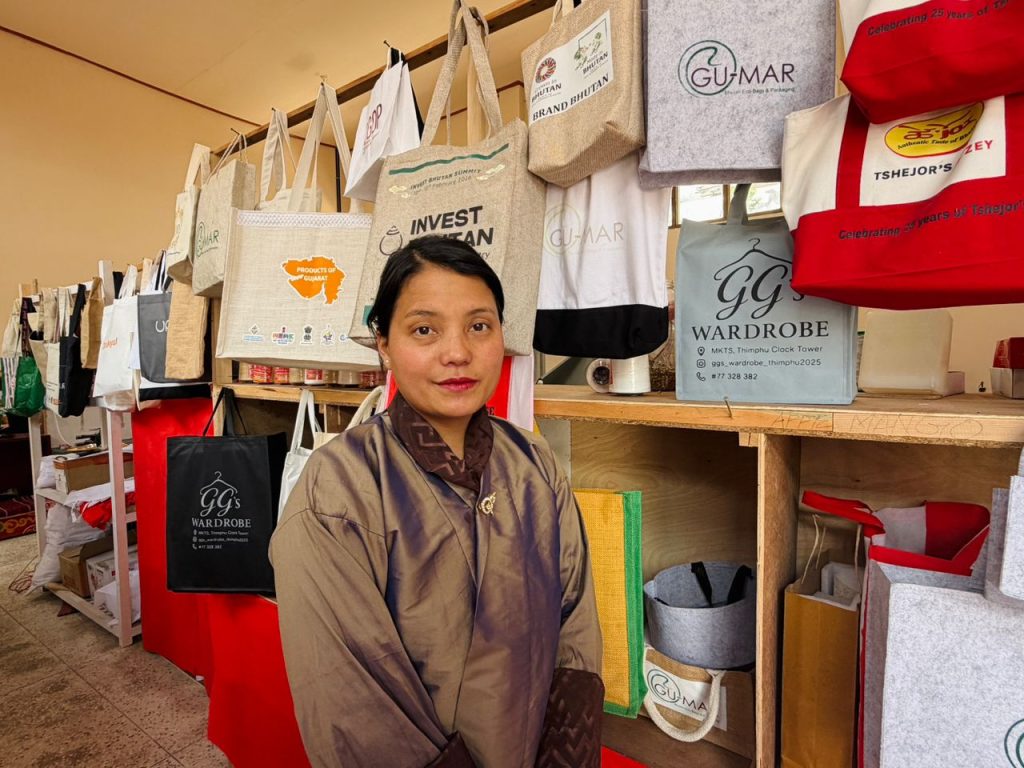
On a quiet evening in Thimphu, the steady hum of a sewing machine breaks the silence inside a small workshop. Rolls of jute and cotton fabric lean against the walls, while neatly stacked eco-friendly bags wait to be packed and delivered.
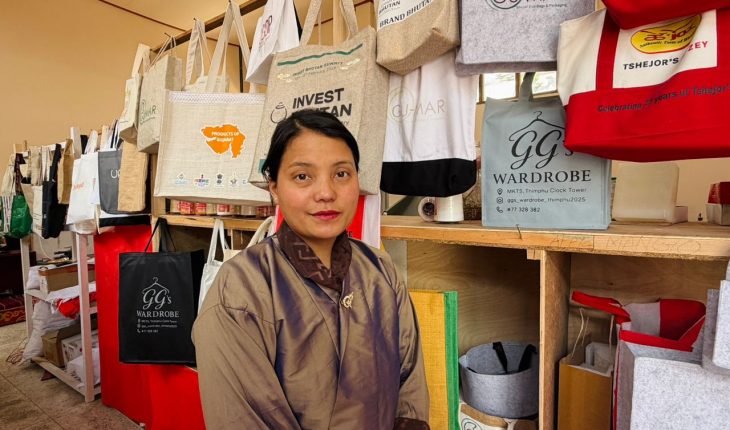
Standing at the Center of it all is Geeta Rai,35 carefully inspecting the stitching on a newly finished bag.
“I never thought I would be in business,” she says, almost reflecting more than stating. “At first, it was not my plan at all.”
Geeta’s journey into entrepreneurship was not driven by ambition alone it was shaped by circumstance, pressure, and eventually, determination.
After graduating in 2014 from NIILM University in India with a background in media, Geeta did not immediately step into the business world. Instead, in 2015, she and her husband, Kinga Jamtsho, opened a restaurant. Life was busy, demanding, and unpredictable.
Then came a turning point in 2016 the birth of her first child. Balancing motherhood with the daily demands of running a restaurant proved overwhelming.
“It was very difficult,” she recalls. “I had to manage a newborn baby and the restaurant at the same time. I used to stay overnight in the restaurant to attend to customers.”
It was during this exhausting phase that an unexpected idea emerged. A friend of her husband suggested reviving an eco-friendly bag manufacturing business that had already shut down. The company, once run by a single mother, had collapsed, leaving behind unused machinery and a heavy loan.
At first, Geeta hesitated. She had no background in manufacturing, and the risks were high. But Bhutan’s long-standing struggle with plastic use despite a ban introduced in 1999 made the idea relevant. Alternatives were still limited, and the need for sustainable options remained urgent.
By the end of 2017, during what she describes as a brief resting period, she began to seriously consider the opportunity. In June 2018, she took a leap.
Taking over the business meant inheriting a loan of Nu 10 million, which was transferred into her name. She added her own investment, bringing the total to around Nu 10.1 million. “It was a big responsibility,” she says. “I knew it would not be easy.”
In August 2018, she officially began operations under Ratna Samphel Fabric and Paper Unit. The business focused on producing eco-friendly, biodegradable, reusable, and recyclable bags ranging from non-woven fabric shopping bags to paper and cloth alternatives.
The goal was simple but ambitious to reduce the use of plastic and provide environmentally friendly packaging solutions. For a few months, things moved forward. Then, just eight months later, everything stopped.
In April 2019, the National Environment Commission found traces of micro-fabric in one of her main products. The material, Geeta explains, was used only in a small amount for sealing and stitching. However, the finding led to regulatory action, and the business was shut down.
“In that difficult time, I was very dissatisfied,” she says. “Our product used only a small amount of micro fabric, but people were still using plastic bags everywhere. That was very hard for me to accept.”
The contradiction was striking. While plastic bags are cheap and widely available continued to dominate the market.
Competing with plastic had always been difficult. “Plastic bags are very cheap,” she explains. “But for us, the raw materials cost almost double. So, it is very difficult to compete.”
The shutdown marked the beginning of a long and challenging chapter.
By 2020, the bank had taken the case to court over loan default. With no business running and financial pressure mounting, Geeta found herself navigating a situation she had never anticipated.
“When the bank took the case to court, it was one of the hardest times in my life,” she says. “There was no business, only loans and pressure. I didn’t know how things would move forward.”
For five years, the business remained closed. The court case continued until 2023, stretching her patience and resilience. It was a period defined not by visible progress, but by endurance.
“Because of the five-year gap, it was very difficult to revive,” she admits. Yet, she refuses to describe those years as failure.
“People may think I failed,” she reflects. “But in these five years, I was not failed. I was learning. I feel I have come closer to my goal.”
Her perspective reveals a deeper understanding of entrepreneurship not as a straight path to success, but as a process shaped by setbacks, policy changes, and persistence. She believes the collapse of her business was largely influenced by changes in government policy rather than a lack of effort or commitment.
Despite the challenges, she acknowledges the support she received along the way. Organizations such as the World Wildlife Fund for Nature, along with initiatives like Bhutan Investment and Brand Bhutan, have contributed to promoting sustainable enterprises like hers.
But beyond institutional support, one constant remained deeply personal. “I was lucky,” she says. “My husband always fully supported me. Without that support, continuing for five years would have been very difficult.”
She said his encouragement had been there from the beginning. In fact, it was his idea in 2018 to take over the business. At a time when women entrepreneurs were still emerging in Bhutan, his support gave her the confidence to step into an unfamiliar field.
What began as his suggestion eventually became her own journey. When Geeta decided to restart, her approach had changed. “If at first I was doing it for business visibility, now my main focus is sustainability,” she adds with a hint of a renewed hope.
Learning from past challenges, she shifted towards materials like jute, cotton, and desho paper ensuring that her products are fully reusable and biodegradable. Today, her brand, Gumar Bhutan, is slowly rebuilding, producing eco-friendly shopping bags and packaging aimed at reducing plastic use.
The challenges, however, remain. Plastic continues to dominate the market due to its low cost and convenience. For eco-friendly businesses, the cost of production remains high, making it difficult to compete. Changing consumer behavior is an ongoing struggle.
Still, Geeta is focused on the future. Her plans include expanding beyond Bhutan and entering international markets through exports. It is an ambitious vision, especially after years of setbacks, but one she approaches with quiet determination.
“Don’t think it is the end of your career,” she says. “If you are positive and you want to do something big, don’t expect success to come at once. There is always a way out. You just need determination.”
Her words carry the weight of experience rather than optimism alone.
Back in her workshop, the work continues steadily. Each bag that is stitched and packed represents more than a product it represents resilience, learning, and the courage to start again.
In a country where plastic still finds its way into daily life despite environmental commitments, Geeta Rai’s journey reflects both the challenges and possibilities of change.
She is not just rebuilding a business. She is rebuilding belief one bag at a time.