
As climate shocks expose growing vulnerabilities in food production and livelihoods, a global summit in Bhutan seeks to rethink how societies produce, consume and govern food.
TIL BDR GHALLEY | Paro
As floods, wildfires and other climate shocks increasingly disrupt food production, livelihoods and ecosystems, nearly 400 participants from more than 60 countries gathered in Bhutan on September 1 to confront a question extending beyond agriculture: can the world’s food systems be transformed without changing the values and decisions that underpin them?
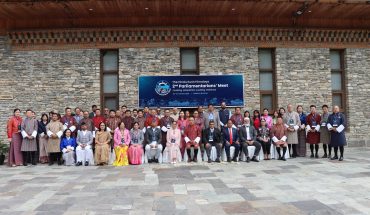
The first Global Conscious Food Systems Summit (GCoFSS) brought together political leaders, farmers, Indigenous Peoples, scientists, policymakers, entrepreneurs, youth and development practitioners to examine how human values, mindsets and relationships shape the institutions, policies and financial decisions that underpin food systems.
The four-day summit, hosted at Dungkar Dzong by the Royal Government of Bhutan, the Conscious Food Systems Alliance (CoFSA) and the United Nations Development Programme (UNDP), comes as climate change, biodiversity loss, inequality and food insecurity increasingly interact, making it harder to treat environmental and humanitarian challenges as separate problems.
From wildfires in Europe to floods across Asia, extreme weather is exposing the vulnerability of food systems and the communities that depend on them. The summit is using food as an entry point to examine those wider connections, including their implications for health, livelihoods, natural resources, culture and economic inequality.
Speaking at the summit Prime Minister Tshering Tobgay said “Behind our systems are people making decisions, and those decisions are shaped not only by what we know and what we can do, they are shaped by what we value. This is where consciousness enters the conversation.”
“It asks us not only what we can produce, but also how we should produce it. Who benefits? At what cost? And what kind of future are we creating in the process?” he said.
The emphasis marks a departure from approaches that focus primarily on production, technology and investment. The summit argues that the effectiveness of those tools ultimately depends on the people and institutions making decisions about how they are used.
“Humanity has never known more about how to produce food. We have extraordinary science, extraordinary technology, extraordinary knowledge and extraordinary productive capacity. We produce more food than ever before, and yet hundreds of millions of people still do not have enough,” he said.
The contradiction is compounded by the fact that food can be transported across continents while healthy diets remain beyond the reach of many families.
“We get more food across continents, and yet healthy diet remains beyond the reach of families.”
The increasingly interconnected nature of climate and humanitarian crises was highlighted at the summit, with former U.N. High Commissioner for Human Rights Mary Robinson pointing to Nepal as an example of how quickly climate impacts can develop into crises affecting livelihoods and food security.
Climate-related disasters can have consequences well beyond the immediate damage. Floods can destroy crops and infrastructure, drought can reduce agricultural production, and changes in temperature and rainfall can disrupt farming patterns. Those impacts can then feed into food prices, household incomes, health and migration.
Robinson said “that climate change, inequality, conflict and food insecurity cannot be treated as “separate crises requiring separate solutions.”
The message is particularly relevant to the Himalayan and Asian region, where communities and economies remain closely connected to agriculture, water resources and climate-sensitive ecosystems.
Beate Trankmann, UNDP deputy regional director for Asia and the Pacific, said food security ultimately depends on the condition of the ecosystems and communities supporting food production.
“Food security depends on the health of our land, the ecosystems sustaining it, and the communities caring for them,” Trankmann said.
“UNDP stands ready to strengthen the framework to turn values into action and consciousness into change, with policies, investment and partnership for food systems that feed everyone, without costing the earth,” she said.
The summit’s central argument is that technical knowledge alone may not be enough to deliver systemic change.
Agriculture is already facing pressure from climate change, while at the same time being positioned as part of the response through more regenerative and resilient approaches.
The Prime Minister of Sri Lanka, Dr. Harini Amarasuriya, said the challenge extends beyond increasing food production, pointing to traditional knowledge and practices as a source of lessons for building more sustainable food systems.
“The challenge before us is not simply producing more food. It is about creating food systems that enable nutritious, accessible and sustainable food for everyone. Sri Lanka is fundamentally shaped by traditional agriculture and diverse knowledge systems and beliefs. We have values and practices that have nurtured the way we manage our water and food, and these traditional systems offer important lessons for how we can build more sustainable and resilient food systems today,” Amarasuriya said.
Thomas Legrand, lead technical adviser of CoFSA, said many of the solutions required to improve food systems are already known.
“Agriculture is on the front line of climate change, but it must also be part of the long-term solution,” Legrand said.
“We know many of the solutions needed to make food systems healthier, more regenerative, resilient and equitable. The harder question is why change remains so difficult.”
The answer, he said, lies partly in the way people and institutions operate.
“Our work is showing that our ways of being, relating, thinking, exercising power and making decisions are instrumental for systemic transformation.”
That places questions of values and power alongside more conventional policy concerns.
A farmer’s decision to adopt a new practice, for example, may depend on access to finance, markets, knowledge and land. A government’s ability to promote sustainable agriculture may depend on political priorities and institutional capacity. Financial investment can determine which forms of production expand and which struggle to survive.
In each case, decisions are shaped by relationships, incentives and perceptions of what matters.
The summit marks the release of a new Conscious Food Systems Framework, developed through more than five years of co-creation, consultation and movement-building across CoFSA’s global community.
The framework brings together a shared vision and principles, approaches to conscious working at individual, collective and institutional levels, lessons from field initiatives and more than 50 initiatives worldwide applying consciousness approaches to food systems.
The alliance has more than 900 members and 8,000 supporters, while more than 300 people have participated in its Conscious Food Systems Leadership Programme.
Six interventions have also been tested in countries including India, Mexico, Colombia, Wales, Cameroon and the Philippines.
The experiments are intended to examine how values, relationships and human capacities can be incorporated into practical efforts to change food systems rather than remaining at the level of theory.
The summit is also giving prominence to Indigenous perspectives on food, land and nature.
Mindahi Bastida, an Otomi-Toltec Indigenous scholar, ceremonial leader and global advocate for biocultural rights, said food should be understood as part of a broader relationship between humans and the natural world.
“When we talk about food systems, we understand that the food that we eat is what we are. We need to rethink everything, as humans, and we need to understand that other beings are also important. It’s a deep connection,” Bastida said.
The perspective places cultural identity and ecological relationships alongside the economic dimensions of food production.
It also raises questions about whose knowledge is recognised when food and environmental policies are developed, particularly as governments increasingly seek solutions to biodiversity loss, land degradation and climate vulnerability.
The summit’s focus on consciousness extends beyond institutions to individual behaviour.
Spiritual teacher and humanitarian Sri Mata Amritanandamayi Devi, known as Amma, argued that changes in external systems must be accompanied by changes in individuals.
“The world will become good, only if the minds of individuals become good. Therefore, along with the understanding of the outer world, it is essential that we also come to know our inner world,” Amma told participants.
The idea is central to the framework being presented at the summit: that systemic transformation requires changes at individual, collective and institutional levels.
Former U.N. Secretary-General Ban Ki-moon placed the discussion within the wider context of global responsibility.
“The challenges facing our world are deeply interconnected and cannot be solved in isolation,” Ban Ki-moon said.
“Lasting transformation begins with recognizing that we are, first and foremost, global citizens — bound by shared responsibility to one another, to nature, and to future generations. That shared identity must now drive collective action.”
Bhutan provides a distinctive setting for a discussion centred on wellbeing, environmental stewardship and development.
The country’s philosophy of Gross National Happiness has long placed wellbeing, environmental conservation, culture and good governance alongside economic progress.
That approach provides a context for examining whether conventional measures of development are sufficient at a time when environmental and social pressures are increasingly interconnected.
The summit is not limited to Bhutan’s experience. Its participants will spend the next several days examining how the ideas can be applied across different countries and food systems.
Discussions will cover regenerative farming, policy and governance, power and inequality, health, education, finance, farmer wellbeing, and Indigenous and faith traditions.
The breadth of the programme reflects the argument that food systems cannot be transformed through agricultural policy alone.
The summit is expected to conclude with recommendations and practical pathways for taking the Conscious Food Systems Framework beyond Bhutan.
That will require translating broad principles about consciousness and values into decisions that affect budgets, policies, investments and institutions.
For governments, it could mean examining how agricultural and environmental policies distribute benefits and costs. For financial institutions, it could mean reassessing where capital is directed. For businesses, it could mean changing production and supply-chain practices. For communities, it could mean strengthening approaches that protect both livelihoods and ecosystems.
The success of the initiative will ultimately depend on whether those ideas can influence decisions outside the summit room.
A climate shock can become an agricultural crisis. An agricultural crisis can become a livelihood crisis. A livelihood crisis can deepen inequality and food insecurity, particularly among communities with fewer resources to recover.
The reverse is also possible. Healthier ecosystems can strengthen agricultural resilience, resilient farms can protect livelihoods, and secure livelihoods can make communities better able to withstand shocks.
Ban Ki-moon’s call for collective responsibility captures the broader ambition of the gathering: to move beyond viewing climate change, food insecurity, inequality and environmental degradation as separate policy challenges.
Healthier ecosystems can strengthen agricultural resilience. More resilient farms can protect livelihoods. Secure livelihoods can, in turn, help communities withstand future shocks.
This interconnectedness is central to the summit’s premise that food provides a practical starting point for addressing wider global challenges because virtually every person, institution and economy is connected to it.
But the deeper questions are about how societies make choices: who benefits from food systems, who bears their environmental costs, whose knowledge shapes policy, how power is exercised and what responsibilities today’s decision makers have to future generations.
Those questions are unlikely to be resolved during a four-day gathering. The more immediate test will be whether the framework can influence policies, investments and practices once participants leave Bhutan.
Bhutan provides a distinctive setting for that discussion. Its development philosophy of Gross National Happiness has long placed wellbeing, environmental conservation, cultural preservation and good governance alongside economic progress.
That context gives the summit a natural connection to Bhutan’s own development experience, but its ambition extends well beyond the country. Participants are seeking to examine whether values centred on wellbeing, responsibility and relationships can be applied across different societies and food systems.
The test will be whether those values can be translated into policies, investments and practices capable of changing food systems on the ground.