DAWA ZANGMO | Thimphu
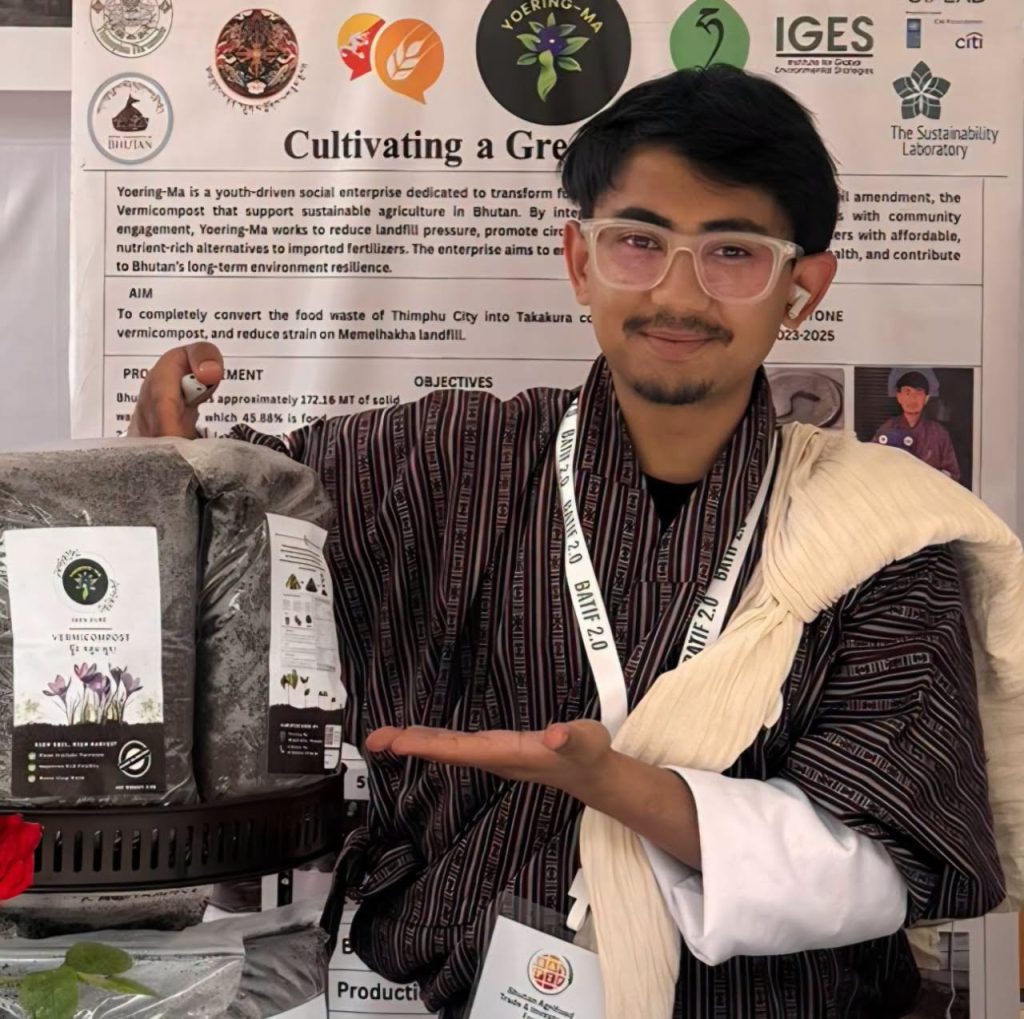
What began as a university research project on earthworms and organic waste has grown into a business that has diverted 35 metric tonnes of food waste from landfills in just nine months.
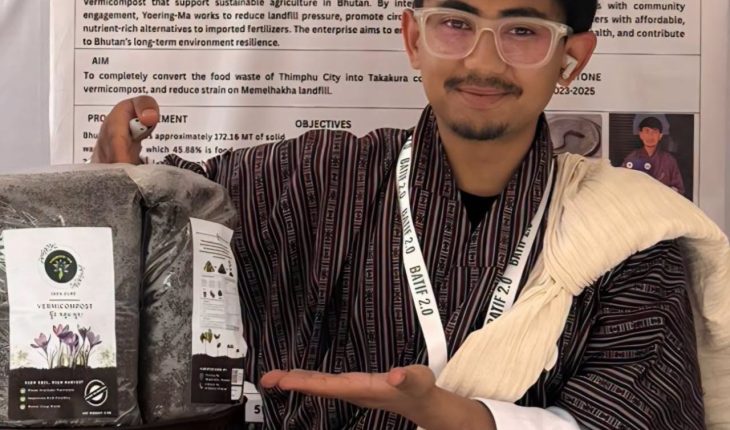
For Sailesh Bhandari, founder of Yoering-Ma, the journey began with a question about how scientific research could address Bhutan’s waste-management challenges while meeting the agricultural sector’s need for quality soil inputs.
A graduate in organic agriculture from the College of Natural Resources (CNR) in Lobesa, Bhandari developed the idea while reviewing literature for his thesis. He learned that Bhutan generated significant amounts of food waste, while commercial-scale composting remained limited.
At the same time, his interest in vermicomposting, which uses earthworms to convert organic material into nutrient-rich compost, led him to explore how the process could be integrated with commercial composting models used in other countries.
“I realized this idea had business potential when I won the Best Research Award at the CSMA Research Meet 2025 and my first business pitch competition at the RUB Business Idea Pitching 2025,” he said.
The two achievements marked a turning point, encouraging him to move beyond academic research and develop Yoering-Ma into an enterprise.
The transition, however, was not straightforward. Despite having scientific knowledge and a business idea, Bhandari lacked the capital needed to establish the venture. He began participating in pitching competitions to secure challenge funds and financial support.
He also persuaded four of his college classmates to join him during the early stages. The team worked for modest wages, using the resources available to gradually build the business.
Bhandari said the experience required a shift in thinking, as running an enterprise involved more than finding a scientific solution to a problem.
“Research is relatively straightforward: identify a problem, investigate it, analyse the results and draw conclusions. Entrepreneurship is very different because you must think about multiple factors simultaneously,” he said.
These included the cost of solving a problem, market size, customer demand, financial feasibility and long-term sustainability. The experience taught him that a solution needed to be scientifically effective and commercially viable to succeed.
𝗧𝘂𝗿𝗻𝗶𝗻𝗴 𝘄𝗮𝘀𝘁𝗲 𝗶𝗻𝘁𝗼 𝗮 𝗿𝗲𝘀𝗼𝘂𝗿𝗰𝗲
Yoering-Ma’s operations build on Bhandari’s academic research comparing ‘Eisenia eugeniae’ (tiger worm) and ‘Eisenia fetida’ (red wiggler) across three Bhutanese feedstock types.
The enterprise collects segregated food waste and uses Takakura composting, a Japanese technology that accelerates decomposition and stabilises organic material. The material is then processed using epigeic earthworms to produce vermicompost for agricultural use.
Through this process, biodegradable waste is transformed into an agricultural input, linking urban waste management with the demand for quality soil amendments.
Within its first nine months of operation, Yoering-Ma diverted approximately 35 metric tonnes of food waste from landfills and produced around 15 metric tonnes of compost, according to Sailesh Bhandari.
The enterprise has also collaborated with Thimphu Thromde on segregated biodegradable waste collection, connecting its operations with the city’s waste-management priorities.
For Bhandari, the approach draws together the interests that shaped his original research: agriculture, environmental protection and the practical application of science. By treating food waste as a potential resource, the business seeks to create value from material that would otherwise be discarded.
𝗕𝘂𝗶𝗹𝗱𝗶𝗻𝗴 𝗮 𝗯𝘂𝘀𝗶𝗻𝗲𝘀𝘀 𝘄𝗶𝘁𝗵 𝘀𝘂𝗽𝗽𝗼𝗿𝘁
Access to finance and equipment remained important as the enterprise developed. Sailesh Bhandari participated in entrepreneurship programmes and sought guidance from experienced business owners to strengthen his understanding of business development and operations.
He identified Ugyen Tshering of Pure Bhutan and Phub Dorji of Nyingnor as mentors who have supported Yoering-Ma’s vision.
The Department of Employment and Entrepreneurship’s Nature-based Solutions (NbS) equipment-support programme has also helped strengthen the enterprise’s production capacity.
Under the programme, selected enterprises receive equipment support through an 80:20 cost-sharing arrangement, with assistance of up to Nu. 2 million. The support has provided Yoering-Ma with an opportunity to improve its operational capabilities.
Sailesh Bhandari said the entrepreneurship community had become an important source of learning since he graduated from college. Interactions with experienced entrepreneurs have helped him gain new perspectives on building a business and navigating its challenges.
He said the journey had broadened his responsibilities beyond research, requiring him to consider production, customers, costs and the long-term sustainability of the enterprise alongside its scientific objectives.
𝗔 𝗹𝗲𝘀𝘀𝗼𝗻 𝗳𝗼𝗿 𝗮𝘀𝗽𝗶𝗿𝗶𝗻𝗴 𝗲𝗻𝘁𝗿𝗲𝗽𝗿𝗲𝗻𝗲𝘂𝗿𝘀
Bhandari’s experience has reinforced his belief that limited financial resources should not necessarily prevent young people from pursuing an idea. His own venture began with academic research, developed through business competitions and gradually progressed with support from classmates, mentors and entrepreneurship programmes.
He encouraged young Bhutanese to use available resources, seek guidance and test their ideas rather than wait until they have everything needed to establish a business.
“Do not let a lack of financial resources stop you from pursuing a good idea. Start with what you have, participate in entrepreneurship programmes, seek mentors, and keep testing your idea,” he said.
“You do not need to have everything figured out at the beginning; you need the courage to start and the willingness to learn along the way.”
Yoering-Ma continues to build on the research that inspired its establishment, applying composting and vermicomposting methods to convert food waste into agricultural inputs. What began as an investigation into earthworms and organic materials has developed into an enterprise working to connect Bhutan’s waste-management needs with its agricultural sector.