Gangzur’s pottery revival faces space and production constraints
TIL BDR GHALLEY | Lhuentse
Traditional pottery is finding new life in Gangzur Gewog, Lhuentse, as rising demand for pots draws more villagers into a craft that had been at risk of disappearing.
The pottery centre now has 10 potters, nine of them women, and receives orders for more than 600 pots a month. The growing market has created an additional source of income for villagers, but meeting demand remains difficult as production continues to rely heavily on manual labour.
Jang Ngar Tshogpa Jigme Thinley said the growing participation in pottery marked a revival of a tradition that was once at risk of disappearing.
“Traditional pottery is important because it is part of the culture and heritage of Gangzur and Lhuentse Dzongkhag. It is important that we preserve and continue this tradition,” he said.
He said the number of pottery makers had declined to about three in 2019, raising concerns about the continuation of the traditional craft. However, government encouragement later helped attract more villagers to the trade.
“Around 2019, the pottery tradition was on the verge of extinction, with only three pottery makers. However, with encouragement from the government, villagers started coming forward and taking up pottery,” he said.
He said pottery had also created employment opportunities for villagers at a time when formal employment, particularly desk jobs, remained limited.
“Since desk jobs are limited, pottery provides an employment opportunity, especially for those who are unemployed,” he said.
For some villagers, the craft has become more than a means of preserving tradition. It has also emerged as a source of income.
Sonam Tobgay, 30, has been making pottery for about 10 years. He said the craft had become more financially viable as the prices of clay products increased. He now earns around Nu 50,000 a month from pottery.
“When I started, the price was not that good and the income was low. Today, the income has increased because the price of pots has almost doubled,” he said.
The centre produces pots in about 12 different types, with prices varying according to size and design.
Sonam Tobgay received training through the De-Suung Skilling Programme, Tarayana and other NGOs with his experience, he now helps and guides those who are new to the craft.
He said that although more people had joined the pottery trade, men in the village remained less interested in taking up the work.
Making pottery is a labor-intensive process that begins with collecting clay. Potters dig and carry the clay to the centre, where it is grounded and sieved to remove stones and other unwanted material. It is then mixed and kneaded before being prepared for shaping.
The centre has a motorized clay-mixing machine provided by Tarayana Foundation to artisan Zam. Following her death, another woman took over its use.
However, during the visit, the machine was lying unused. Potters said the woman who normally operates it was away for medical treatment. The rest of the process continues to depend largely on traditional methods and basic tools.
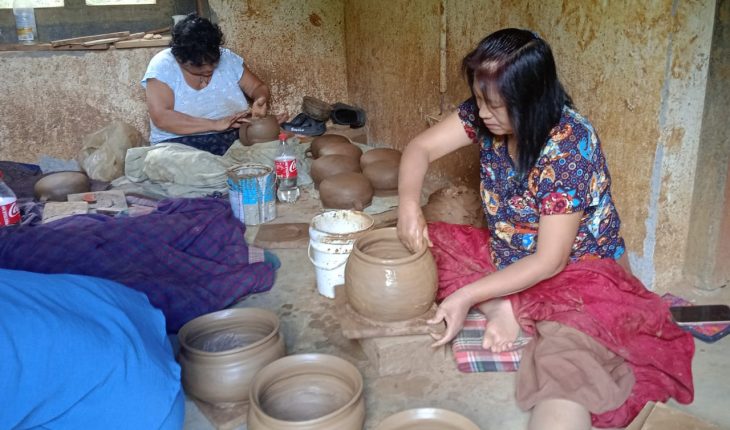
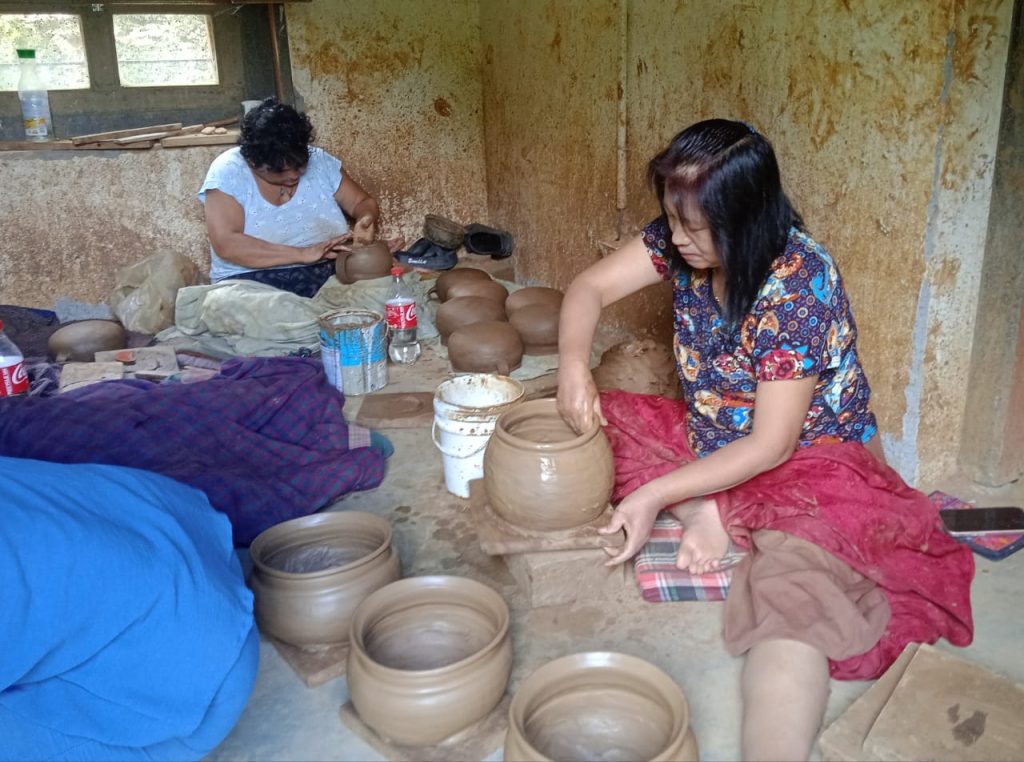
Once the clay is ready, the potter places a portion on a wooden plank and begins shaping it by hand. One hand guides the clay while the other steadily rotates the plank, gradually forming the rough lump into a pot.
The shaped body is left to dry before the base is attached. Handles are added afterwards, and the completed pot is left to dry in the shade for about a week before being fired and coloured.
“The clay used here is terracotta clay,” Sonam Tobgay said. Once the pots have dried, they are fired in an open fire for about two hours until they produce a metallic sound when tapped.
The process limits how quickly the artisans can respond to rising orders. They said machinery for digging, grinding and sieving clay would reduce the physical workload and help increase production.
For the growing number of potters, however, production capacity is not the only constraint.
Jigme Thinley said the increasing number of potters had created another challenge: limited space at the centre.
“The main challenge today is the lack of space. More villagers are coming forward to take up pottery, but the existing space is small. Once they produce more pots, there is also limited space to store the finished products,” he said.
He said the gewog had earlier allocated a budget to construct a storage building and use the existing house as a pottery-making space. However, the budget was later taken over by ecotourism, which had planned to construct the building.
“But I do not know what happened afterwards, as the building was not constructed,” he said.
The potters also depend on firewood to fire the pots. Jigme Thinley said the gewog had been providing additional firewood to support the pottery makers.
He said the gewog had also planned to provide machinery to help potters increase production and reduce the physical workload. However, the plan had been delayed because of budget constraints.
Potters said machinery could help address some of the challenges associated with the growing demand for pottery.
“We have huge demand, but we are facing challenges in meeting that demand because of the increasing number of new potters and the congested space,” Sonam Tobgay said.
For some, pottery has become an additional livelihood later in life.
Sonam Tshomo, 62, began working as a potter a year ago. She produces about 30 to 40 clay pots a month and said the work had provided her with an additional source of income.
Her husband, Tashi Phuentsho, 65, a former soldier from Royal Bhutan Army, helps with the more physically demanding parts of the work.
“I have been helping my wife to dig, carry, grind and sieve the clay for the past month,” he said.
Tashi Phuentsho said pottery could provide a sustainable livelihood for those willing to work and who did not look down on the profession.
“If we do not feel shy or lazy to work as potters, we can sustain adequately,” he said. “I am helping my wife because I believe that even a little contribution is important.”
The trade has also attracted younger people. Ugyen Yangzom, 30, said she became interested in pottery as demand increased. She earns about Nu 22,000 to Nu 25,000 a month, although she does the work mainly during her free time.
She said the growing market, together with limited employment opportunities, had encouraged some villagers to take up pottery.
“Despite the increase in workers here, the younger generation still does not take much interest in making pottery,” she said.
According to Ugyen Yangzom, many villagers treat pottery as work they can take up during their free time or when they have no other work to do at home.
Jigme Thinley said attracting unemployed youth directly into pottery would be difficult, but training could help encourage more young people to take up the craft.
“It is difficult to employ unemployed youth directly here. Therefore, it is necessary to train and encourage young people to engage in pottery,” he said.
The expanding market has also changed the role of people who previously depended on selling pottery.
Dechen Wangmo, 47, used to buy pots from the centre and sell them outside Gangzur. As demand increased, she decided to enter production herself.
“I used to take pots from here and sell them outside Gangzur. As the demand increased, I was encouraged to take up this job,” she said.
The number of people involved in pottery has more than tripled, rising from about three potters in 2019 to 10 in 2026, an increase of about 233 percent. Despite the growth, attracting younger people to the traditional craft remains a challenge.
For a traditional craft that is gaining renewed market demand, the challenge is now to increase space and production capacity while retaining the skills and techniques that have sustained Lhuentse’s pottery tradition.