TIL BDR GHALLEY | Thimphu
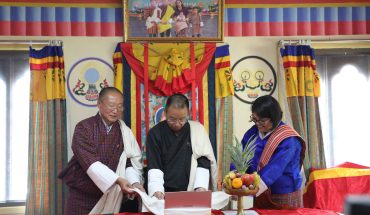
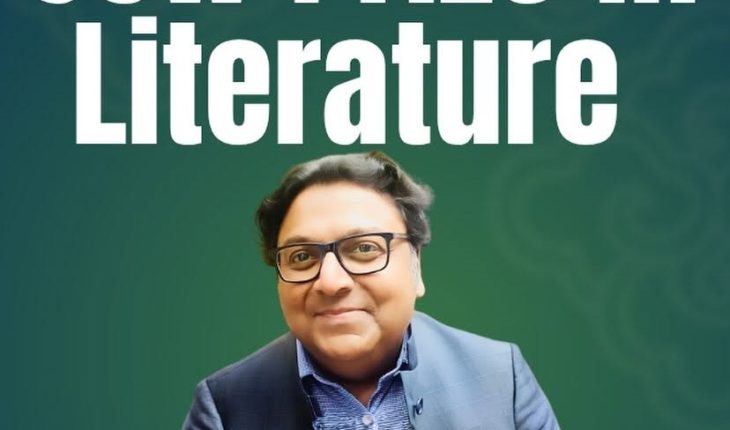
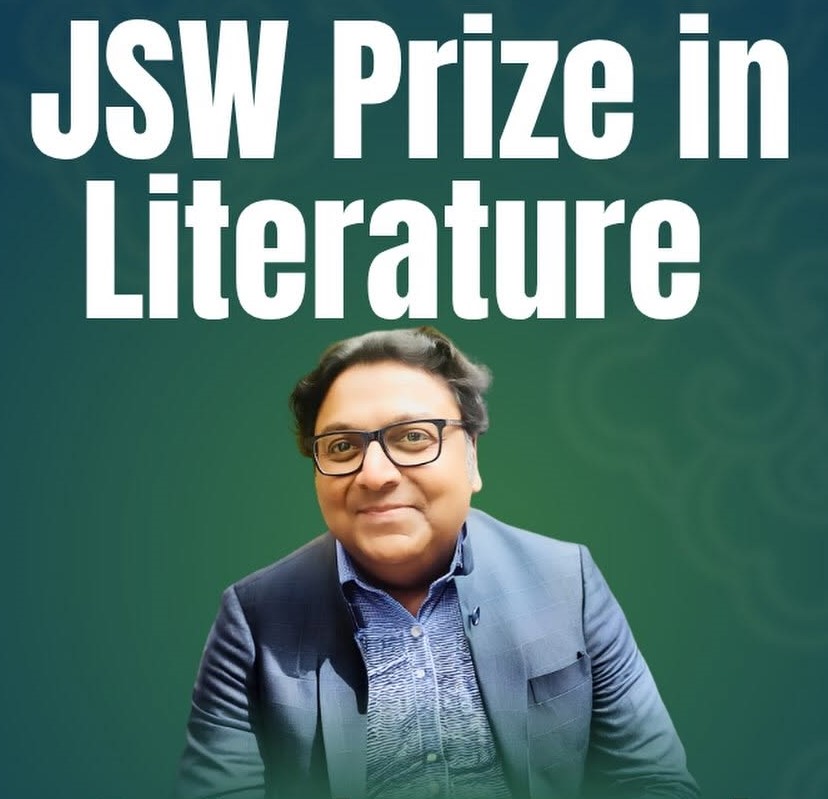
Indian author Ashwin Sanghi received the inaugural Jigme Singye Wangchuck Literature Prize (JSWLP) during the opening of the Drukyul’s Literature and Arts Festival (DLAF) in Thimphu, recognising his contribution to contemporary literature and storytelling.
The award was instituted to commemorate the 70th Birth Anniversary of His Majesty the Fourth Druk Gyalpo and was presented to Ashwin Sanghi at the beginning of this year’s DLAF festival. This marks his fourth participation in DLAF.
Sanghi, one of India’s best-selling English-language fiction authors, has sold more than two million books worldwide. He is known for his thriller novels, including the Bharat Collection series and two New York Times bestselling crime thrillers.
Speaking at DLAF under the theme “The Art of Being Human,” Sanghi reflected on the role of storytelling in connecting people, saying stories remain a fundamental part of human experience even in an era shaped by rapid technological advancement and artificial intelligence.
“From my perspective, the shortest distance between two people is a story. We are living in a world where technology and artificial intelligence are transforming the way we communicate and create. Yet, I believe there will always remain a deeply human instinct, the ability to recognise that this is a story that I must tell,” he said.
He said storytelling is driven by purpose, empathy and connection, qualities that continue to shape human expression.
Sanghi also spoke about the changing relationship between humans and artificial intelligence, noting that AI has advanced rapidly in areas such as data analysis, memory and recollection, pattern recognition and generating creative outputs based on a set of instructions.
He questioned whether creativity alone would continue to define human uniqueness as machines become increasingly capable.
“So when we say humans are unique because we are creative, I doubt whether that distinction will remain exclusively ours,” he said.
Sanghi said emotions such as love, compassion and care, often considered uniquely human qualities, are also visible in the animal world.
“When we look at the animal kingdom, we see these emotions too: an animal caring for another, an elephant standing beside its mother. Many of the emotions that we talk about as uniquely human are also present in the natural world,” he said.
He said the search for meaning and the human desire to understand what lies beyond knowledge remain central to the human experience.
“The very little that remains, I believe, is perhaps the need to bow our heads before something greater than ourselves, which is the power of faith,” he said.
During the session, Sanghi shared his interpretation of the concept of God through an equation he wrote during a conversation with friends more than a decade ago:
G = ∞ – K.
He explained that G represented the divine, ∞ represented the entire universe, and K represented human knowledge.
“In simple terms, God, or divinity, is what remains beyond human understanding. It is the universe minus human knowledge. What I cannot explain or comprehend becomes, for me, the divine,” he said.
Using the example of ancient Egyptian beliefs about the sun god Ra, Sanghi said human understanding evolves as scientific knowledge expands, with mysteries becoming explainable over time.
“To me, the unique aspect of being human is that we are always in pursuit of that one thing we cannot explain,” he said.
He added that unlike machines, humans would continue searching for forces and ideas greater than themselves.
“Unlike machines, humans will continue searching for that one extraordinary force that inspires us to bow our heads before something greater than ourselves,” he said.
As artificial intelligence expands its capabilities, questions about what truly distinguishes humans from machines continue to shape discussions on identity, values and the future of humanity.
Following his recognition with the inaugural JSWLP, Sanghi announced that he would donate the prize money to the Tarayana Foundation, a civil society organisation working to support vulnerable communities across Bhutan. The donation followed his session under the theme “The Art of Being Human,” where he reflected on storytelling, faith and the qualities that shape human experience.