Led by Gyalwa Dokhampa, the Garsha Eco Pad Yatra brought Buddhist values of compassion, interdependence and reverence for life into the climate conversation, calling for greater action to protect the Himalayas, which are reeling under the impacts of climate change.
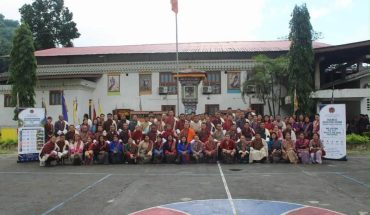
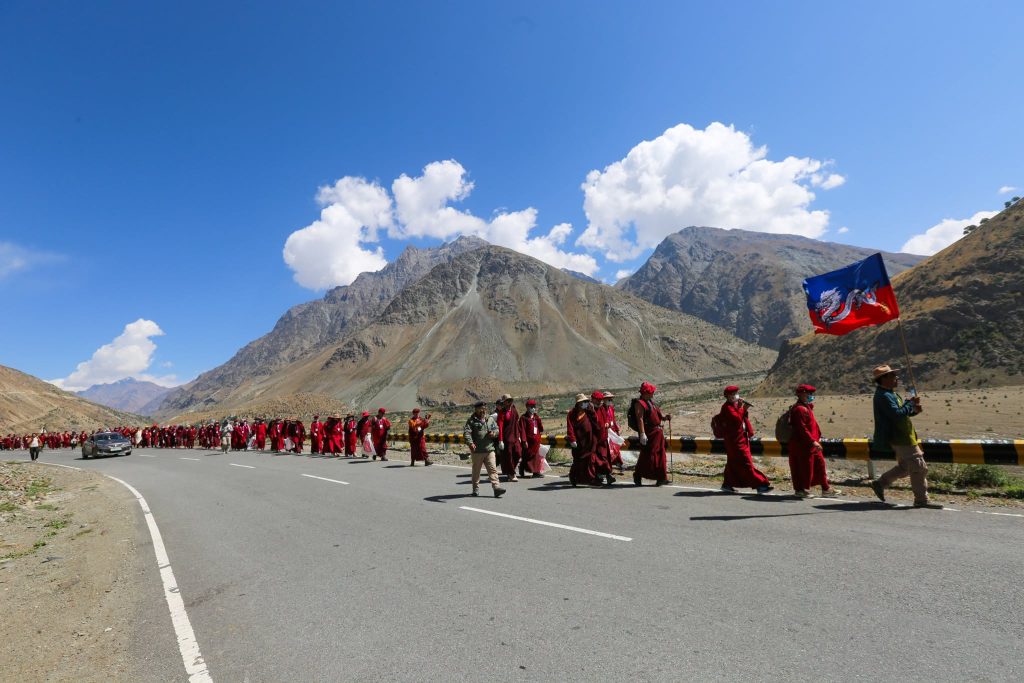
Joined by the renowned Drukpa Kung Fu nuns and participants from Bhutan, India, Nepal, Malaysia, Singapore and Vietnam, nearly 1,000 people walked more than 100 kilometres through seven villages in Garsha (Lahaul), Himachal Pradesh, not simply as pilgrims, but as witnesses to a landscape undergoing profound change.
Held from September 20 to 26 under the theme “Walking for Climate and Heritage,” the journey invited people to view the climate crisis through a Buddhist lens: compassion, interdependence, non-harm and reverence for life.
“We are part of nature,” said Gyalwa Dokhampa, a revered Drukpa Buddhist teacher and author of the book The Restful Mind. “The Buddha taught us about interdependence. Nothing exists completely on its own. Our lives depend on water. Water depends on the mountains. The mountains are connected with forests, glaciers and the wider ecosystem. And our communities depend on all of these.”
𝗧𝘄𝗼 𝗰𝗼𝘂𝗻𝘁𝗿𝗶𝗲𝘀, 𝗼𝗻𝗲 𝘁𝗿𝗮𝗱𝗶𝘁𝗶𝗼𝗻
The journey also traced a spiritual thread between India and Bhutan. Buddhism took root in Bhutan through teachers and traditions that crossed the Himalayas from the Indian subcontinent. Among them was Guru Padmasambhava, revered in Bhutan as Guru Rinpoche, who is said to have travelled from India through Tibet to Bhutan in the eighth century. The Drukpa Kagyu school, which shapes Bhutan’s spiritual life today, belongs to the same Himalayan Buddhist world that includes Lahaul, Spiti and Ladakh.
Lahaul sits along ancient trade and pilgrimage routes linking India and the Tibetan plateau. Walking this route, Bhutanese and Indian participants were retracing a shared inheritance as much as crossing a border.
This is why the Pad Yatra may prove to be more than a single event. A Pad Yatra is a pilgrimage on foot, and the Garsha walk suggests the beginning of a new Buddhist pilgrimage circuit in India, one that connects sacred sites, mountain villages and living communities, and links the heritage of India with that of Bhutan. Unlike many pilgrimages of the past, it unites devotion with environmental stewardship.
𝗪𝗶𝘁𝗻𝗲𝘀𝘀𝗶𝗻𝗴 𝗮 𝗰𝗵𝗮𝗻𝗴𝗶𝗻𝗴 𝗺𝗼𝘂𝗻𝘁𝗮𝗶𝗻
Walking beside rivers and through remote villages, participants saw how climate change is reshaping Himalayan life.
In Jhalman, a sudden flood in June, linked to glacial melt upstream, washed away a bridge and sections of road. In Lindoor, the ground is giving way beneath a village of 14 households and about 150 people, who now face relocation. “I don’t want to leave my village,” one woman said. “This is my home. Where will I move? I will stay here as long as I can.” In Sissu, residents worry about the expanding Ghepan Lake and the risk of a glacial lake outburst flood.
For Dechen Wangmo, a former Bhutan Broadcasting Service (BBS) journalist, these encounters were the heart of the journey. Rivers were becoming unpredictable, slopes were giving way and familiar seasons were disappearing. September, normally cool in the mountains, was unusually hot.
“Everywhere, people spoke of a climate that no longer behaves as it once did,” Dechen said after returning to Bhutan on 1 October. “People told us simply that there are no longer seasons in Garsha. We felt what they meant.”
For her, the walk turned climate change from an issue discussed in reports into a human experience. She saw how rising temperatures and shifting weather are affecting people who have lived in these mountains for generations.
For Bhutanese participants, the changing conditions carry particular significance because of the country’s dependence on mountain ecosystems. But the message resonated just as strongly with those from Singapore, Malaysia and Vietnam.
𝗔 𝗰𝗿𝗶𝘀𝗶𝘀 𝘁𝗵𝗮𝘁 𝗰𝗿𝗼𝘀𝘀𝗲𝘀 𝗯𝗼𝗿𝗱𝗲𝗿𝘀
Garsha is only one part of a much larger story. The Hindu Kush Himalaya stretches across eight countries, including Bhutan, India and Nepal. More than 270 million people live in the region, and its rivers supply water to nearly two billion people downstream. Often called the “Water Tower of Asia,” it is vital to the water security of millions.
Yet its glaciers are retreating fast. A 2026 assessment by the International Centre for Integrated Mountain Development (ICIMOD) found that glaciers across the region are losing ice at twice the rate recorded since 2000, with some thinning by up to 27 metres since 1975. Changing snowfall, degrading permafrost and erratic river flows are raising the risk of floods, landslides and glacial lake outburst floods.
“This matters to Bhutan as much as it does to communities in northern India or Nepal,” said a Bhutanese participant. “The mountains may be divided by national borders, but the climate system is not.”
𝗙𝗿𝗼𝗺 𝘄𝗮𝗹𝗸𝗶𝗻𝗴 𝘁𝗼 𝗮𝗰𝘁𝗶𝗼𝗻
The Pad Yatra did not stop at awareness. Along the route, participants collected waste and planted more than 200 trees. Its deeper aim was to build a sense of shared responsibility, a recognition that the Himalayas are a living system, not merely a spectacular landscape.
“From a Buddhist perspective, protecting nature is not something different from practicing Dharma,” said Gyalwa Dokhampa. “Taking care of the earth is an expression of compassion. When we protect a water source, we protect the people and animals who depend upon it. When we plant trees, we are thinking about generations beyond our own. When we reduce plastic d waste, we show respect for the land that sustains us.”
The climate crisis is, at its core, a crisis of relationship: with nature, with one another and with future generations.
The walk ended in Garsha, but its message is meant to travel further, along the same routes that once carried the Dharma between India and Bhutan. To protect the Himalayas is to protect the lives they sustain, and to remember that none of us exists apart from the natural world.
𝘾𝙤𝙣𝙩𝙧𝙞𝙗𝙪𝙩𝙚𝙙 𝙗𝙮 𝙍𝙞𝙣𝙯𝙞𝙣 𝙒𝙖𝙣𝙜𝙘𝙝𝙪𝙠, 𝙀𝙭𝙚𝙘𝙪𝙩𝙞𝙫𝙚 𝘿𝙞𝙧𝙚𝙘𝙩𝙤𝙧 𝙤𝙛 𝙩𝙝𝙚 𝙅𝙤𝙪𝙧𝙣𝙖𝙡𝙞𝙨𝙩𝙨’ 𝘼𝙨𝙨𝙤𝙘𝙞𝙖𝙩𝙞𝙤𝙣 𝙤𝙛 𝘽𝙝𝙪𝙩𝙖𝙣