TIL BDR GHALLEY | Thimphu
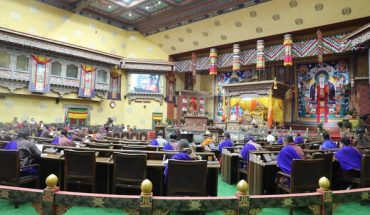
The National Assembly has directed the Ministry of Infrastructure and Transport to conduct further assessments on proposals to increase building heights from three to five storeys in Yenlag Throms, with Members of Parliament raising concerns over infrastructure readiness, housing shortages, loan burdens, and urban planning challenges.
Presenting the Action Taken Report to the House, Chandra Bdr. Gurung minister for Ministry of Infrastructure and Transport said the current building height regulations were formulated based on population projections, infrastructure carrying capacity, settlement patterns, cultural considerations, and site conditions.
The Minister said the Ministry undertook a comprehensive review of urban centres following directives from the Environment and Climate Change Committee of the National Assembly. The assessment examined development trends, infrastructure capacity, and existing urban conditions across Yenlag Throms.
According to the Minister, the review found that current development rights are sufficient to accommodate projected population growth until 2040. He added that many plots in Yenlag Throms remain underdeveloped, indicating there is still adequate room for future expansion under existing regulations.
“While there are individual requests to increase the heights to capitalize on investments, there is no need to increase the building heights from the current limits,” the Minister said.
Yenlag Throms, identified in 2015 as secondary growth centres, were established to provide services and amenities to surrounding rural communities. However, the Minister said many of these urban centres have yet to be formally declared and administered as independent local government entities.
Currently, most Yenlag Throms allow buildings up to three story, while Nganglam permits four stories and Damji Urban Centre allows two stories.
Under the Bhutan Building Regulations 2023, basements, stilt floors, and partial attic spaces known as Jamthog are also permitted and can be used as habitable areas.
The Minister explained that when these provisions are included, some buildings already achieve the equivalent of five functional floors, creating additional pressure on infrastructure systems such as water supply, sewage, roads, and parking facilities.
He said decisions on building heights are determined using four key considerations: population projections, infrastructure capacity, cultural and settlement context, and topographical conditions.
The Minister said increasing building heights without sufficient population demand could result in underutilized infrastructure and financial risks for property owners.
“Increasing building heights without corresponding population demand may lead to underutilization of infrastructure,” he said.
He also emphasized the importance of preserving Bhutan’s traditional settlement character and cultural identity. According to the Minister, uncontrolled vertical expansion could affect traditional streetscapes, view corridors, and the visual character of settlements with cultural significance.
The Ministry further noted that site conditions such as steep slopes, unstable soil, and landslide risks are important factors in determining permissible building heights.
As part of the review, the Ministry assessed development trends in several Yenlag Throms, including Jyenkana, Gomtu, Tsimasham, Lobesa, Panbang, Rangjung, Nobding, and Doksum.
Referring to Nobding in Wangdue Phodrang District, the Minister said the current population of around 800 is projected to grow to 1,640 by 2037 and that the existing three-storey limit remains adequate to support the projected population increase.
He said any proposal to allow five-storey buildings in Nobding would require significant improvements in water supply, waste management, parking infrastructure, earthquake safety measures, and community spaces.
“Without the supporting population, the five-storey buildings will become economically unviable,” the Minister said, adding that taller buildings could lead to vacant rental spaces and loan repayment difficulties.
Similarly, in Doksum under Trashiyangtse District, the Minister said the current population of 420 is projected to increase to around 2,000 by 2035, but existing development rights remain sufficient to accommodate the projected growth.
During the deliberations, several Members of Parliament raised concerns regarding inconsistencies in regulations, housing shortages, and the economic impact of current building restrictions.
MP Kinzang Wangchuk representing Dramedtse_Ngatshang constituency questioned the Minister on the financial burden faced by building owners who are struggling to repay loans due to restrictions on building heights.
He asked whether the Ministry had discussed the issue with financial institutions, noting that many owners are unable to generate sufficient rental income from three-storey buildings to meet their monthly loan repayments.
MP Kinzang Wangchuk also raised concerns over inconsistencies in the regularization of attic and basement spaces. He said some property owners were allowed to regularize such spaces while others were denied.
“As per the Minister, including attic and basement spaces already makes it equivalent to five storey. If that is the case, then there is no reason not to regularize them uniformly,” he said.
MP Namgay Dorji representing Khamdang-Ramjar constituency said residents in Trashiyangtse are facing housing shortages despite the dzongkhag being limited to two-storey buildings in certain areas.
He said allowing three-storey buildings would help address the growing demand for housing in the district, which hosts numerous government offices and has a growing population.
“The housing situation has reached a point where the National Housing Development Corporation Limited has had to construct housing units,” he said.
MP Namgay Dorji also highlighted challenges in Doksum, saying the area is experiencing housing shortages linked to the ongoing Kholongchhu Hydropower Project. According to him, around 120 households are facing accommodation shortages.
Opposition Leader Dasho Pema Chewang said that while the Ministry had considered population projections, infrastructure, settlement context, and topography in determining building heights, social factors should also be incorporated into the assessment framework.
He urged the Ministry to consult dzongkhags and relevant agencies to ensure that social considerations are reflected in future urban planning decisions.
Meanwhile, MP Pempa representing Bongo_Chapchha said towns such as Tsimasham, Gedu, and Darla in Chhukha District have favourable site conditions and topography suitable for development.
However, he said residents continue to pay taxes according to satellite town regulations without receiving corresponding urban services and facilities.
“Regarding budgets and facilities, they are still not being treated like towns,” he said.
Additionally, the Ministry was instructed to report on the progress of several initiatives currently under review, including revisions to local area plans, geotechnical and hazard mapping studies, spatial planning for remaining Yenlag Throms, and clarification of regulations concerning road rights-of-way along national highways.
The Minister said future revisions to building heights would not be introduced through a blanket nationwide policy. Instead, any changes would be based on detailed, site-specific spatial planning reviews.
“Site-specific height regulations will be adopted based on the conditions and development potential of each area,” the Minister said.
He added that the Ministry is establishing technical committees involving local governments, communities, and service providers to support future urban planning and infrastructure development efforts.
The deliberation highlighted growing national concern over balancing urban expansion with infrastructure capacity, economic realities, and the preservation of Bhutan’s traditional settlement character as secondary urban centres continue to develop across the country.
After deliberation, the House directed the Good Governance Committee to further review the concerns raised, identify gaps in the report, and present recommendations and necessary interventions in the next Session.