KINLEY KHANDU CHODEN | Thimphu
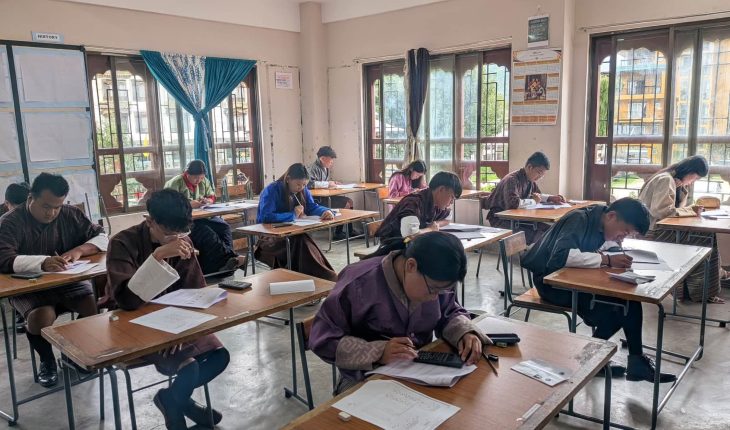
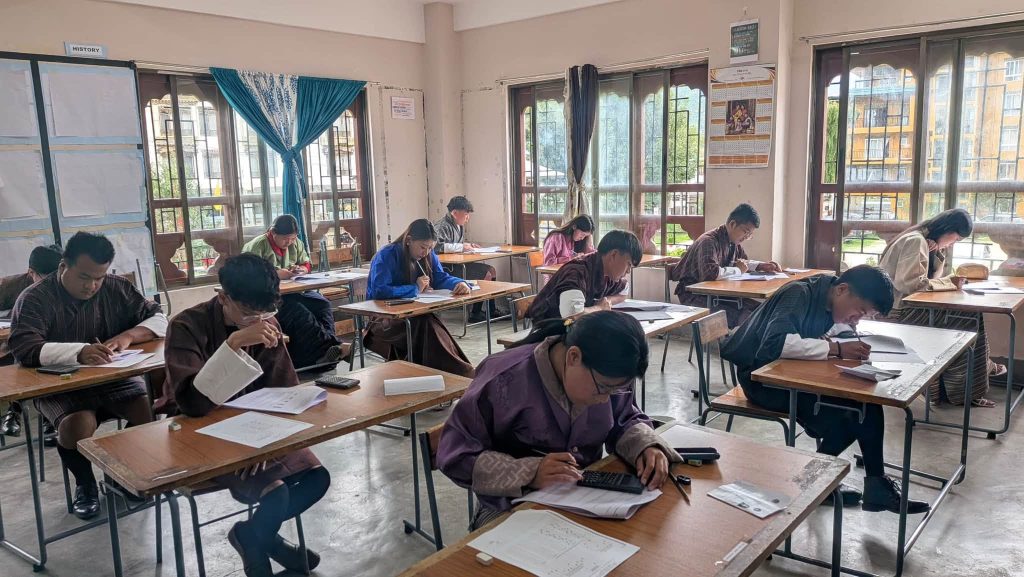
Nearly 2,000 graduates are competing for limited civil service positions as 1,994 candidates have registered for the 2026 Bhutan Civil Service Examination (BCSE) Main Examination.
According to figures provided by the Royal Civil Service Commission (RCSC), the candidates are registered across six categories. The technical category has the highest number of candidates at 714, followed by administrative services with 594 candidates. B.Ed. has 278 candidates, finance 217, Post Graduate Diploma in Education (PGDE) 163 and Dzongkha with 29.
The RCSC has listed 742 vacancies across the categories, with an overall vacancy-to-candidate ratio of 1:3. Administrative services has 594 candidates competing for 65 vacancies, while B.Ed. has 278 candidates for 150 vacancies. Dzongkha has 29 candidates for three vacancies, finance has 217 candidates for 40 vacancies, and PGDE has 163 candidates for 60 vacancies. The technical category has 714 candidates and 427 vacancies according to the category-level figures provided by the RCSC.
The RCSC said the technical category has the highest number of registered candidates because it covers different technical professional groups.
The technical category includes fields such as agriculture, animal science, biotechnology, chemistry, environment, forestry, engineering, medicine, ICT, law and other specialised areas.
Clinical nursing has the highest number of candidates among the technical fields, with 140 candidates competing for 111 vacancies. ICT has 78 candidates for 31 vacancies, while environmenthas 52 candidates for seven vacancies.
MBBS has 51 candidates for 53 vacancies, agriculture has 39 candidates for six vacancies, and animal science has 37 candidates for five vacancies. Electrical engineering has 30 candidates for 11 vacancies, while electronic and communication engineering has 26 candidates for one vacancy.
For candidates, preparing for the examination has involved covering subjects beyond their university specialisations.
Narish Chhetri, a BSc Physics graduate from Sherubtse College, said his decision to sit the examination was motivated partly by a desire to give back to the country.
“The government of Bhutan has provided us with free education since PP up to degree graduation, so now to pay for their generosity is what motivated me,” he said.
He said securing a civil service position would give him an opportunity to serve the country while building a stable career.
“To me securing a position in civil service would be something that I would be proud of, as I could get a chance to serve the country and help contribute to His Majesty Vision for the country,” he said.
Narish is preparing for the examination through coaching classes at Rigzin Institute for the general categories. He said the classes have helped him with answer-writing techniques, current affairs and Bhutanese history.
However, coming from a science background has made some parts of the preparation challenging.
“Since I have been learning STEM subject since class 11 and now, I lost track of all the history topics I have learned,” he said.
He said theory-based subjects were challenging after years of studying science subjects that largely involved equations.
Narish said knowledge of Bhutan’s history and current affairs is important for civil servants, but candidates from specialised academic backgrounds may face difficulties when examination content differs significantly from what they studied.
“Being a citizen of Bhutan, it is our responsibility or it should be like History and Current affairs of the country should come naturally to us,” he said.
“At the same time, the questions that we answer in the ME is completely different from what we prepared or learned through college and High division as a science student,” he said.
He said the examination could include questions related to candidates’ academic backgrounds.
“If there can be change, I would like to see RCSC to print some questions that also includes the question related to what we had prepared in college and higher division,” he said.
Yeshey Tshogyel, 22, who studied at Rangsit University in Thailand, said her interest in working in Bhutan and the requirement for civil service applicants to sit the RCSC examination motivated her to participate.
“I have always been interested to work in an organization here in Bhutan and it is mandatory for applicants to do the RCSC exam for the application, therefore, I decided to sit for the main exam,” she said.
She is preparing through coaching classes. She said one of her main challenges is finding enough time to study while covering subjects outside her university course.
“As I’ve not learned about most of the topics we have to learn for the exam since it is not related to my course which I took in university, it is difficult for me to catch up with everything in a short period of time,” she said.
Yeshey said the examination assesses some important areas required for civil service, including knowledge and analytical ability, but may not fully measure practical skills.
“It may not fully measure practical skills such as leadership, teamwork, communication, and problem-solving, which are also important for an effective civil servant,” she said.
For Jigdrel from Royal Thimphu College, the examination is an opportunity to explore the possibility of securing a stable job.
“I just wanted to give it a try because I don’t know what to do during these few days. Even if I get a position, I would be happy because it would provide me with a secure job,” he said.
He is taking tuition classes for various subjects and said he has not faced major challenges in his preparation.
“If it is based on knowledge, then I would say yes. I believe that people who study and work hard will surely have a better chance of getting the job, regardless of other factors,” he said.
Karma Pem Lhaden, 23, from Rangsit University, said the opportunity to use her education in public service was a major motivation for sitting the examination.
“My main motivation for sitting the RCSC Main Examination is the opportunity to use my education and skills in a career where I can contribute to the country,” she said.
As a Biomedical Science graduate, she said she is particularly interested in contributing to Bhutan’s health and public service sectors.
Karma is preparing by studying the syllabus systematically, reviewing previous examination questions, following current affairs and national issues, and practising answer-writing within the limited examination time.
“One of my biggest challenges is managing the large amount of information that needs to be covered within a limited time,” she said.
Karma said the examination assesses general knowledge, awareness of national issues, analytical ability, writing skills and understanding of government policies. However, she said a written examination alone cannot assess all competencies required of a civil servant.
“I do not think a written examination alone can fully assess all the competencies required of a civil servant,” she said.
She said communication, teamwork, problem-solving, adaptability, integrity, leadership and practical decision-making are also important qualities that may not be adequately reflected in a written examination.
She suggested incorporating more practical assessments into the recruitment process.
“I would like to see a greater emphasis on assessing practical skills and competencies alongside academic knowledge,” she said.
She suggested case-based questions, problem-solving exercises, communication or situational assessments that reflect challenges civil servants may face.
“Greater transparency in the examination and selection process would also help candidates understand how they are being assessed,” she said.
The candidates’ experiences show different motivations for entering the civil service, including the desire to serve the country, secure stable employment and apply their academic qualifications in public service.
For some candidates, preparation has also involved revisiting subjects outside their academic specialisations, particularly Bhutanese history, current affairs and other general areas covered by the examination.
With 1,994 candidates competing for 742 positions, the examination remains a major entry point into the civil service for graduates from diverse academic backgrounds.
The written exam will be held from 1to 3 October, followed by viva from 12 to 20 October, 2026 and the result will be declared in 1st week of December.