TIL BDR GHALLEY | Samtse
For generations, orange orchards were an important part of the cash crop in Ngawang Dramtoe, Tading Gewog, Samtse. Today, many of those orchards have disappeared, leaving farmers searching for a cash crop that can provide a dependable source of income from the land.
The change is particularly visible in the Lhop community, where farmers say orange trees that once covered large stretches of their orchards began dying about a decade ago because of disease.
For 47-year-old Namgay Lhop, the failure of oranges remains a reminder of how difficult it has become to find a crop suited to the village.
He planted two orange saplings near his house to see whether they could thrive and revive what was once a familiar crop in the community. Despite regularly applying manure, the trees have grown only about five metres in five years, far slower than expected.
“They should have been bearing fruit by now, but they still look like two-year-old trees. They have turned yellow and are dying,” he said.
The loss of the orange orchards has left farmers experimenting with alternatives. Areca nut, locally known as doma, is among the crops some farmers are now considering, but there is uncertainty over whether it will perform well in Ngawang Dramtoe.
“Now we are planting betel nut, but we do not know how it will work. Ngawang Dramtoe is neither as hot as Taba Dramtoe, where betel nut grows well, nor cool enough for cardamom. Our climate is moderate, so we are not confident that betel nut will grow well here. Even if the trees bear fruit, we do not expect them to produce as much as those in Taba Dramtoe or other parts of the gewog,” Namgay said.
His uncertainty reflects a wider problem facing farmers: losing an established cash crop does not necessarily mean there is an obvious replacement.
Samtse is one of Bhutan’s important agricultural districts, with a subtropical climate supporting crops including maize, oranges, cardamom and areca nut. The dzongkhag administration lists areca nut, ginger, orange and cardamom among its main cash crops, with nearby markets and markets in West Bengal providing outlets for produce.
But what works in one part of the district may not necessarily work in another. Farmers in Ngawang Dramtoe say they are still trying to identify a crop that matches their local conditions and can generate sufficient returns.
For some households, the alternative has been to return to food crops rather than risk investing in an uncertain cash crop.
“We do not have many options for cash crops. We plant food crops such as maize and cassava,” said Mendu Lhop.
Cassava has traditionally provided food, but farmers say growing crops primarily for household consumption does little to address the need for cash income.
Even food production, however, is becoming increasingly difficult because of wildlife.
Farmers say maize and other crops remain vulnerable to wild boar, monkeys, deer, porcupines and birds. The damage can be severe, with some farmers forced to harvest their crops before they fully mature to prevent losing them to wildlife.
Another farmer, Sonam Doya, 54, from the same village said what appears to be a decline in human-wildlife conflict does not necessarily mean wildlife has become less of a threat.
She said that crop-related wildlife conflict has fallen by about 80 percent, but said this is largely because farmers themselves have reduced cultivation.
“The wildlife attack has not stopped. It has decreased because people have stopped planting,” she said.
“We cannot guard our crops day and night. The constant threat of wildlife damage has discouraged us from cultivating, and many of us have stopped farming,” Penday Zam said.
Purna Bdr, Gewog Agriculture Extension Supervisor, said awareness programmes on the National Crop and Livestock Insurance Scheme (NCLIS) had already been completed across all chewogs under Tading Gewog, but no applications had been received from the gewog.
“The scheme could have provided relief to those whose crops were damaged by wildlife. However, till date, no applications have been received from the entire gewog. Therefore, we will need to further intensify awareness and facilitation in the future to ensure enrollment,” he said.
“If the community is comfortable with electric fencing, we will propose the activity after due consultation with them and forward the proposal through the proper channel,” he said.
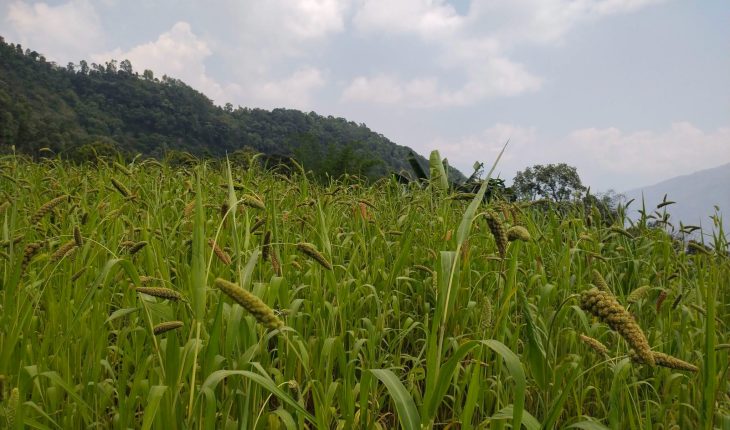
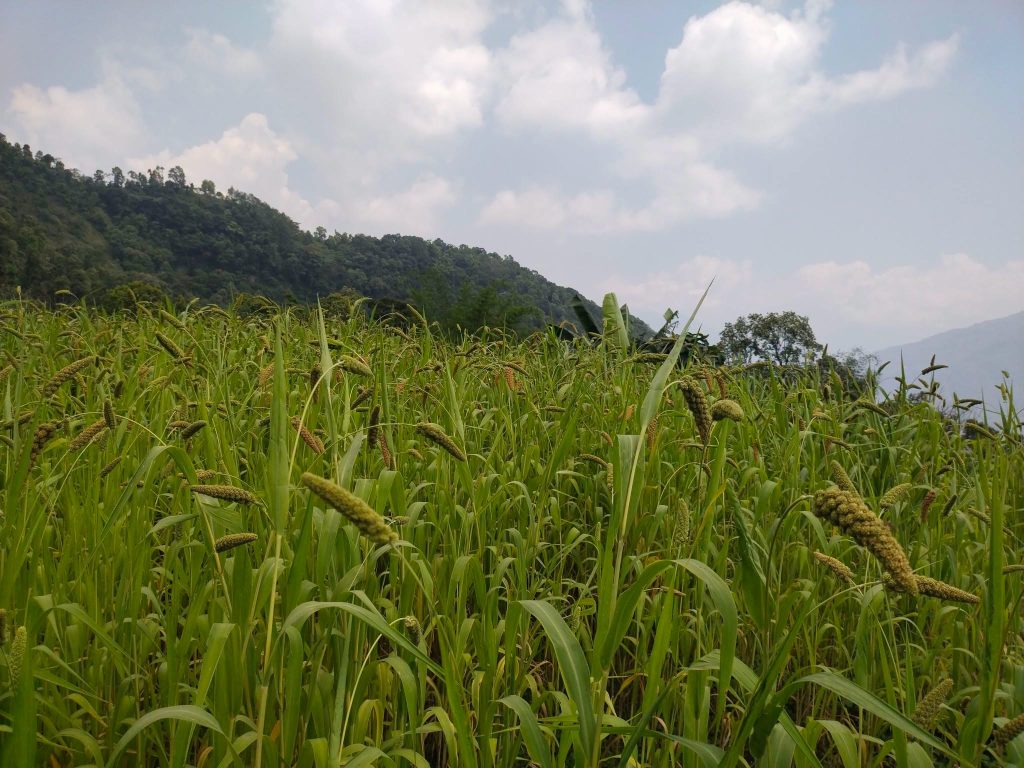
The change is particularly significant for foxtail millet, a crop that has long been part of Lhop food and farming practices.
Sonam said foxtail millet was once cultivated extensively in the community, but only a handful of people now grow it, largely for household consumption and occasional sale within the village.
The decline in cultivation also reflects a broader change in traditional agricultural practices. Shifting cultivation, once part of the community’s farming system, has largely stopped, she said.
The result is a gradual shift from a farming system that once produced a range of staple crops towards smaller-scale cultivation shaped by market access, wildlife pressure and changing livelihoods.
Ngawang Dramtoe is connected by road, and its proximity to Phuentsholing gives farmers access to one of the country’s major commercial centres. Tading Gewog itself is located close to Phuentsholing and is connected by the Phuentsholing–Samtse Secondary Highway and Phuentsholing–Gomtu National Highway. She says farmers sell fresh produce at roadside vegetable stalls, reflecting the growing connection between farming and local markets.
“Since we have access to roads and are close to Phuentsholing, we can sell our vegetables there and buy whatever we need,” she said.
Vegetable production has previously shown potential in the community. In 2021, farmers in Ngawang Dramtoe were reported to have started growing vegetables such as chilli, beans and cabbage, with some households earning income from their produce.
But vegetables alone may not fill the gap left by the loss of perennial cash crops such as oranges.
The Agriculture Sector under the Samtse Dzongkhag Administration is responsible for providing agricultural extension services and supporting farmers through initiatives including high-value crop production, integrated pest and disease management, sustainable land and soil-fertility management, irrigation and farm mechanisation, as well as post-harvest management and market linkages.
Purna Bdr said citrus greening disease (HLB) and ageing orchards had been identified as the main factors behind the decline of orange trees in the area.
“Therefore, we will conduct a consultation with the affected farmers and develop a specific action plan to revive the orchards, including provision of disease-free seedlings and exploration of suitable alternative cash crops as per local conditions,” he said.
For farmers in Ngawang Dramtoe, however, the challenge is identifying a cash crop suited to the local conditions that can provide a reliable alternative to the orange orchards lost to disease.
The disappearance of the orange orchards has therefore done more than change what farmers plant. It has altered the community’s relationship with its farmland.
A generation ago, farmers could point to established orchards as a source of both food and income. Today, some are planting new crops without knowing whether they will thrive, while others are reducing cultivation because wildlife damage makes farming increasingly difficult.
The challenge for Ngawang Dramtoe is no longer simply to produce more. It is to find a crop that can survive the village’s growing pressures from disease and wildlife to changing farming practices and still provide farmers with a reason to keep their land under cultivation