TIL BDR GHALLEY | Thimphu
Bhutan has identified promising prospects for copper and tungsten, as well as potential rare earth elements and geothermal resources, through its first nationwide airborne geophysical survey, but further ground studies will be needed to establish whether the findings represent are commercially viable deposits.
The survey covered about 15,410 square kilometres across the lower southern belt and the Thimphu-Paro region and identified anomalies considered favourable for copper and tungsten, along with rare earth elements, base and precious metals and geothermal structures, according to the Department of Geology and Mines (DGM).
The findings mark a shift from broad mineral exploration to targeted investigation, with the government now moving to ground-based studies to verify the airborne results.
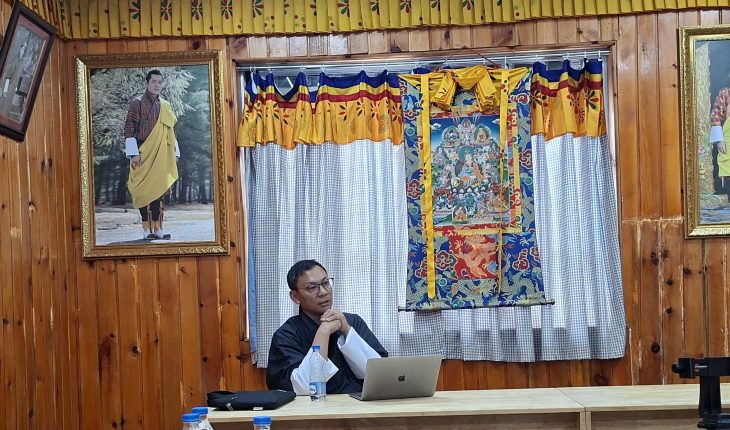
Phuntsho Namgyal, Director General of DGM, said the survey had provided Bhutan with a clearer picture of where further exploration should be focused.
“For fifty years we did not know what lay beneath us. This survey moves Bhutan from a position of searching to a position of knowing,” he said.
He cautioned, however, that the airborne findings do not amount to confirmed mineral resources.
“The interpretation gives us a defensible map of where to look,” Phuntsho Namgyal said. “Where independent methods agree, that is not noise. But a favourable anomaly is a hypothesis, not a deposit.”
Prime Minister Tshering Tobgay said the preliminary findings for copper and tungsten were promising, but the government would first have to establish the quantity, quality and economic viability of the deposits.
“There are possibilities of critical and rare earth minerals which have to be established,” PM said.
He said geochemical and geophysical studies would be carried out to determine the extent and quality of the mineralisation.
“We have to look at the quantity, quality and if it is economically feasible,” he said. “Tungsten and copper are very important and we need to establish the quantity and quality.”
The government has allocated a budget for the ground studies, he said.
The airborne survey also identified geological formations associated with rare earth mineralisation, including granitic intrusions and carbonatites.
The DGM said these are among the rock types that host much of the world’s rare earth production. However, it stressed that the survey could establish the presence and geometry of such geological bodies but could not determine whether they contained economically significant concentrations of rare earth elements.
That determination will require geochemical sampling and further ground investigation.
The department said the survey had not produced a resource estimate or economic assessment. Establishing the cause, grade, quantity and depth of a geophysical anomaly will require geochemical sampling, ground geophysics, detailed mapping, drilling and assay.
Phuntsho Namgyal said the government’s approach would be to verify the findings before making decisions on development.
“Our obligation is to test these targets to a standard any competent geologist anywhere would accept, and to report what we find whether or not it is what we hoped for,” he said.
The survey has also identified geological structures that could indicate geothermal potential.
According to the department, the survey detected deep structural corridors and fault systems associated with geothermal circulation, together with zones of magnetic depletion consistent with hydrothermal alteration. These features correlate with locations of Bhutan’s known thermal springs.
PM said Bhutan could explore geothermal resources for electricity generation, citing Iceland as an example.
“There is a lot of opportunity in geothermal vents for power generation like in Iceland,” he said, adding that the airborne survey had produced positive indications.
He said sustainable green power could support emerging economic activities such as data centres and artificial intelligence.
The DGM said the survey was particularly relevant as global demand for critical minerals increases. Copper is increasingly important for power grids and data-centre infrastructure, while tungsten is used in semiconductor manufacturing and precision tooling.
PM said any future mining would have to comply with Bhutan’s environmental standards and deliver benefits to the public.
“The mining done at any point has to be in line with our environmental standards and must benefit the public,” he said.
He said future decisions would be guided by the principles of Gross National Happiness, environmental protection and sustainable development.
“We will follow the principles of GNH and protecting our environment in going ahead,” he said. “Any mining should not harm the environment, give people economic development and happiness and be sustainable.”
The DGM also stressed that identifying mineral potential does not amount to a decision to extract the resources.
The department said the survey was primarily intended to improve geological understanding and identify areas requiring further investigation. Any future development would take place only if required, when the time was right, through public processes and within Bhutan’s constitutional and environmental framework.
The Constitution of Kingdom of Bhutan requires at least 60 percent of the country to remain under forest cover in perpetuity, a requirement the department said remains central to its approach to resource development.
The survey used airborne magnetic and gravity sensors, along with LiDAR, to map subsurface structures and terrain. Two helicopters completed more than 43,000 line-kilometres of survey over the 15,410-square-kilometre area.
The next phase will focus on ground verification. Only after establishing the extent, quality and economic viability of the identified mineralisation will Bhutan be in a position to determine whether the resources can be developed.