The government seeks to finally achieve the moves towards WHO malaria-free certification
TASHI DEKI | Thimphu
Bhutan has maintained zero indigenous malaria cases since 2022, strengthening its position for World Health Organization (WHO) malaria-free certification as the country prepares to enter a new phase focused on preventing the re-establishment of transmission.
According to the National Malaria Elimination Report submitted by the Ministry of Health to the WHO on 15 June 2026, Bhutan interrupted indigenous malaria transmission in 2021 and has not recorded an indigenous case since 2022.
The country is seeking WHO malaria-free certification in 2026, a milestone that would formally mark its transition from malaria elimination to prevention of re-establishment.
The report shows that Bhutan’s achievement has come despite continued exposure to malaria across its southern border with India. Imported cases remain a concern, particularly because people and potentially infected mosquitoes can cross the border into areas where communities live close to the international boundary.
Bhutan’s malaria programme dates back to 1964, when the National Malaria Eradication Programme was launched. The early programme combined active surveillance with indoor residual spraying. Reported cases fell to 114 by 1966, but malaria subsequently returned to much higher levels. By 1994, reported malaria cases had risen to almost 40,000, the highest level recorded in the country.
The country gradually strengthened its malaria control and surveillance systems. The National Malaria Control Programme was renamed the Vector-borne Disease Control Programme (VDCP) in 2003, expanding its mandate to other vector-borne diseases while retaining malaria surveillance, diagnosis, treatment, vector control and awareness activities.
Between 2006 and 2012, Bhutan recorded a 95.6 percent decline in malaria cases, from 1,868 in 2006 to 82 in 2013. The decline provided the basis for the country to move towards malaria elimination. In 2006 and 2008, Bhutan also received Global Fund grants that supported interventions including long-lasting insecticidal nets and the introduction of artemisinin-based combination therapy for Plasmodium falciparum infections.
The latest data show a clear shift like malaria cases recorded in Bhutan. In 2022, the country reported 11 malaria cases, of which eight were imported and three were introduced, with no indigenous cases. In 2023, there were 24 cases: 20 imported and four introduced, again with no indigenous transmission.
The country experienced an unusual increase in malaria cases in 2024, when 144 cases were recorded. Of these, 135 were classified as imported and nine as introduced, with zero indigenous cases. The report notes that the outbreak coincided with an outbreak across the border in India. Detailed epidemiological review found that the majority of the cases were imported, although distinguishing imported and introduced cases was challenging because of population movement and the characteristics of communities along the border.
The situation improved considerably in 2025. Bhutan recorded 43 malaria cases, including 42 imported cases and one introduced case. No indigenous case was reported.
The report also records a major improvement in malaria-related mortality. The last two malaria deaths in Bhutan were recorded in 2017 and 2018. No malaria deaths have been reported since 2018. This means the country recorded its most recent malaria death in 2018, while maintaining zero malaria deaths from 2019 through 2025.
The health system’s ability to contain imported malaria without allowing sustained local transmission is central to Bhutan’s progress. During the 2024 outbreak, cases occurred despite a malaria outbreak in neighbouring Assam, India. The report says Bhutan’s health system was able to control the outbreak and prevent further transmission into the following transmission season.
However, the report identifies the Indo-Bhutan border as the country’s greatest continuing risk. Farmers working in areas along the border account for a large share of malaria cases, while students studying in India.
The report warns that human movement across the border and the movement of infected vectors can result in malaria parasites being introduced into Bhutan. This makes continued surveillance particularly important even after indigenous transmission has been interrupted.
To prevent re-establishment, Bhutan maintains malaria diagnosis through microscopy and rapid diagnostic tests across the healthcare system. Passive case detection is supported by proactive and reactive case detection when required. Confirmed cases receive quality-assured antimalarial treatment, while referral hospitals retain the capacity to manage severe malaria.
Vector control remains another important component. Indoor residual spraying is used in southern dzongkhags bordering India, complemented by insecticide-treated and long-lasting insecticidal nets. The selection of insecticides is guided by susceptibility testing and WHO recommendations intended to reduce the risk of insecticide resistance.
The country is also strengthening community participation. Health education programmes are being conducted particularly in vulnerable communities along the southern border. Community action groups help raise awareness about malaria, encourage people to seek medical attention when symptoms occur and support community participation in activities designed to prevent the re-establishment of transmission.
Maintaining technical capacity is another challenge as malaria becomes increasingly rare. The report notes the risk of declining diagnostic and clinical skills among health workers because they encounter fewer malaria cases. The Vector-borne Disease Control Programme (VDCP) therefore conducts regular competency assessments and training and provides quick-reference materials to health workers.
Funding will also become an important issue following certification. The report estimates that the five-year prevention-of-re-establishment programme for 2026–2030 will require USD 8, 173, 055, or slightly more than USD 1.5 million annually. Of the total, USD 11, 58, 910, approximately 14 percent, is estimated for monitoring and evaluation.
Bhutan is currently supported by a GFATM grant (Global Fund to Fight AIDS, Tuberculosis and Malaria) that began in 2024 and remains active until June 2027. The allocation amount for malaria for this period was USD13, 73, 076, while USD 461,705 has been requested under the prioritised above-allocation request. The report says the government has also committed alternative financing through the Bhutan Health Trust Fund after some donor funding was reduced or withdrawn.
Cross-border cooperation with India is expected to become increasingly important. The report says collaboration improved in 2025, including visits by Bhutanese malaria officials to the Indian side of the border. It recommends expanding joint planning, networking and activities across both sides of the border.
With zero indigenous malaria cases since 2022 and no malaria deaths since 2018, Bhutan has built a strong case for WHO malaria-free certification. But the report makes clear that certification will not mean the end of malaria surveillance. Instead, it will begin a new phase in which sustained vigilance, rapid detection, border surveillance, community awareness and continued financing will be essential to ensure that malaria does not regain a foothold in the country.
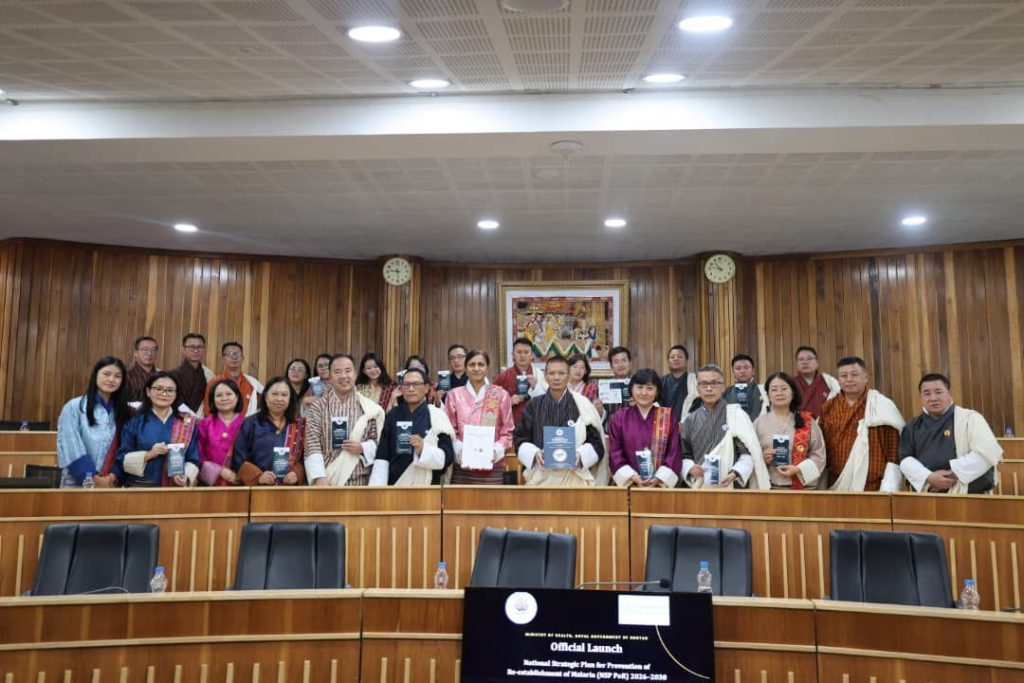
The National Strategic Plan for Prevention of Re-establishment of Malaria 2026–2030 sets out the measures Bhutan intends to implement after certification. The report identifies maintaining high vigilance along the Indian border, where malaria remains prevalent, as the country’s greatest long-term challenge.