RENUKA RAI | Thimphu
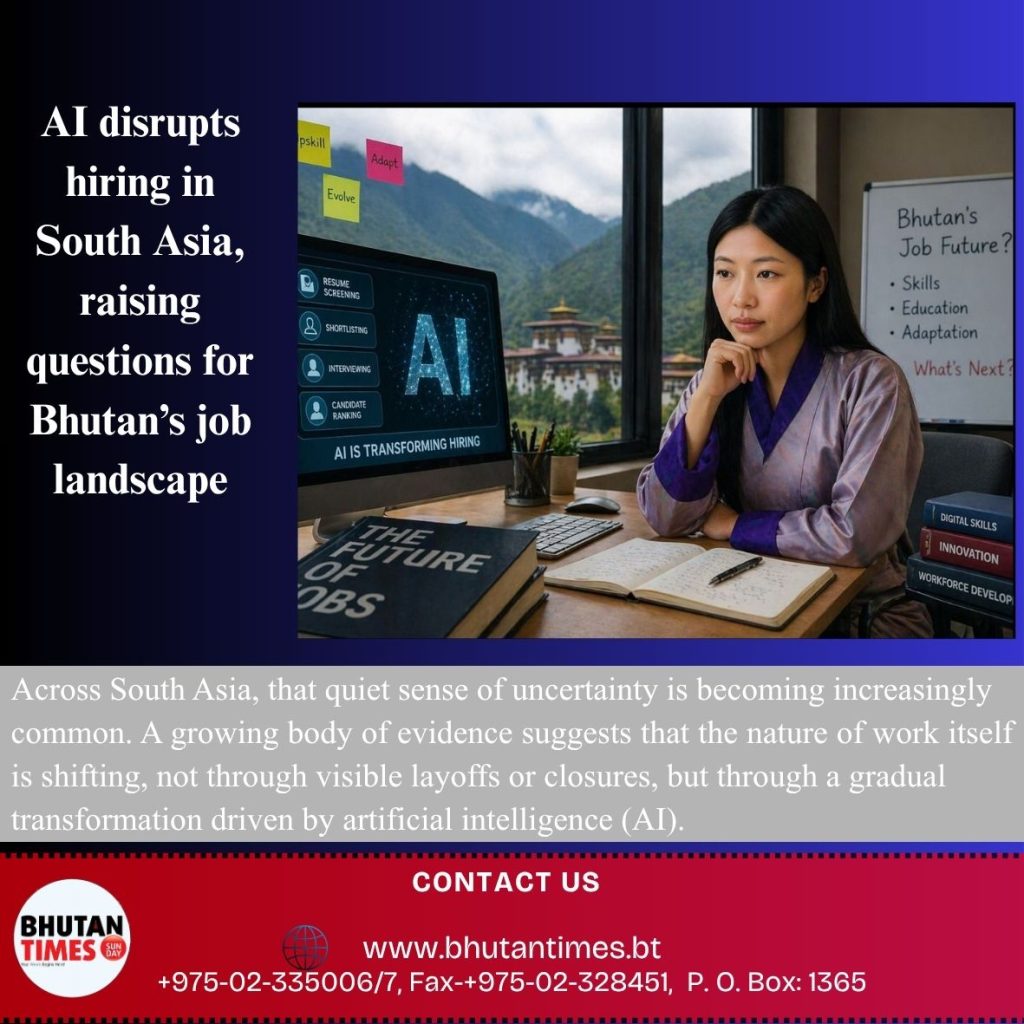
Across South Asia, that quiet sense of uncertainty is becoming increasingly common. A growing body of evidence suggests that the nature of work itself is shifting, not through visible layoffs or closures, but through a gradual transformation driven by artificial intelligence (AI).
According to the South Asia Economic Update (April 2026) by the World Bank, AI is already reshaping hiring patterns in the region, subtly reducing demand for labour in certain sectors while increasing the need for new types of skills.
The changes are not dramatic at first glance. The report notes that an increase in AI exposure has been associated with a decline in job postings by about 1.5 percent on average, with even sharper reductions in firms connected to multinational networks.
But behind these numbers lies a deeper shift one that could have long-term implications for countries like Bhutan, where youth unemployment and job market transitions are already pressing concerns.
A shift that’s hard to see Unlike traditional economic disruptions, the rise of AI does not arrive with immediate, visible consequences. There are no factory gates closing or mass layoffs making headlines. Instead, the transformation unfolds quietly through fewer entry-level openings, slower hiring processes, and changing job requirements.
Across South Asia, companies are increasingly adopting AI tools to automate routine tasks. From processing data to handling customer queries, many functions that once required human workers can now be performed by machines or software. As a result, firms may not need to hire as many employees as before.
The impact is particularly evident in industries connected to global markets.
The report highlights that firms linked to international supply chains are experiencing changes in hiring patterns, partly due to the influence of AI adoption among their foreign partners.
Even when AI is not directly implemented within a local company, its effects can ripple through the system.
For smaller economies like Bhutan, which are increasingly integrated into regional and global networks, this indirect impact is especially significant.
AI is not just replacing jobs it is reorganizing how work is done. Companies are becoming more efficient, but that often means they need fewer people for the same tasks.
In Bhutan, the job market has been under strain for several years. Youth unemployment remains a persistent issue, with many graduates struggling to find stable and meaningful work. While economic growth continues in certain sectors, job creation has not always kept pace.
The emergence of AI adds a new dimension to this challenge. Bhutan may not yet be a major player in AI-driven industries, but it is not immune to global trends. As neighboring countries and international firms adopt new technologies, the effects inevitably filter down.
Rash Maya who works in NLD Training Institute Thimphu notes that while AI presents opportunities for innovation and efficiency, it also demands a proactive response.
“We are at a point where we cannot ignore technological change,” she says. “The question is how we prepare our workforce to adapt, rather than be left behind.”
This concern is echoed by educators and employers alike; many of whom observe a widening gap between the skills graduates possess and those demanded by the market.
One of the most significant challenges highlighted in the report is the mismatch between available skills and employer needs. As AI takes over routine and repetitive tasks, demand is shifting toward roles that require analytical thinking, digital literacy, and adaptability.
In Bhutan, however, many graduates continue to emerge from traditional academic programs that may not fully equip them for this new environment.
Sonam a university graduate from Royal Thimphu College shared her experience reflects this gap.
“We learned a lot in university, but when I look at job requirements, they ask for things like data analysis, software skills, or experience with digital tools,” he says. “I didn’t realize how important those would be.”
For many young job seekers, this realization comes too late, after they have already entered a competitive and evolving labour market.
Training institutions are beginning to respond, but progress is gradual. Limited resources, infrastructure, and exposure to emerging technologies pose additional challenges.
Despite the concerns, experts caution against viewing AI solely as a negative force. The same technologies that reduce demand for certain jobs can also create new opportunities if countries are able to adapt effectively.
The World Bank report emphasizes that skill development and technological adoption are key to maintaining competitiveness in an AI-driven economy.
Workers who can complement AI by managing systems, interpreting data, or providing human-cantered services are likely to remain in demand.
In Bhutan, this could translate into opportunities in sectors such as digital services, creative industries, and tourism, where human interaction and cultural knowledge remain essential.
“Technology cannot replace everything,” says Dhan Kumar Rai 32 from Dekiling in Sarpang, a local entrepreneur who runs a small digital marketing firm.
“Creativity, communication, and understanding people these are still human strengths. If we build on those, there is still space for growth.”
There is also potential for Bhutan to leverage its unique strengths, including its focus on sustainability and well-being, to create new forms of employment that align with global trends.
For policymakers, the challenge lies in balancing technological progress with social stability. Encouraging innovation is essential for economic growth, but it must be accompanied by measures to support workers during the transition.
The report suggests that broad-based reforms such as improving education systems, investing in infrastructure, and strengthening the business environment remain critical.
“At the same time, targeted policies may be needed to address specific disruptions caused by AI,” it states.
Skill development programs, vocational training, and partnerships with the private sector could play a crucial role in preparing the workforce for the future.
For young people like Sonam, these changes are both daunting and motivating. While the path ahead is uncertain, there is also a growing awareness that adaptability is key.
In recent weeks, he has started enrolling in online courses to improve her digital skills. It is a small step, but one that reflects a broader shift in mindset among Bhutan’s youth.
“I realized I cannot just wait for opportunities,” he says. “I have to prepare myself for what the future looks like.”
His journey mirrors that of many others across South Asia a generation navigating the complexities of a rapidly changing world.
As South Asia continues to grow economically, the nature of that growth is evolving. The rise of AI presents both challenges and opportunities, reshaping labour markets in ways that are still unfolding.
For Bhutan, the task ahead is clear but not simple: to ensure that its workforce is equipped for the future, while preserving opportunities for inclusive growth.
The transformation may not always be visible, but its effects are already being felt in quieter job markets, shifting expectations, and the stories of young people searching for their place in a changing economy.
In that quiet resolve lies both the challenge and the promise of Bhutan’s future in an AI-driven world.