RENUKA RAI | Thimphu
Artificial Intelligence (AI) is creating new opportunities for Bhutanese entrepreneurs by making advanced business tools more accessible, reducing traditional barriers to starting businesses and enabling small enterprises to compete in wider markets.
For a country where many aspiring entrepreneurs face challenges related to finance, expertise, technology and geographical access, AI could become an important tool in supporting innovation, improving productivity and developing new business opportunities.
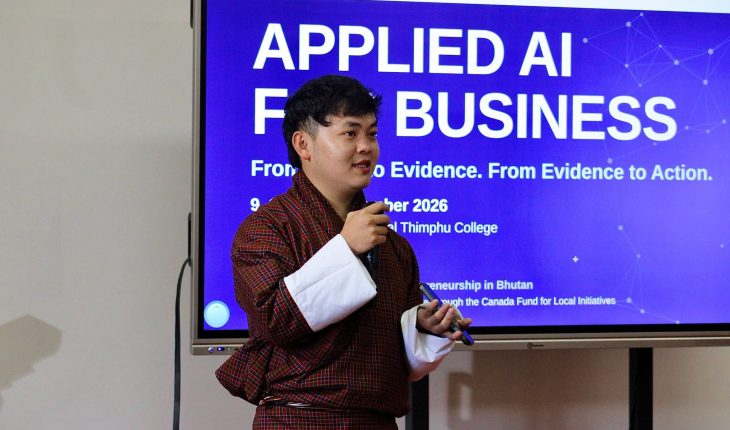
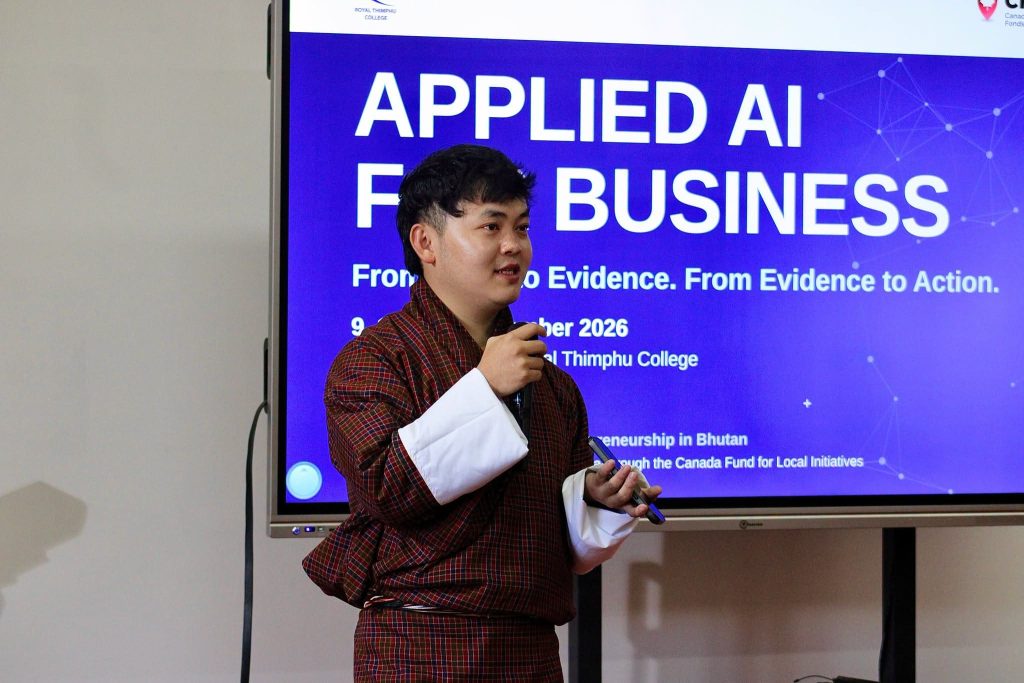
This potential was highlighted at the AI for Entrepreneurship Summit hosted by Royal Thimphu College (RTC), which brought together policymakers, entrepreneurs, industry representatives, educators and international experts to explore how AI can support sustainable enterprise development in Bhutan.
Speaking at the summit, Lyonpo Namgyal Dorji, Minister of Industry, Commerce and Employment, said AI was helping reduce traditional barriers to entrepreneurship by making advanced business tools accessible regardless of financial resources or geographical location.
He noted that AI could provide entrepreneurs with valuable tools to research markets, develop business plans, improve products and explore opportunities that might otherwise require significant financial investment and specialised expertise.
However, the Minister emphasised that technology alone cannot create successful entrepreneurs. “AI can provide entrepreneurs with valuable tools, but it cannot replace human creativity, courage and determination,” he said.
He also stressed the importance of responsible AI adoption, noting that technological progress must remain aligned with Bhutan’s development philosophy of Gross National Happiness (GNH), with human wellbeing at its centre.
The emphasis reflects the need for Bhutan to embrace emerging technologies while ensuring that innovation contributes to inclusive economic development, meaningful employment and improved livelihoods.
The summit was organised as part of RTC’s initiative to equip young Bhutanese with practical digital skills and entrepreneurial knowledge, enabling them to transform business ideas into viable enterprises using AI-powered tools.
The programme focused on helping participants understand how AI can be applied to practical business activities, including customer research, market analysis, business planning, decision-making, product development and marketing.
It also highlighted the importance of validating business ideas before making substantial investments. Entrepreneurs were encouraged to distinguish between assumptions and verified information, understand customer demand and establish a strong domestic market before expanding internationally.
The AI for Entrepreneurship Summit marked an important milestone in RTC’s AI-enabled entrepreneurship initiative, supported by the Government of Canada through the Canada Fund for Local Initiatives (CFLI).
The initiative was developed in collaboration with Pelsung and the De-suung Skilling Programme (DSP), two major youth development initiatives in Bhutan.
Rather than adopting a generic training approach, RTC conducted a needs assessment to understand participants’ entrepreneurial aspirations, experiences and challenges, ensuring that the programme addressed practical business requirements.
The initiative began with a self-paced programme comprising 30 videos across six modules, covering the application of AI in understanding customers, conducting market research, business planning, decision-making and business growth. Ninety participants and De-suung alumni enrolled in the programme.
Selected participants subsequently attended a three-day Applied AI for Business Programme from November 17 to 19, receiving hands-on training and mentorship from Bhutanese entrepreneurs and experts from Humber Polytechnic, Canada.
During the summit, participants also developed their own business ventures and prepared 30-60-90-day Venture Progression Plans outlining practical steps for developing and advancing their business ideas.
Two panel discussions, titled AI for Sustainable Enterprise: From Traction to Growth and AI for Entrepreneurship: From Potential to Action, explored business sustainability, entrepreneurial mindsets, AI-enabled prototyping, customer validation and the support required to translate emerging opportunities into viable ventures.
The Minister acknowledged the Government of Canada’s support for the initiative. Jenilee Ward, Counsellor for Public Affairs and Advocacy at the Embassy of Canada to Bhutan, also delivered a special message virtually.
Selected participants are expected to receive further international mentorship opportunities through Humber Polytechnic.
For Bhutan, the potential applications of AI extend across tourism, agriculture, manufacturing, retail, education and services.
Tourism businesses can use AI to personalise travel experiences, understand visitor preferences and reach international customers. Agricultural enterprises can examine market trends, improve supply-chain planning and identify opportunities for processing and value addition.
AI also offers possibilities in Dzongkha-language technologies, product traceability, digital record-keeping and business services designed to address local challenges.
These opportunities could be particularly significant for young entrepreneurs and small businesses that have traditionally faced limitations in accessing specialised expertise, technology and financial resources.
However, access to AI tools alone will not guarantee business success. Entrepreneurs must establish customer demand, maintain product quality, protect data privacy and intellectual property, and ensure that AI-generated information is accurate and reliable.
Stronger collaboration among government agencies, educational institutions, businesses and the private sector will also be essential in developing digital skills and creating an enabling environment for innovation.
Ultimately, Bhutan’s AI journey should not be measured simply by how quickly businesses adopt new technologies, but by how effectively those technologies improve livelihoods, create meaningful employment and contribute to sustainable economic development. As emphasised by Lyonpo Namgyal Dorji, AI should serve as an enabler of human potential, not a substitute