KARMA CHOGYAL YOEZER | Thimphu
The quality, design standards, and implementation of completed and ongoing infrastructure development projects across the country came under intense discussion during the question answer session of the National Assembly on 29th May.
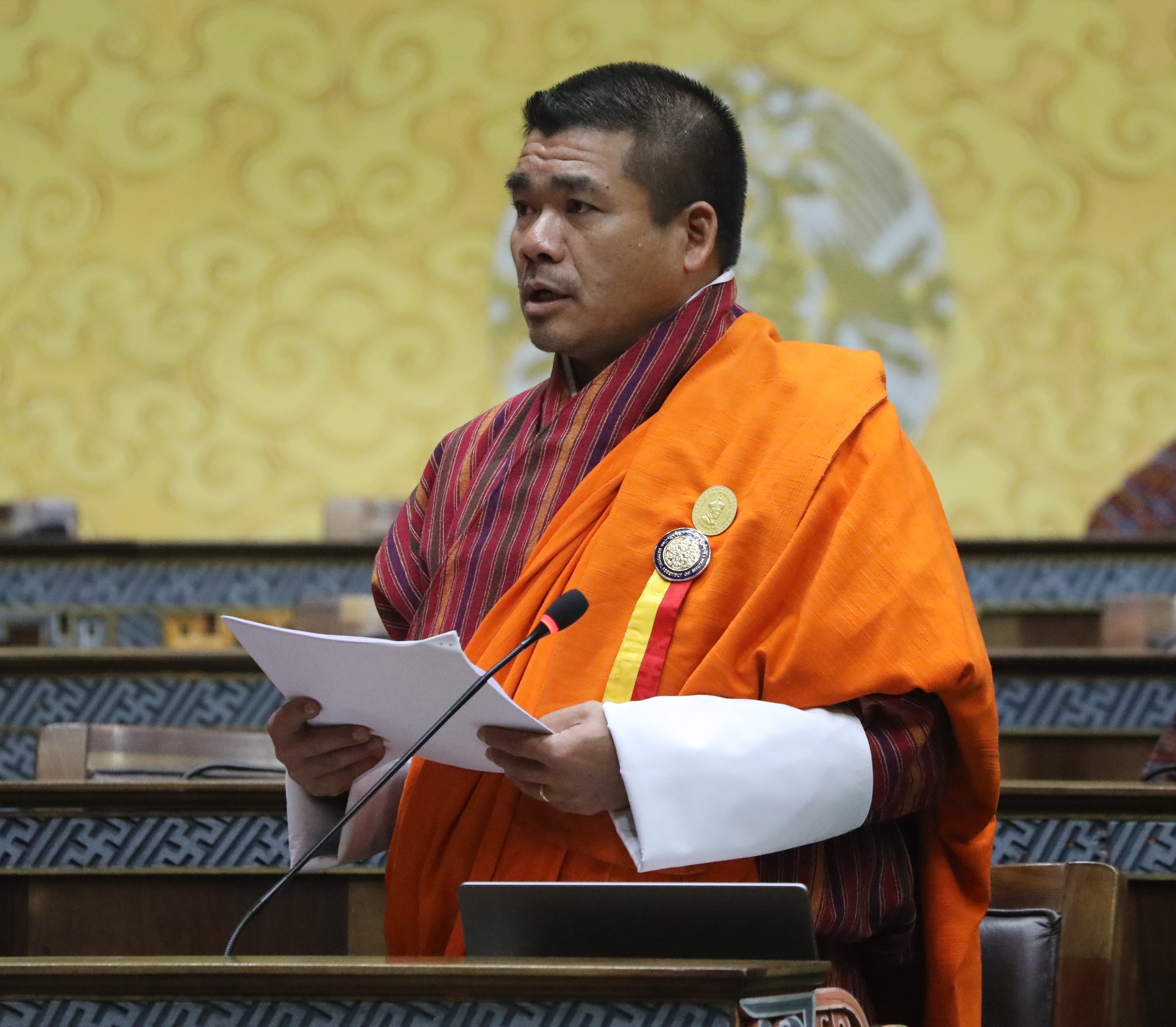
The issue was raised by Rinzin Dorji, the Member of Parliament (MP) from the Phuentsholing Constituency, who questioned the Minister for Infrastructure and Transport (MoIT) on whether the country’s infrastructure planning and design systems are strong enough to respond to emerging climate risks and recurring infrastructure-related challenges.
The MP sought clarification on the mechanisms currently in place to ensure proper technical studies, hydrological assessments, climate resilience considerations, and engineering designs before infrastructure projects are implemented.
The question comes at a time when several parts of the country are experiencing increasing incidences of flash floods, landslides, debris flows, river erosion, and extreme weather events. These events have affected roads, bridges, culverts, drainage systems, and other public infrastructure, raising concerns over whether existing planning and design standards are adequate for changing climatic conditions.
The MP said that the infrastructure projects require careful planning because they involve large public investments and directly affect people’s safety, mobility, and access to essential services.
“The poor design, weak technical assessment, or inadequate consideration of local conditions could lead to repeated damage, high maintenance costs, and inconvenience to the public,” he said
In response, the Minister for Infrastructure and Transport, Lyonpo Chandra Bahadur Gurung, highlighted that the ministry follows structured engineering frameworks before breaking ground on any major project. He explained that all public works are guided by strict pre-feasibility rules, which include detailed multi-disciplinary site investigations.
“The ministry utilizes historical climate data combined with modern forecasting tools to perform comprehensive hydrological assessments—studies that measure water flow and rainfall risks. This ensures that the water carrying capacity of structures can handle severe monsoonal weather” the Minister said.
He also stated that geotechnical surveys, which test soil and rock stability, are mandatory for high-risk mountainous regions to prevent structural settling or unexpected land failures. Furthermore, the ministry enforces the integration of Climate Change Adaptation (CCA) parameters directly into engineering software models, ensuring that newly planned structures are physically robust against sudden environmental shifts.
The MP also raised specific concerns relating to Phuentsholing, particularly the Amochu culvert, Omchu bridge, and recurring debris-related road blockages. He asked whether the ministry had carried out any review or investigation into the design adequacy and quality concerns linked to these infrastructure issues.
Phuentsholing, being one of the country’s major commercial towns and a key gateway for trade and transport, depends heavily on reliable infrastructure. Any disruption caused by flooding, debris flow, bridge damage, or road blockage can affect not only local residents but also businesses, commuters, transport operators, and the wider movement of goods and services.
The MP’s question highlighted the need to examine whether infrastructure in such vulnerable areas is being designed with sufficient understanding of river behaviour, slope stability, drainage capacity, and debris movement. In areas exposed to monsoon pressure and steep catchments, standard design approaches may not always be enough if they do not account for future climate risks and site-specific hazards.
Addressing these critical commercial points, the MoIT minister confirmed that the ministry has initiated a formal, targeted investigation into the specific bottlenecks in Phuentsholing. Regarding the Amochu culvert, Lyonpo stated that an independent technical task force is actively evaluating the structural dimensions and the levels of the local four-lane highway to fix unexpected drainage backlogs.
For the Omchu bridge and the surrounding roads plagued by recurring blockages, the Minister announced that the government has launched the comprehensive Climate-Resilient Omchhu River Basin Project. Backed by international development partners, this project specifically reviews upstream landslide patterns and riverbed gradients.
The minister explained that standard engineering failed here because the real enemy is the massive volume of debris and sediment washed down from steep catchments during cloudbursts, rather than just high-water volume. The ongoing investigation will establish permanent, structural riverbank protection and advanced debris-trapping mechanisms to stabilize the critical transport gateway.
The MP further asked what measures the ministry would take to strengthen project planning, design review, quality assurance, and accountability mechanisms. He said such measures are important to ensure that infrastructure investments provide long-term value and resilience against climate-induced events.
This part of the question focused on the broader issue of public infrastructure accountability. While infrastructure development is often measured by the number of projects completed, the MP’s question drew attention to the importance of durability, safety, and performance after completion. Public infrastructure, he said, should not only be built to meet immediate needs but should also be able to serve communities for many years without repeated failure or excessive repair costs.
The issue also points to the role of consultants, contractors, engineers, supervising agencies, and implementing authorities in ensuring that infrastructure projects meet approved designs and quality standards. Stronger quality assurance could include better site supervision, material testing, independent design review, regular monitoring, and stricter enforcement of contract obligations.
To tackle the challenge of accountability, the Minister detailed a multi-layered strategy to enforce strict quality assurance across the construction sector. The ministry is introducing mandatory third-party independent design reviews for all public works valued above a certain financial threshold. This means external experts must approve blueprints before funds are released.
To curb poor execution by contractors, the minister stated that field supervision teams are being equipped with digital monitoring systems to track construction progress in real time. Material testing laboratories are also being expanded across various regions to perform randomized stress tests on concrete and steel used in public works.
Crucially, the minister warned that accountability frameworks are being legally tightened: contractors and consulting agencies who deliver substandard work will face immediate blacklisting, financial penalties, and must bear the financial liability of repairs under extended latent defect liability periods.
The MP’s final question sought clarification on whether the ministry has plans to revise current infrastructure planning and design standards in view of increasing incidences of flash floods, landslides, and extreme weather events.
The concern reflects a growing national challenge. Climate-related disasters are becoming more frequent and intense, requiring infrastructure systems to be planned with greater attention to resilience. Roads, bridges, culverts, retaining walls, and drainage systems that may have been designed based on past rainfall patterns may no longer be sufficient under changing weather conditions.
Revising infrastructure standards could involve updating hydrological data, improving drainage design, strengthening slope protection measures, incorporating climate-risk assessments into project planning, and ensuring that designs are suitable for high-risk locations. It could also involve greater coordination between engineering agencies, local governments, disaster management authorities, and environmental experts.
In his final remarks, the Lyonpo Chandra Bdr Gurung firmly agreed that older engineering baselines are obsolete in the face of modern climate change. He announced that the MoIT is currently partnering with international climate scientists and the United Nations Development Programme (UNDP) under the Infrastructure Resilience Accelerator Fund to completely overhaul the Bhutan Schedule of Rates (BSR) and standard engineering codes.