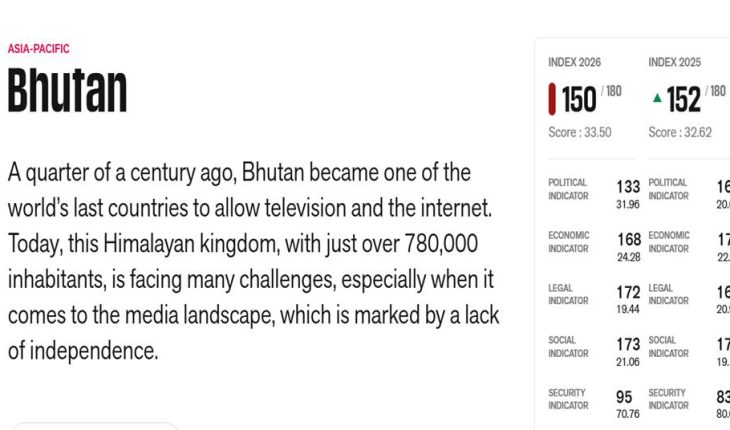
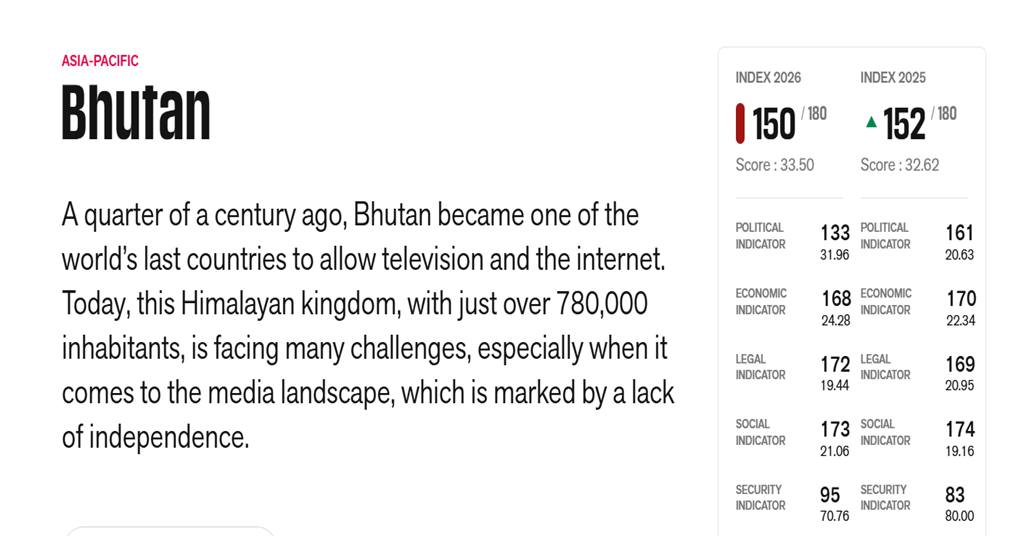
RSF ranks Bhutan 150th out of 180 countries, as journalists continue to face legal uncertainty, self-censorship, and structural constraints on media independence.
TIL BDR GHALLEY | Thimphu
Bhutan continues to face significant challenges to press freedom, ranking 150th out of 180 countries in the 2026 World Press Freedom Index released by Reporters Without Borders.
Despite slight improvements compared to previous years, the country remains in the very serious category, reflecting persistent structural constraints affecting media independence, editorial freedom, and journalistic safety.
The report highlights a widening gap between Bhutan’s constitutional guarantee of freedom of expression and the lived reality of journalists operating under legal uncertainty, financial dependency, and socio-cultural pressures.
A journalist, speaking on condition of anonymity, described the situation as a system where freedom exists in principle, but hesitation defines practice.
He further added, “Most of the time, we don’t stop because we are told to stop, we stop because we already know what cannot be crossed.”
One of the most critical concerns identified is Bhutan’s restrictive legal environment governing media practice.
Broad defamation provisions and national security clauses continue to create caution among journalists when covering sensitive or critical issues.
A reporter noted, “Even when we have verified information, we ask ourselves twice whether it is worth the risk of being misunderstood legally or institutionally.”
The absence of a comprehensive Right to Information (RTI) law further limits access to public data, often delaying reporting on matters of public interest.
Journalists frequently face challenges in obtaining timely responses from government agencies, which affects both the completeness and timeliness of reporting.
The RSF report identifies self-censorship as one of the most entrenched challenges in Bhutan’s media landscape.
“In a closely connected society, journalists often avoid stories that could be perceived as confrontational or critical of institutions and authority figures,” it states.
This practice is not always externally imposed but is often internally developed through professional experience and social awareness.
A reporter explained, “It is not pressure in the traditional sense. It is anticipation the awareness of consequences before anything is even written.”
Another journalist added, “We are trained to inform, but also to avoid disturbing balance. The line between the two is where journalism becomes difficult here.”
A senior reporter reflected, “Self-censorship is not always conscious. Over time, it becomes part of how you decide what is safe to pursue and what is not.”
Cultural values emphasizing harmony and respect also contribute to this dynamic. While these values are deeply rooted in Bhutanese society, they can limit critical inquiry and investigative journalism.
Bhutan’s media sector continues to struggle with financial sustainability. Operating in a small market, many private media outlets rely heavily on government advertising and institutional support.
This dependency creates structural vulnerabilities, where editorial independence may be indirectly influenced by financial considerations.
The journalist said, “there are gradual decline in newsroom capacity as experienced journalists exit the profession, leaving behind a younger workforce.”
This shift affects the depth and quality of reporting, particularly on governance, policy, and economic issues.
Another journalist said, “We are seeing more stories, but fewer deeply reported stories. Experience is leaving faster than it is being replaced.”
Access to timely and reliable information remains a significant obstacle. Journalists frequently face delays when seeking responses from government agencies, resulting in incomplete or outdated reporting.
One reporter described the situation as “waiting for information that arrives after the story has already been published.”
Bureaucratic procedures and limited transparency mechanisms further complicate access, reducing the media’s ability to function effectively as a watchdog institution.
While Bhutan does not experience widespread physical violence against journalists, RSF notes rising concerns related to legal intimidation, job insecurity, and psychological pressure.
A journalist observed, “The pressure here is quiet but constant. It is not about fear of harm, but fear of consequences.”
Another added, “You learn to measure every sentence—not only for accuracy, but for what it might mean beyond journalism.”
These pressures contribute to a cautious reporting environment and reinforce existing patterns of self-censorship.
Bhutan’s position in the global index has seen notable fluctuations in recent years. After reaching a relatively strong position in 2022, the country experienced a sharp decline before showing modest improvement in 2026.
Journalists attribute these changes to broader structural pressures rather than isolated factors within the media sector.
A senior journalist said, “Press freedom is not only about laws. It is about confidence—the confidence of journalists to ask, and the confidence of institutions to respond.”
Bhutan’s 2026 ranking reflects modest progress but underscores deep structural challenges that continue to shape its media environment.
While constitutional guarantees of freedom of expression exist, journalists describe a working reality defined by caution, economic dependence, and institutional limitations.
Self-censorship remains a defining feature of Bhutan’s media landscape, narrowing the space for investigative journalism and critical inquiry.