TIL BDR GHALLEY | Thimphu
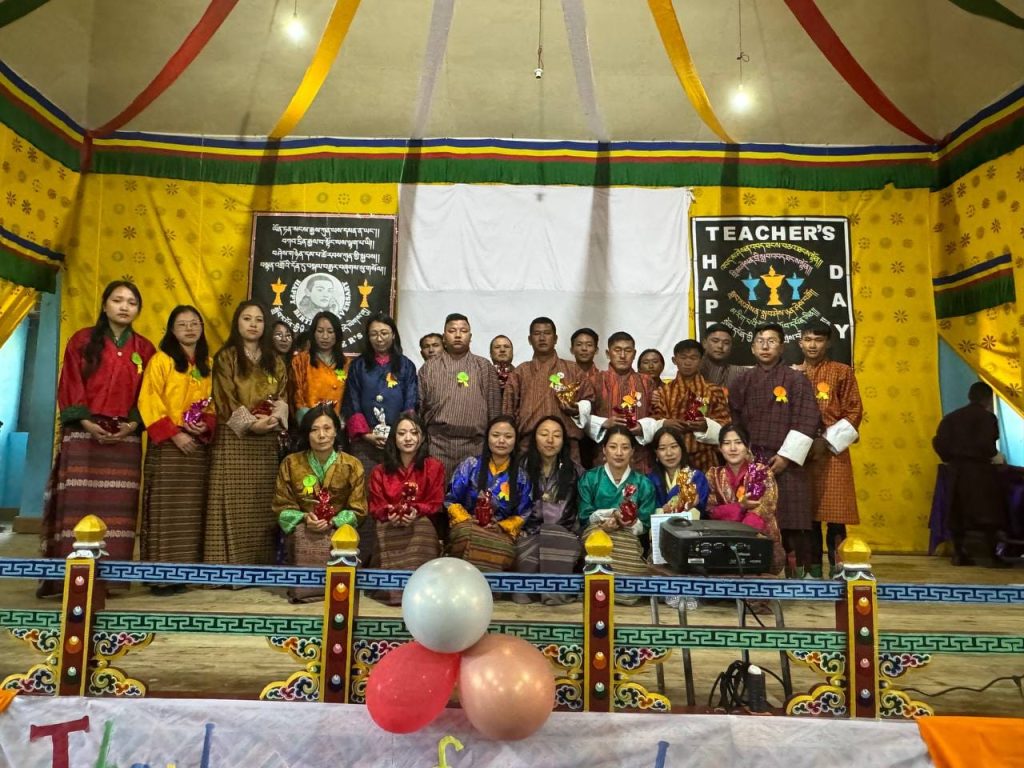
Bhutan observes Teachers’ Day with deep respect for educators who continue to shape the nation’s moral, intellectual, and social foundation. In classrooms across the country, teachers are being remembered not only as transmitters of knowledge but as custodians of values that uphold the philosophy of Gross National Happiness.
At the heart of Bhutan’s modern education system stands the enduring legacy of His Majesty the Third Druk Gyalpo, Jigme Dorji Wangchuck, widely regarded as the Father of Modern Bhutan.
His reign (1952–1972) marked a transformative era during which the country transitioned from isolation to modernization. Among his most significant contributions was the establishment of formal education systems, including modern schools and teacher training institutions.
His vision placed education as a cornerstone of national development, ensuring that knowledge would become accessible beyond monastic learning and elite circles.
Today, his legacy continues to echo in every classroom, particularly on Teachers’ Day, where educators reflect on their evolving role in a rapidly changing Bhutan.
Delivering a national message, Yeezang De Thapa Minister of Education and Skills Development, extended gratitude to teachers across the country:
“On behalf of the Ministry of Education and Skills Development and the Royal Government of Bhutan, I wish all our teachers a happy Teachers’ Day,” she said.
“Not having a national celebration does not diminish your hard work, commitment, and dedication. Your role in shaping the future of our children and nation is deeply valued not only by the government, but by parents and communities across the country.
“Despite the challenges you face every day, your sacrifices are not unseen. Every policy decision we make begins with one thought—our teachers and our students. You remain at the heart of the nation’s future.”
Khandu, 59, a teacher from Lobesa LSS, Punakha with over 32 years of service, reflected on how the celebration itself has evolved:
“Earlier, Teachers’ Day felt deeply personal. A handwritten note, a simple khadar. Today, celebrations are larger and more organized, but sometimes I miss that simplicity it carried a different kind of warmth,” he said.
He added teaching is not always visible work. There are days you doubt yourself. But when former students return and say, ‘Sir, you changed my life,’ that moment alone heals years of exhaustion,” he added.
“We stand in classrooms today because of the vision of the Third Druk Gyalpo. He gave Bhutan its first classrooms, but more importantly, he gave dignity to teaching,” Khandu said.
Khandu said Teachers’ Day reflects the deep bond between teachers and students a relationship built on trust, care, and lifelong influence.
“When students show us love and affection, it becomes deeply emotional,” he said. “In those moments, I feel overwhelmed with gratitude, and tears of happiness quietly fall. It reminds me that every effort, every challenge, and every sacrifice in teaching have truly been worthwhile.”
Amrit Gurung, 30, a teacher from Tsirang, shared the changing culture of appreciation: “Social media has changed everything. Students who rarely express themselves in person now send messages, photos, and memories. It makes you realize your impact travels far beyond the classroom walls.”
He added that even a short message saying ‘I still remember your class’s feels powerful. It reminds us that our work continues to live in people long after they leave school.”
Deo Raj Rai, 31, a teacher from Chukha HSS, said, “We are expected to be patient every single day, no matter what we are going through personally. A classroom does not pause for our emotions. But when a student finally understands something, they have struggled with, it feels like a small victory we share together.”
Pabitra Chettri, a lecturer at Norbu Rigter College, Paro, shared a personal reflection on the changing realities of modern classrooms.
“Today’s students are different they are more aware, more connected, but also more distracted. Teaching today is about constantly adapting to keep them engaged and grounded,” he said.
She added that despite these challenges, the rewards remain deeply meaningful: “Still, when a student returns after years and greets you with respect, you realize that every effort, every difficult day in the classroom, was never wasted.”
Dorjee Ghalley, a Class XI student of Drukgyel Higher Secondary School in Paro, said, “Teachers are like second parents. They do not just teach us subjects they teach us how to behave, how to fail, and how to try again. Today is the only day we feel we can truly pause and say thank you properly, without rushing.”
Another Class XI student, Arjun Pradhan from Babesa HSS in Thimphu, added, “We may not always show it, but teachers are the reason we have direction in life. When we are confused, they remain patient with us, and when we feel like giving up, they are the ones who push us forward.”
“Even when we don’t listen properly in class, teachers never stop believing that we can improve. That belief changes us slowly, even when we don’t realize it,” said Chencho Dema a class X student of Bitekha Middle Secondary School.
Former students also shared their reflections, recalling the lasting impact of their teachers beyond school years. Joty Pradhan, 23, alumni of Yangchenphug HSS said, “It is only after leaving school that I truly understood what my teachers meant. At the time, I thought they were strict, but now I realize they were preparing us for life, not just exams.”
Punam Kumar Bhujel 29, former student of Mothithang HSS added, “Years have passed, but I still remember the patience my teachers showed. Their words continue to guide me even in my professional life today.”
Parents also expressed deep appreciation for teachers’ often unseen role.
Passang Wangmo parent in Thimphu said: “Teachers carry responsibilities that go beyond textbooks. They are shaping discipline, respect, and character in ways that families alone cannot always manage.”
Pem Zam, a parent, said, “We trust teachers completely. Sometimes they know our children better than we do not just academically, but emotionally. That is a rare and profound responsibility.”
She added, “In many ways, teachers are co-parents. They carry our children’s future with patience, dedication, and often without the recognition they truly deserve.”
As Bhutan observes Teachers’ Day, the celebrations may differ in form from earlier years, but the spirit remains unchanged—one of gratitude, reflection, and renewed commitment to education.
From the visionary reforms of the Third Druk Gyalpo to the quiet dedication inside today’s classrooms, teachers continue to stand as the unseen architects of Bhutan’s future—shaping not just educated minds, but responsible citizens.