KINLEY KHANDU CHODEN | Thimphu
Patients at Jigme Dorji Wangchuck National Referral Hospital are spending less time waiting for consultations as the national referral hospital gradually expands its appointment-based system across departments.
Although the system has shown positive results in several departments, hospital officials say challenges still remain as many patients continue to rely on the older token system.
The appointment system was first introduced in 2018 with the aim of streamlining patient flow and reducing unnecessary waiting time at the hospital.
Medical Director Dr. Phub Tshering said the hospital introduced the system mainly to make healthcare services more convenient for patients.
“The main purpose of the appointment system is to facilitate people or patients to see the doctor as quickly as possible in the allocated given time,” he said. “When you are given an appointment time and if you come on that particular appointment time, then there is no time wastage in between.”
According to the medical director, the traditional token system often resulted in overcrowding and long waiting hours, even for patients who arrived at the hospital at the same time.
“The main problem with the token system is that people have to line up to get the token first of all,” he explained. “Somebody who gets token number one will be seen immediately, but somebody with token number 15 or 20 may have to wait three or four hours even if they arrived at the same time.”
Currently, some departments in the hospital operate fully through appointments, while others still continue using tokens. Doctor says the long-term goal is to eventually transition all departments into a complete appointment-based system.
“We want to streamline and ultimately make all departments an appointment system,” said Dr. Phub Tshering.
The hospital administration believes the system can significantly reduce crowding in waiting areas and help doctors manage patient consultations more effectively.
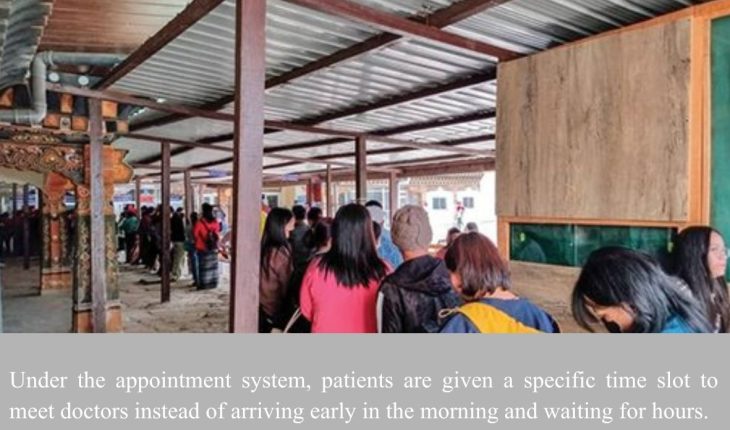
Under the appointment system, patients are given a specific time slot to meet doctors instead of arriving early in the morning and waiting for hours.
“Say you have an appointment at 2 p.m.,” the medical director explained. “You don’t come to the hospital by 9 a.m. You come a few minutes before your appointment time and then there is no waiting time. You are seen immediately by the doctor.”
However, despite the benefits, the hospital continues to face challenges in implementing the system smoothly. One of the biggest concerns is the lack of awareness and understanding among some patients regarding how the appointment system works.
“We have some patients who are used to the appointment system, and we get very good feedback because they realize there is minimal time wastage,” he said. “But for people who are yet to understand the importance of the appointment system, we sometimes see dissatisfaction.”
Dr. Phub Tshering added that public awareness remains important for the success of the initiative.
“With the help of the media, I think we can work together to educate our people on the appointment system” he said.
Patients visiting the hospital shared mixed experiences regarding the new system. Some said it has improved services and reduced stress, while others believe there is still confusion and inconsistency in implementation.
Tshering Lhamo, a patient from Punakha visiting the hospital for regular follow-up treatment, said the appointment system saved both time and money.
“Before, I had to leave home very early and wait almost the whole day,” she said. “Now I know exactly when to come, and I can finish my consultation faster. It is much easier for people coming from outside Thimphu.”
Another patient, Karma Dorji from Wangdue, said the system works well when appointments are properly managed.
“When doctors are available on time, the appointment system is very helpful,” he said. “But sometimes there are delays, and people still get confused about where to go or whom to ask.”
Some members of the public also believe the hospital should strengthen communication and provide clearer instructions for patients, especially elderly people who may struggle with digital systems or appointment procedures.
Sonam Choden, who accompanied her mother to the hospital, said older patients often face difficulty understanding appointment schedules.
“My mother doesn’t use phones much, so I have to manage everything for her,” she said. “The hospital should have more staff guiding patients because many elderly people still depend on the token system.”
Similarly, college student Pema Thinley said awareness campaigns could help improve public understanding.
“I think many people are still not fully aware about how the appointment system works,” he said. “If hospitals explain it more through social media or announcements, it will become easier for everyone.”
The hospital administration says discussions are ongoing to further improve the system and make it more digital and accessible in the future.
According to Dr. Phub Tshering, stakeholders are already exploring ways to modernize appointment booking services.
“We are currently having a lot of discussions around the appointment system,” he said. “We definitely want to make it more convenient for people to make appointments.”
Hospital officials believe that a more digital system could help reduce congestion even further while improving overall efficiency in healthcare delivery.
However, they also acknowledge that digital transformation will require proper public awareness, technical support, and infrastructure development.
As Bhutan’s healthcare system continues to modernize, the appointment system at JDWNRH reflects a broader effort to improve patient care and reduce pressure on medical services. While challenges remain, many patients and hospital staff agree that the system has already brought noticeable improvements compared to the older token-based approach.
For now, the success of the initiative may depend not only on hospital management but also on how well patients adapt to the changing system. Officials say cooperation between the hospital, media, and the public will be essential in ensuring that the appointment system benefits everyone in the long run.