NGAWANG JAMPHEL | Thimphu
After remaining non-operational for more than seven months following severe monsoon flooding, the Dagachhu Hydropower Plant (DHP) is now preparing to resume operations, with the refilling of its water conductor system scheduled to begin on May 9.
The update was shared by Karma Penjor Dorji, Director General (DG) of Department of Energy (DoE) during the 23rd Meet the Press session, where he detailed the scale of the damage caused by the unprecedented flooding and the restoration efforts undertaken over the past several months.
According to the DG, the hydropower plant has remained shut down since October 9, 2025, after intense flooding on October 5 severely damaged several critical components of the project.
The flood reportedly exceeded 1,300 cubic metres per second, far surpassing the project’s design flood capacity of around 859 cubic metres per second. He said the flood event was considered extremely rare, corresponding to a one-in-10,000-year return period event.
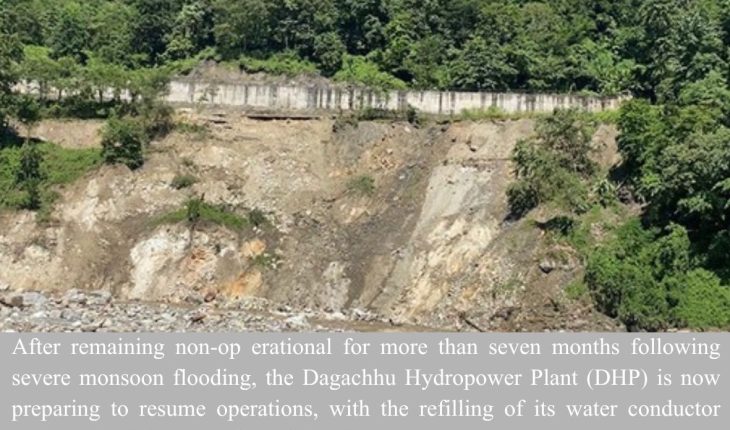
“The unprecedented flood caused severe toe erosion below the headrace channel alignment, resulting in continuous slope displacement,” the DG said.
The erosion destabilized the slope beneath the headrace channel (HRC), eventually leading to the failure of the HRC itself. The flooding also washed away access roads and damaged several downstream structures essential for plant operations.
Among the damaged infrastructure were the gantry crane, stop logs, wing walls, fish ladder, and log boom. The destruction forced authorities to suspend operations indefinitely while engineers assessed the extent of the damage and searched for long-term stabilization solutions.
The prolonged shutdown has resulted in significant financial losses for the project. According to the DG, the plant incurred generation losses amounting to approximately Nu. 655 million during the downtime. This is equivalent to a loss of around 192.35 million units of electricity generation.
To restore the project, three Bhutanese contractors were engaged to carry out different components of the rehabilitation work.
Yoezer Engineers was assigned the stabilization of the slope below the headrace channel, restoration of access roads, and river training works.
Vajra Builders undertook civil works, including the construction of saddle supports for the headrace pipes.
Meanwhile, Bhutan Hydropower Services Limited, in Jigmeling, Sarpang, handled hydro-mechanical restoration works.
The DG said substantial progress has now been achieved in the restoration process.
According to DG, access roads to both the weir and powerhouse have already been restored, allowing movement of personnel and equipment to the site.
Restoration and stabilization work below the headrace channel has also been completed. This included the stabilization of HRC benches, construction of gabion walls and drainage systems, reinforced concrete saddle blocks, completion of the transition block, and installation of 243 metres of steel pipe along with expansion joints.
Officials believe these measures will help improve the structural resilience of the affected areas and reduce the risk of future damage from slope instability and erosion.
The next major phase involves refilling the water conductor system. The process will be carried out according to the DG, “Guidelines for Initial Filling and Dewatering of the Water Conductor System” prepared by SNC-Lavalin in November 2013.
The DG explained that the refilling process must be done gradually to ensure safety and allow engineers to monitor the system closely for any signs of leakage, instability, or operational concerns.
The filling process is expected to take about one week.
If the process proceeds smoothly, the spinning of the machine is scheduled for May 16, 2026, marking a major milestone toward restarting electricity generation at the plant.
The DHP is one of Bhutan’s important renewable energy projects and contributes to the country’s domestic power supply as well as electricity exports. Hydropower remains one of Bhutan’s major economic drivers, contributing significantly to government revenue and foreign exchange earnings.
The incident has also highlighted the increasing vulnerability of hydropower infrastructure to extreme weather events and climate-related disasters.
Experts have increasingly warned that changing rainfall patterns and glacial melt linked to climate change could expose Bhutan’s hydropower sector to higher risks in the future.
While the restoration works have brought optimism about the project’s revival, officials emphasized the importance of long-term monitoring and slope stabilization to ensure the safety and sustainability of the infrastructure.
With restoration works nearing completion and operational testing set to begin soon, authorities are hopeful that the DHP will resume power generation in the coming weeks after months of disruption and financial losses.