DAWA ZANGMO | Thimphu
Pork prices across several parts of Bhutan have seen sharp fluctuations in recent months, driven largely by increased domestic production, weak market demand, and rising input costs, according to farmers, meat vendors, consumers.
Farmers and meat vendors say pig rearing has become one of the main sources of household income in many rural communities, leading to a rise in pork production across the country. However, the increase in supply has reportedly exceeded consumer demand, pushing down farm gate prices and creating financial pressure on producers.
A meat shop owner from Upper Tshogchuna Chumithang under Pasakha in Chukha Dzongkhag, Lal Bdr Khapangi, said pork production has increased significantly in villages, where many households keep multiple pigs for sale.
He said the growing number of pigs in villages has created an oversupply in the market, resulting in declining pork prices. According to him, farm gate prices in some areas have fallen to between Nu. 270 and Nu. 290 per kilogram.
Despite the lower rates, he said many farmers are struggling to find buyers. He added that the cost of production has increased due to higher feed prices, GST-related expenses, transportation charges, water, and electricity costs, leaving farmers with minimal profit margins.
Lal Bdr Khapangi also said market access remains a challenge for many small-scale producers. According to him, several meat vendors rely on their own livestock production or external suppliers, limiting opportunities for villagers to sell locally produced pork.
He further claimed that while farmers are forced to sell pork at low prices, retail prices in meat shops remain comparatively high, creating what he described as an imbalance in the value chain.
Lal Bdr Khapangi raised concerns over the absence of effective price regulation mechanisms and alleged rumors of illegal pork imports from across the border. He said farmers had also expanded production earlier in anticipation of procurement support from Bhutan Livestock Development Corporation Limited (BLDCL).
According to him, expectations that BLDCL would purchase pork and chicken from farmers encouraged many households to increase production. However, he said procurement support has remained limited, affecting producers in other dzongkhags such as Samtse.
He added that changing consumer patterns, a relatively smaller customer base, and the emergence of larger supermarkets supplying meat directly to hotels have further reduced market opportunities for small farmers and local vendors.
Another meat shop vendor from Pasakha, Phurba Tshering Tamang of Ethan Meat Shop, also attributed the fluctuations in pork prices to increasing competition among producers.
He said many individuals who start businesses through government-supported loans often enter similar sectors, resulting in market saturation and reduced demand for pork.
According to him, vendors selling pork at rates between Nu. 200 and Nu. 250 per kilogram are struggling to sustain their businesses because of rising feed costs and limited profit margins.
Phurba Tshering Tamang also noted that some small-scale producers sell pork directly to households at lower prices, affecting the customer base of established meat shops and wholesalers.
He said proper marketing systems and stronger government support could help improve the situation for both producers and vendors.
Consumers meanwhile say the price gap between villages and urban retail outlets remains a major concern.
Sonam Kinga, a consumer from Chukha, said pork sold directly in villages is comparatively cheaper, while retail shop prices remain significantly higher.
Another consumer, Pema Tshomo form Pasakha said fluctuating prices and inconsistent supply have affected household purchasing habits. She said consumers in urban areas often depend on meat shops because they do not always have direct access to village sellers.
Amid growing concerns from farmers and vendors, the Ministry of Agriculture and Livestock (MoAL) said it is implementing both short-term and long-term measures to stabilize the pork market and support producers.
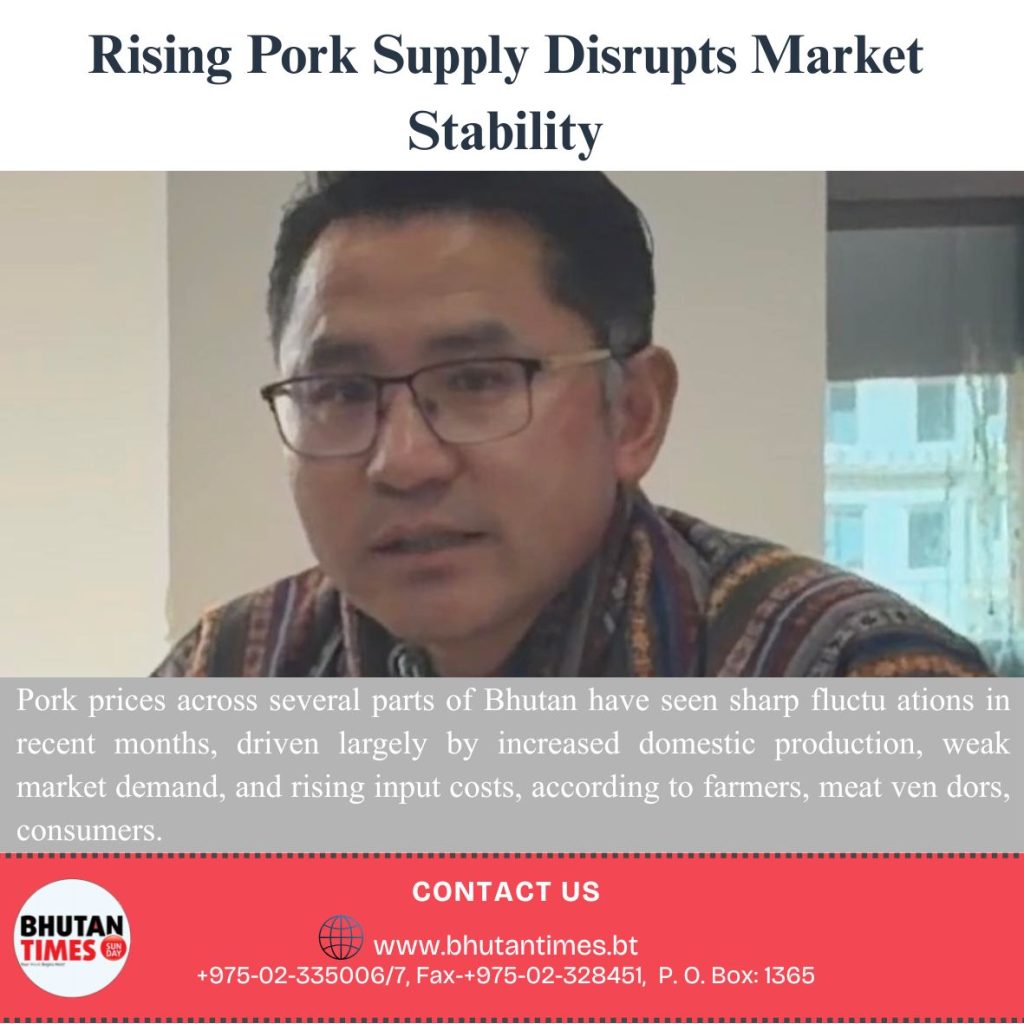
MoAL minister Younten Phuntsho, said the ministry is strengthening enforcement and disease prevention measures while also working to align domestic production with current market demand.
He said the ministry is addressing structural issues in the pork market and facilitating breeding and piglet management interventions to reduce further market imbalances.
The Minister added that a Technical Working Team comprising officials from the MoAL, Ministry of Finance, BLDCL, and Bhutan Development Bank Limited (BDBL) has been formed to provide immediate support measures.
“One of the immediate interventions being proposed is the revision of the pricing framework under the Price Guarantee Scheme to establish a more balanced and market-responsive system that protects both producers and consumers,” minister said.
He added that the ministry is also proposing phased harvesting and coordinated marketing measures to manage the growing number of market-ready pigs and reduce financial stress on farmers.
According to the minister, efforts are underway to formalize livestock aggregators in key production areas such as Dagana and Tsirang to strengthen organized market systems and improve supply coordination.
He said the ministry has already established dedicated pork stalls at Kaja Throm to sell pork and related products at affordable prices.
The ministry is also working to improve the use of cold storage facilities to support staggered storage and distribution of pork products in order to maintain price stability.
In addition, minister said efforts are being made to connect surplus production areas with deficit dzongkhags to improve market access and facilitate the movement of pigs across the country.
Stakeholders across the pork value chain continue to point to overproduction, rising production costs, weak procurement systems, and uneven market access as the main factors behind the recent fluctuations in pork prices in Bhutan.