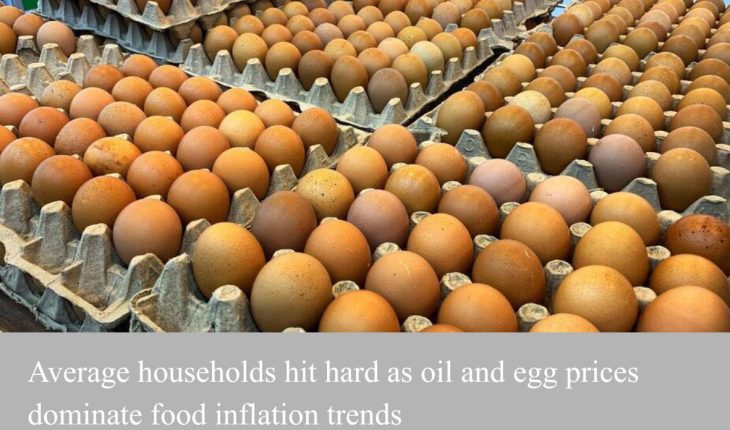
Average households hit hard as oil and egg prices dominate food inflation trends
TIL BDR GHALLEY | Thimphu
Bhutanese households are facing increasing pressure from the rising cost of two essential kitchen staples edible oil and eggs as continued supply disruptions, import linked inflation, and transportation costs push prices upward across the country.
Data from the Market Price Information (MPI) shows edible oil prices increased between 2.28 percent and 15.65 percent between December 2025 and March 2026, while egg prices rose nationally by 11.59 percent during the same period. In some districts, egg prices varied by as much as 44 percent.
The increases come at a time when most other staple commodities, including rice, flour, pulses, and milk, have remained relatively stable, making edible oil and eggs the most visible contributors to rising household food expenses.
According to the Consumer and Competition Affairs Authority (CCAA), the continued price increases are largely driven by genuine supply and cost pressures rather than market manipulation or anti-competitive practices.
Officials from CCAA said Bhutan’s heavy dependence on imports for edible oil and disruptions in domestic poultry production have combined to create sustained inflationary pressure on the two commodities.
Bhutan imports nearly 97 percent of its edible oil requirement from India, making domestic prices highly sensitive to international fuel costs, freight charges, and wholesale market trends.
Among edible oils, Shudh Refined Oil (3.75 litres) recorded the sharpest increase at 15.65 percent, followed by Bengal Gold Refined Oil at 13.03 percent and Natural Gold Oil at 12.26 percent.
By March 2026, average retail prices reached Nu. 1,154.25 for Saffola Gold Oil, Nu. 757.74 for Natural Gold Oil, Nu. 477.44 for Bengal Gold Refined Oil, and Nu. 466.43 for Shudh Refined Oil.
The upward trend continued even after the initial market adjustments following GST implementation.
Bengal Gold Refined Oil alone recorded a further 5.02 percent increase between February and March 2026.
Tshering Gyeltshen, Secretary General of Traders Association of Bhutan said the external geopolitical and economic conditions are largely responsible for the increase.
“The rise in the price of edible oil is mainly attributed to the ongoing conflict in the Middle East, which has resulted in an increase in fuel prices,” he said.
“Consequently, the higher fuel costs have led to a rise in freight charges by more than 20 percent in the Indian market, which is the main source of edible oils for our country.”
He added that suppliers in India have also revised prices upward, further contributing to the increase.
“Suppliers have also increased their prices, further contributing to the overall increase in the cost of edible oil,” he said.
Despite the rising costs, traders say efforts are being made to avoid excessive price increases in the domestic market.
“As General Secretary of the Traders Association of Bhutan, I have requested all importers and distributors to avoid increasing prices by an excessive margin and to keep any price adjustments as minimal as possible,” Tshering Gyeltshen said.
The CCAA stated that Bhutan’s free-market system does not permit the authority to impose price caps on general consumer goods.
However, the agency said it continues to monitor the market for signs of price-fixing, collusion, or unfair trade practices.
Addressing reports that a 5-litre edible oil container purchased at around Nu. 645 was being sold at approximately Nu. 750, the authority stated that such margins are not automatically unreasonable.
“A retail price of Nu. 750 on a product purchased at Nu. 645 reflects a mark-up of approximately 16 percent,” the authority explained.
“Retailers incur real costs beyond the purchase price, including transportation, storage, handling and overhead.”
While edible oil prices have risen relatively consistently nationwide, egg prices have shown far greater regional variation.
Nationally, egg prices increased from Nu. 478.70 per tray in December 2025 to Nu. 534.20 in March 2026, with an additional 3.21 percent rise recorded between February and March alone.
Prices ranged from Nu. 406 per tray in Samdrup Jongkhar to Nu. 585 in Paro, creating a gap of nearly 44 percent.
Other districts recording high egg prices included Thimphu at Nu. 562.50, Punakha at Nu. 578.33, and Wangduephodrang at Nu. 570.
According to the Ministry of Agriculture and Livestock (MoAL), the shortage is linked to disruptions within Bhutan’s poultry production cycle.
Minister said the current situation originated in 2023 when an unplanned oversupply of approximately 149,800-day-old chicks flooded the market with eggs, causing prices to collapse below production costs.
“The excess supply caused egg prices to fall below the cost of production, resulting in considerable financial losses for poultry farmers,” the ministry stated.
As a result, many poultry farmers either reduced production or temporarily exited the sector.
Only about 64.5 percent of the planned day-old chicks were lifted during the subsequent production cycle, eventually leading to fewer laying birds entering production in 2025 and 2026.
At the same time, demand continued rising, particularly from institutional consumers such as school feeding programmes and bulk buyers.
The ministry explained that poultry production follows a biological cycle, meaning supply adjustments take several months before reaching the market.
“Any imbalance in production planning tends to have delayed but significant impacts on market supply and prices,” minister said.
To stabilize supply, the government permitted controlled egg imports through the Food Corporation of Bhutan Limited (FCBL) and Bhutan Livestock Development Corporation Limited (BLDCL).
FCBL imported 9,000 cartons of eggs for the general market, while BLDCL imported an initial consignment of 1,092 cartons, equivalent to 229,320 eggs, primarily for schools.
The CCAA said regional price disparities are also influenced by Bhutan’s difficult geography and transportation challenges.
“Remote districts face longer supply routes, higher transportation costs, and sparser retail networks, all of which add to the final price consumers pay,” the officer stated.
The agency added that areas with fewer retailers naturally experience weaker competition and fewer consumer alternatives.
For consumers, however, the impact is being felt most directly in daily household spending.
“Oil is something you use every day, so even a small increase affects the monthly budget. You don’t feel it at once, but over time it adds up,” said Punam Kumari.
Passang Dema said eggs have also become noticeably more expensive for ordinary families. “Eggs used to be something you didn’t think much about. Now when the price crosses Nu. 500 per tray, you notice it immediately because it’s part of your regular food,” she said.
Retailers report growing customer concern over food prices, particularly in urban areas.
“Customers are asking about egg prices almost every day now. Even a small increase leads to questions or reduced purchases,” said a shopkeeper in Motithang.
Despite current pressures, the Ministry of Agriculture and Livestock expect egg production to gradually recover beginning in May 2026 as newly supplied chicks and pullets enter their laying cycle.
The ministry projects that domestic production could meet Bhutan’s monthly egg requirement of approximately 10.99 million eggs by October 2026.
Meanwhile, edible oil remains exempt from GST, and the government continues subsidizing diesel fuel to reduce wider transport-related inflation.
“The existing measures undertaken by the government are already providing reasonable protection to consumers while ensuring market stability,” Tshering Gyeltshen said.
For many Bhutanese households, however, the concern is less about sudden price shocks and more about the cumulative burden of steady increases in the cost of everyday essentials.