TIL BDR GHALLEY | Thimphu
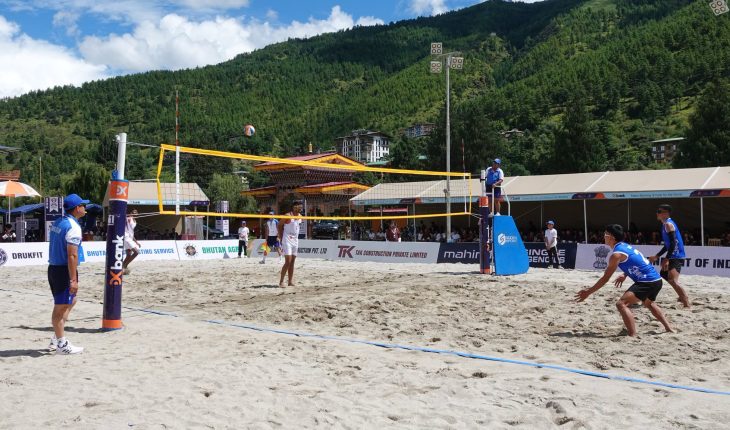
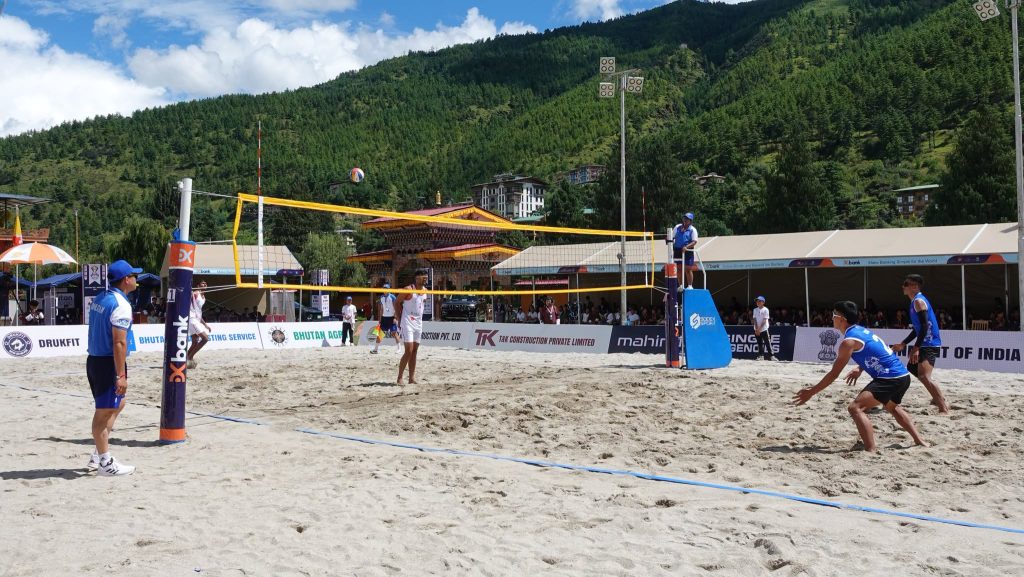
Twenty-one teams from seven countries have converged in Thimphu for the three-day Central Asian Volleyball Association (CAVA) Beach Tour-Bhutan Open 2026, hosted by Bhutan from September 4 to 6.
The opening ceremony was graced by Prime Minister Tshering Tobgay, who attended the launch of the tournament at Changlimithang.
Bhutan is represented by six teams, comprising three men’s teams and three women’s teams, competing against teams from Bangladesh, India, Sri Lanka, the Maldives, Nepal and Uzbekistan.
The tournament has allowed Bhutanese players to test themselves against experienced regional competitors and gain exposure to international competition.
For Bhutanese players, the tournament is also part of a broader effort to develop beach volleyball, a discipline that remains relatively new in the country.
The players trained for about two months ahead of the tournament, with several competing against international opponents for the first time. The exposure has given them an opportunity to understand the demands of international competition and identify areas that require further improvement.
Bhutan men’s head coach Tandin Wangchuk said the tournament was valuable not only as a competition but also as an opportunity to assess his players against the regional standard.
“For us as coaches, this tournament is also about gaining experience, understanding the level of regional competition and identifying what we need to work on,” he said.
He said the players had shown progress in confidence, communication and their ability to adapt to the pace of international competition.
However, he said several technical aspects still needed to be strengthened, including serve consistency, reception, ball control, attacking execution and blocking.
With only two players on each side, he said beach volleyball places greater importance on individual skills and decision-making.
Bhutan women’s coach Pema Dorji said the tournament was particularly important for players experiencing international competition for the first time.
He identified spiking, defence and jumping ability as some of the areas requiring greater attention. Blocking, he said, would be introduced gradually as players develop confidence and technical ability.
Unlike indoor volleyball, beach volleyball requires players to adapt to different playing conditions and develop a distinct set of skills, making regular competition important for their development.
“My goal is to build the team step by step and prepare them to compete more strongly at future regional and international tournaments,” he said.
Rinchen Selden, who competed in the women’s category, said the matches had provided important lessons beyond the results.
“The biggest lesson for us was the importance of communication, consistency and staying composed throughout the match,” she said.
She said competing against players with different styles and levels of experience had taught Bhutanese players to adapt quickly and remain focused throughout a match.
Tshering Drukpa said the performances showed both the challenges facing Bhutanese players and their potential to improve.
“I would say the results were disappointing, but the overall performance displayed our potential for future matches,” he said.
He said a lack of experience compared with regional opponents remained one of the team’s biggest challenges, with defence identified as a particular area for improvement.
The Bhutan Volleyball Federation sees hosting international tournaments as an important way of addressing that experience gap.
Bhutan Volleyball Federation President Kinzang Wangdi said bringing international teams to Bhutan allows local players to compete against stronger opponents without the expense of travelling abroad.
He said the cost of overseas participation can limit the number of Bhutanese athletes who get opportunities to gain international exposure.
The Bhutan Open also represents a progression from the CAVA Beach Volleyball Challenge Cup hosted by Bhutan in 2024.
Kinzang Wangdi said the 2026 tournament carries Class 1 World Ranking status, giving participating players an opportunity to earn ranking points.
He said this year’s event was different from the 2024 tournament because Bhutan had hosted the Challenge Cup at the lower level that year.
“CAVA has 14 nations, and from there we have the upper and lower levels. In 2024, we organised the tournament at the lower level. However, this year, we are hosting the Open Challenge, where every player has the opportunity to compete,” he said.
He said beach volleyball is traditionally played in coastal locations, generally around 0.5 or 1 metres above sea level, making the Bhutan Open distinctive as it is being held at Changlimithang in Thimphu, about 2,300 metres above sea level.
He said this year’s CAVA Beach Volleyball Tour is also being used to highlight the fight against climate change.
“Our theme this year is that we are fighting against climate change. Whenever I speak to CAVA nations, I always tell them about the vulnerability of the Himalayas to climate change. The recent floods in Nepal have demonstrated how vulnerable the region is,” he said.
“So, we want raise awareness of environmental and climate-related issues while providing Bhutanese athletes with a platform to develop in a sport that is still in its early stages in the country.”
Beyond the current tournament, the federation is looking at ways to create more regular opportunities for players to compete domestically.
Pema Dorji said the federation hopes to introduce a women’s beach volleyball league in Bhutan, which would give players more consistent competition and help build experience between international tournaments.
The coaching teams plan to review individual performances following the Bhutan Open, identify strengths and weaknesses, and continue technical, tactical and physical training.
They also plan to seek further opportunities for regional and international competition.
For Bhutan’s beach volleyball programme, the tournament serves as both a competitive event and a development platform, giving players valuable international exposure while providing coaches with a clearer picture of what is required to compete more strongly at the regional level.